

 1-888-601-9980


- Top providers of disability insurance in Canada for 2026 include Canada Life, RBC Insurance, Manulife, Desjardins, Edge Benefits, and Humania
- Disability insurance replaces a portion of income if illness or injury prevents you from working
- Coverage options vary by occupation, risk class, benefit periods, and optional riders
- Premiums typically range from 1–3% of annual income, depending on age, health, and job type
- Understanding waiting periods, definitions of disability, and coverage limits is essential before buying a policy
A sudden illness or injury can interrupt your income without warning. Disability insurance in Canada replaces part of your earnings when a medical condition prevents you from working, helping you cover essential expenses.
Over 8 million Canadians aged 15 and older live with at least one disability, according to Statistics Canada, showing how common and unpredictable income loss can be. This guide explains how coverage works, compares leading providers, and shares tips to help you choose affordable, reliable protection.
Based on our review of leading disability insurance providers in Canada, the following five companies stand out for 2026 for their strong coverage and flexible options, with the remaining providers covered later in our full comparison.
Top 5 disability insurance companies in Canada (2026)
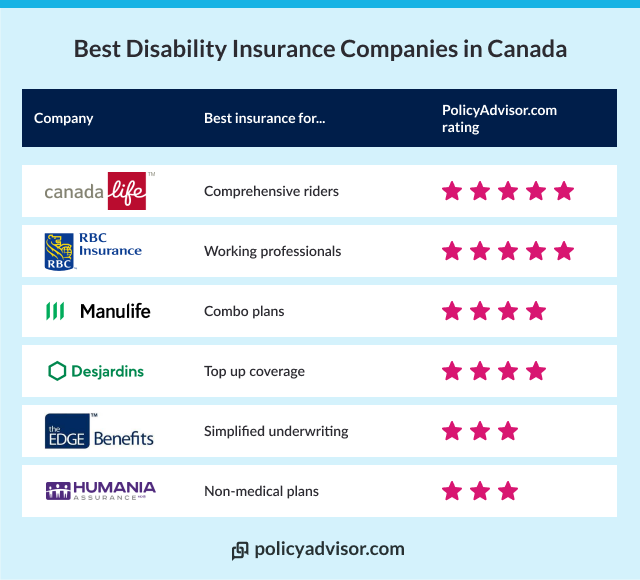
- Canada Life: Best for comprehensive riders
- RBC Insurance: Best for working professionals
- Manulife: Best for combo plans
- Desjardins: Best for top-up coverage
- Edge Benefits: Best for simplified underwriting
What is disability insurance in Canada?
Disability insurance is designed to protect your income if a physical or mental health condition, such as an illness or injury, prevents you from performing your job. When you cannot work, this coverage replaces a portion of your after-tax income, helping you maintain financial stability while focusing on recovery. You can use the benefits to cover essential expenses such as rent or mortgage payments, groceries, medical bills, and loan obligations.
Types of disability insurance in Canada
Disability insurance in Canada generally falls into two main categories: short-term and long-term coverage.
1. Short-term disability (STD) replaces part of your income for a limited time, typically from a few weeks up to six months, if an illness or injury prevents you from working
2. Long-term disability (LTD) covers more serious or extended conditions and usually replaces 60% to 80% of your income for several years or until age 65, depending on the policy
Coverage applies to both physical and mental health conditions, including illnesses, injuries, and psychiatric disorders such as anxiety or depression. Insurers require medical confirmation and ongoing documentation to approve and continue benefits.
Best disability insurance companies in Canada (2026)
Finding the right disability insurance provider is essential for protecting income in case of illness or injury. Coverage, flexibility, and affordability vary across insurers, so choosing a trusted company can make a significant difference.
Our ranking identifies providers that offer strong coverage, competitive pricing, and policy options that suit different occupations and lifestyles.
Top disability insurance providers in Canada (2026)
- Canada Life: Best for comprehensive riders
- RBC Insurance: Best for working professionals
- Manulife: Best for combo plans
- Desjardins: Best for top-up coverage
- Edge Benefits: Best for simplified underwriting
- Humania: Best for non-medical plans
Let’s take a closer look at each of these top insurers, their unique features, and what makes them stand out in 2026.
1. Canada Life: Best for comprehensive riders

5 years
up to age 65
PolicyAdvisor rating
We give Canada Life a 5/5 because its disability insurance offers one of the most customizable options in Canada. Policyholders can choose from a wide range of riders and add-ons, including accidental death & dismemberment, return of premium, and catch-up rider. This flexibility allows coverage to be tailored to unique financial and lifestyle needs. Canada Life is ideal for white-collar and light manual workers seeking competitive pricing. Healthcare workers also benefit from exclusive discounts.
Why choose Canada Life
- Flexible structure supports personalized disability coverage
- Competitive pricing for desk-based or light manual occupations
- Optional riders enhance protection for specific needs
- Strong reputation for long-term financial protection
Unique selling point (USP): Customizable coverage with flexible riders, multiple benefit periods, and healthcare worker discounts. Ideal for Canadians seeking tailored income protection.
2. RBC Insurance: Best for working professionals

self-employed
farmers
small business owners
5 years
up to age 65
PolicyAdvisor rating
We give RBC Insurance a 5/5 because it offers flexible disability coverage tailored to working professionals and self-employed Canadians. The plan includes essential riders at the base price, the family compassionate care benefit, and COLA (Cost of Living Adjustment) / FIO (Future Income Option) riders for enhanced protection. It is backed by Canada’s largest bank, ensuring long-term reliability.
Why choose RBC Insurance
- Flexible coverage tailored to occupation and income type
- Robust built-in riders for comprehensive protection
- Family compassionate care benefit for support during family illness
- Backed by Canada’s largest bank for long-term policy reliability
Unique selling point (USP): RBC Insurance delivers professional-focused disability coverage with built-in riders, flexible options, and reliable backing from a top-tier Canadian bank.
3. Manulife: Best for combo plans

PolicyAdvisor rating
We give Manulife a 4/5 because its Synergy policy combines disability, life, and critical illness insurance in one bundled plan. This all-in-one solution is ideal for self-employed Canadians or those without group benefits. Optional term life riders and early benefit access provide additional flexibility and protection.
Why choose Manulife
- Combines three types of insurance in a single plan for simplicity
- Ideal for self-employed Canadians and small business owners
- Streamlined application and policy structure
- Multi-risk protection through one policy
Unique selling point (USP): Manulife Synergy delivers all-in-one protection with flexible access to benefits, making it suitable for Canadians seeking simplified financial security.
4. Desjardins: Best for top-up coverage

PolicyAdvisor rating
We give Desjardins a 4/5 because it offers flexible top-up disability coverage for Canadians who already have partial coverage. The plan provides non-integrated benefits up to $1,200 per month for 36 months, includes a death benefit, and guarantees renewability as long as premiums are paid. It is cost-effective and ideal for those needing additional security without a full standalone policy.
Why choose Desjardins
- Works perfectly as a supplement to employer or group plans
- Reduces the need for add-ons with built-in benefits
- Supports newcomers and work-permit holders who meet eligibility requirements
Unique selling point (USP): Desjardins ensures supplemental income protection with cost-effective, guaranteed features. Ideal for Canadians needing additional security without a full standalone policy.
5. Edge Benefits: Best for simplified underwriting

PolicyAdvisor rating
We rate Edge Benefits 3/5 for its fast, simplified application, guaranteed injury coverage, optional zero-day waiting periods, and monthly benefits of up to $5,000–$6,000 depending on occupation class. Applicants with minor health concerns can often qualify without full medical underwriting. It works well for self-employed and blue-collar Canadians who need quick, accessible disability coverage.
Why choose Edge Benefits
- Quick and simplified application process
- Reliable injury-only coverage
- Optional zero-day waiting period for short-term use
- Coverage available up to age 70
Unique selling point (USP): Edge Benefits offers fast, simplified access to disability insurance with guaranteed injury protection and extended coverage options.
6. Humania: Best for non-medical plans

PolicyAdvisor rating
We give Humania a 3/5 because it provides Insurance Without Medical Exam (IWME) coverage, offering essential protection for those unable to work due to illness or injury. The plan includes partial disability coverage up to $1,000/month for part-time and seasonal workers and a monthly benefit cap of $6,000, depending on eligibility. It allows bundling with life and critical illness insurance and guarantees premiums for the first five years.
Why choose Humania
- Accessible coverage without a medical exam
- Partial disability protection for non-traditional workers
- Fast approval and simplified application
- Can bundle with life and critical illness insurance
Unique selling point (USP): Humania provides no-medical disability coverage with partial protection for seasonal or part-time workers.
Methodology: How we ranked the best disability insurance in Canada
Our expert team of licensed insurance advisors at PolicyAdvisor ranked the top disability insurance providers in Canada based on key factors:
- Term lengths: Flexibility of short-term and long-term coverage options
- Waiting periods: How quickly policyholders can access benefits after a claim
- Premium rates: Monthly costs compared to coverage value and affordability
- Application process: Ease of underwriting, including no-medical exam options
- Online accessibility: Ability to get quotes, apply, and manage policies digitally
- Financial strength ratings: Third-party ratings (e.g., AM Best) for stability and claims-paying ability
- Plan features and customization: Availability of riders, conversion options, and built-in benefits for tailored protection
How much does disability insurance cost in Canada?
Several factors influence how much you’ll pay for disability insurance. Understanding these helps you choose coverage that protects your income without overpaying:
- Age: Younger applicants generally pay lower premiums
- Occupation: High-risk jobs cost more; low-risk office roles pay less
- Waiting period: Shorter waiting periods increase premiums; longer waits reduce them but delay benefit payments
- Benefit period: Longer coverage periods (e.g., to age 65) cost more but protect long-term earning power
- Coverage amount: Higher monthly benefits increase premiums
- Health: Healthier applicants and non-smokers qualify for lower rates
- Policy type: Short-term disability is cheaper; long-term provides more comprehensive protection
On average, individual disability insurance costs around 1–3% of your annual income, which may be about $40–$125 per month for low-risk, younger applicants earning approximately $50,000 per year. Premiums can be higher for more comprehensive plans or higher-risk professions. For example, long-term plans with broader coverage or riders can cost a larger percentage of income.
Cost for disability insurance premiums by occupation class
Before looking at the table, it’s important to note that occupation risk is one of the biggest determinants of premiums. Low-risk office roles have lower monthly costs, while higher-risk manual jobs carry higher premiums.
| Class | Occupation example | Monthly premium |
| 4A | Software professional, doctor, lawyer, accountant | $103.78 |
| 3A | Office administrator | $128.12 |
| 2A | Nurse | $55.12 |
| A | Dental hygienist | $128.12 |
| B | Truck driver, manual labour | $128.12 |
*Illustrative cost for a 35-year-old male, non-smoker, in good health, with a $5,000 monthly benefit, 90-day waiting period, and coverage to age 65.
Cost for disability insurance premiums by age
Premiums increase with age because older applicants are statistically more likely to claim. The table below shows how age affects monthly costs for $5,000 and $10,000 benefits with a standard 90-day waiting period.
| Age | $5,000 monthly benefit (90-day waiting period) | $10,000 monthly benefit (90-day waiting period) |
| 25 | $62.00 | $125.00 |
| 35 | $83.00 | $166.04 |
| 45 | $131.00 | $262.00 |
| 55 | $223.00 | $445.69 |
* Illustrative cost for a male, non-smoker, in good health, with coverage to age 65 and a 90-day waiting period.
Cost for disability insurance premiums by waiting period
The waiting period determines how soon benefits start after a disability. Shorter waiting periods increase premiums because the insurer begins paying sooner, while longer waits reduce monthly costs.
| Age | 60-day waiting period | 90-day waiting period |
| 25 | $73.75 | $62.00 |
| 35 | $100.94 | $83.00 |
| 45 | $154.39 | $131.00 |
| 55 | $248.99 | $223.00 |
* Illustrative cost for a 35-year-old male, non-smoker, in good health, with a $5,000 monthly benefit and coverage to age 65.
Who should consider disability insurance?
If losing your ability to work, even temporarily, would impact your income or financial stability, disability insurance can help protect your livelihood. It’s especially important for individuals who depend on their income to cover day-to-day expenses.
- Employees who rely on a steady paycheque
- Self-employed professionals or those with variable income
- Homeowners with rent or mortgage obligations
- Individuals with dependents who rely on their income
- People without sufficient savings to cover months of expenses
Workers with limited or no employer-provided disability benefits
Key factors to consider when applying for disability insurance
When choosing a disability insurance policy in Canada, it’s best to look beyond the price. Several technical features, such as how your insurer defines disability, the waiting period, and the coverage amount, will determine how much protection you receive.
- Definition of disability: Insurers define “disability” in three main ways:
- Own occupation pays benefits if you can’t perform your specific job or specialized profession
- Regular occupation covers you if you can’t work in your field, but ends benefits if you take another job
- Any occupation offers the least protection. If you can work in any role, even one unrelated to your training, you won’t qualify for benefits
- Waiting period: This is the time you must wait after becoming disabled before benefits begin. Longer waiting periods lower premiums but require you to cover all expenses until payments start. If your condition resolves during this time, you receive no payout
- Coverage amount: Short-term disability insurance often covers 70% to 100% of your income. Long-term disability typically replaces 50% to 70%, which may not be enough for most Canadians. Consider topping up your coverage with an individual plan to ensure long-term financial stability
How to get the best disability insurance quotes in Canada
Get the best disability insurance quotes in three easy steps:
1) Tell us your occupation and income
2) Compare top-matched plans and riders side-by-side
3) Lock in your rate with a licensed advisor from PolicyAdvisor, at no cost. You’ll need: job title, income estimate, and an idea of your emergency fund (for waiting period choice).
Once you choose a plan, licensed PolicyAdvisor experts provide free guidance and ongoing support to help you understand your coverage and make informed decisions.
Frequently asked questions
Is disability insurance worth it in Canada?
Yes. For most Canadians, disability insurance is valuable as it can cover living expenses, debts, and other financial obligations during periods of short- or long-term disability, effectively replacing a portion of their income.
How much do most people pay for disability insurance?
If your short-term disability insurance is part of your employer benefits, you pay little to no premiums. However, if you opt for a private policy, your premium is determined by your salary and occupation (among other factors), with basic injury-only coverage starting at $10 per month.
Long-term disability insurance typically costs between 1% and 3% of your annual income. For a 30-year-old in an office job earning $40,000, premiums for $2,500/month benefits can range from $28 to $50 per month, depending on occupation and health. A 2-year benefit period is on the lower end, while coverage to age 65 costs more.
What percentage of my income is covered by disability insurance?
Short-term disability insurance typically covers 60–90% of your income, while long-term disability insurance usually replaces 60–70% of your gross income, depending on the policy. The exact percentage for both depends on your specific policy and insurer.
Can you work on long-term disability in Canada?
Yes, some policies allow you to work while receiving long-term disability benefits. However, they usually limit the income you can earn and the work you can do. Violating these terms could result in the termination of your benefits.
What happens if I miss a premium payment on my disability insurance plan?
Most Canadian insurers offer a 30-day grace period during which your coverage remains active. If payment isn’t made within this period, the insurer may terminate your policy. Some policies can be reinstated by paying missed premiums and providing updated medical information. To avoid interruption, set up automatic payments or contact your insurer for temporary solutions.
What is the difference between disability insurance and critical illness insurance?
Disability insurance replaces a portion of your income if you are unable to work due to illness or injury. Critical illness insurance pays a one-time lump sum after diagnosis of a covered serious illness.
Are disability benefits taxable in Canada?
Generally, individual policy benefits are tax-free when you pay the premiums personally. If your employer pays the premiums, benefits may be taxable; plan your coverage amount accordingly.
How does disability insurance interact with Employment Insurance (EI) sickness benefits?
Employment Insurance (EI) sickness benefits can provide temporary income support for up to 26 weeks if you’re unable to work due to illness or injury. Private DI can supplement EI benefits, but some group policies may offset EI payments, reducing your private insurance payout. Individual DI policies are often non-integrated, so benefits may stack with EI.
What is typically not covered by disability insurance?
Disability insurance usually does not cover:
- Pre-existing conditions during the exclusion period
- Disabilities resulting from non-covered activities (e.g., extreme sports if excluded)
- Periods that do not meet the policy’s waiting period before benefits begin
Why do exclusion periods exist?
Exclusion periods protect insurers from covering known health conditions at the time of application. This ensures premiums remain fair for all policyholders.
We reviewed six leading disability insurance providers in Canada for 2026. Our evaluation considered term lengths, waiting periods, premium rates, application process, online accessibility, financial strength, and plan features, including riders and customization. Canada Life and RBC Insurance stand out for flexible, occupation-specific coverage. Manulife Synergy excels with combo plans, Desjardins for top-up coverage, Edge Benefits for simplified underwriting, and Humania for non-medical plans. This guide helps Canadians choose disability insurance that balances protection, affordability, and policy flexibility.