1-888-601-9980


- Debt is one of the key considerations when choosing life insurance coverage. Make sure your policy will cover any major debts you have, such as a mortgage
- If you plan to use life insurance for income replacement, take into account your dependents’ expenses and needs
- When choosing a life insurance coverage amount, it is also important to ensure you can afford the premiums
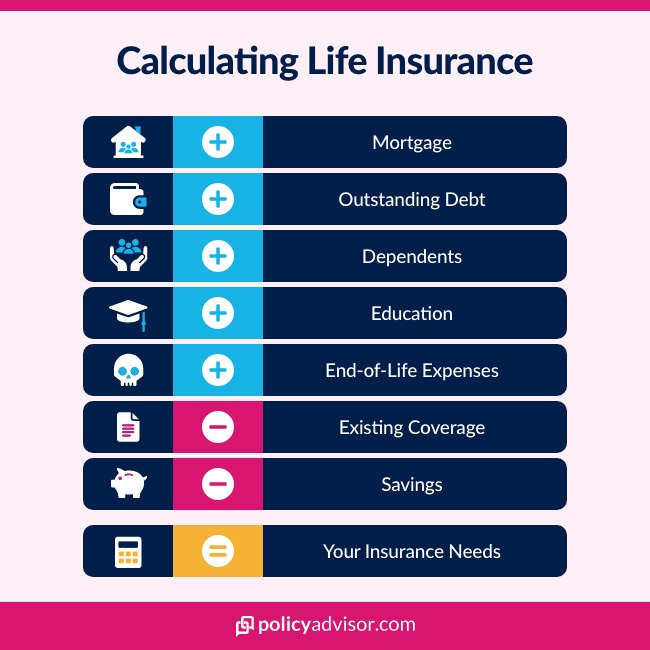
- Subtract existing savings and employer-provided or individual life insurance from your coverage needs
According to a 2026 report published by LIMRA, the new annualized premiums reached a record $2.3 billion in 2025, up 9% year over year, while policy sales increased 4%. This data highlights how more people are now getting life insurance coverage in Canada. You should get at least 5 to 10 times your income in life insurance coverage; however, choosing the right amount also depends on factors such as your income, debts, mortgage, dependants, savings, and long-term financial goals.
How much life insurance should you have in Canada?
There is no one-size-fits-all amount of life insurance coverage in Canada. A common rule of thumb is to have 5 to 10 times your annual income in life insurance. However, this can be too little or too much depending on your financial situation. A family with a large mortgage and young children may need significantly more coverage than a single person with substantial savings and few financial obligations.
Example: Calculating life insurance needs for someone earning $100,000 a year
| Yearly income | $100,000 |
| Mortgage | $400,000 |
| Other debts | $30,000 |
| Children’s future education | $100,000 |
| Savings | $100,000 |
| Existing life insurance coverage through employer | $200,000 |
| Estimated coverage | $1,000,000 + $400,000 + $30,000 + $100,000 − $100,000 − $200,000 = $1.23 million |
In this example, about $1.23 million of additional life insurance could provide a reasonable starting point. Your result will depend on your circumstances and the assumptions used. Use our life insurance calculator to get a personalized estimate, then compare policies that fit your needs.
How do I calculate how much life insurance I need?
The amount of life insurance you need depends on how much financial support your family would require if you died. Rather than relying on a single rule of thumb, consider the different expenses and financial obligations your policy may need to cover, along with the savings and insurance you already have.
The best way to figure out how much insurance you need is to use a life insurance calculator. These calculators perform an instant assessment of your personal and financial situation. They look at both your assets and liabilities. Then they estimate how much insurance you need to cover those liabilities.
To understand how that estimate is calculated, ask yourself these questions:
Outstanding debts
Your outstanding debts are one of the first things to consider because they could become a financial burden for your family after your death. Add up your mortgage, car loans, lines of credit, credit cards, and other outstanding loans to determine how much would need to be repaid. Life insurance can provide your beneficiaries with a lump sum they can use to pay these obligations without having to sell assets or rely on their regular income to make debt payments.
Family’s living expenses
After accounting for your debts, consider the ongoing expenses your family would still need to pay. These can include housing, food, utilities, childcare, transportation, insurance, and other household costs.
A dependent is anyone who needs your financial support. If you are the primary breadwinner in your household and/or have kids, then you already have dependents. You may also have elderly parents or disabled family members who depend on you financially. Their needs should all be considered when calculating the coverage amount. They will be the beneficiaries of the life insurance payout.
Future expenses
Once you have considered your debts and your family’s ongoing expenses, estimate how much of your income they would need to replace if you were no longer there.
Your family may not need to replace 100% of your after-tax income. Consider what percentage would be enough to maintain their lifestyle and meet their financial obligations.
For example, if you earn $100,000 annually and estimate your family would need 70% of that income, you would plan around $70,000 in annual income replacement. The number of years this support is required will depend on your age, dependants, retirement plans, and other household income.
Existing savings
Do you have any savings? Whether it’s in your bank account, an investment portfolio, an RRSP you opened at 19, or wads of cash stuffed under your mattress, any assets you have stored away can help reduce your life insurance coverage needs.
While some people reduce their life insurance coverage because they have savings, others may buy life insurance to protect it. That way, your dependents would not need to dip into savings that have been allocated for long-term growth (like investments) or sell assets.
Discuss with your dependents
Your coverage calculation should also reflect what your family would actually need. Discuss your finances with your spouse or other dependents and consider how your death would affect the mortgage, household expenses, childcare, education, retirement plans, and other financial commitments. This conversation can help identify expenses that may be missed in a basic calculation and give you a better idea of the financial cushion your life insurance should provide.
How to calculate life insurance coverage using the DIME method
A life insurance calculator provides a more personalized estimate, but you can also use common rules of thumb to get a quick starting point.
DIME Method
The DIME method is often used by brokers and financial advisors to determine your life insurance needs on the fly. It stands for four major aspects that you should consider in your financial strategy: Debt, Income, Mortgage, and Education.
- Debt: Add your outstanding debts other than your mortgage
- Income: Estimate how many years of income your family would need to replace
- Mortgage: Include the amount required to repay your outstanding mortgage
- Education: Estimate future education costs for your children
The DIME method is useful as a starting point, but it does not account for everything that can affect your coverage needs. It may overlook your savings, existing life insurance, funeral expenses, investments, childcare costs, and other future financial obligations.
Is 10 times my annual income enough life insurance?
Another common rule of thumb is to buy 5 to 10 times your annual income in life insurance coverage. For example, someone earning $100,000 a year might consider $1 million to $1.5 million of coverage.
This approach is quick, but it does not account for individual circumstances. Someone with a large mortgage and young children may need considerably more coverage than another person with the same income but substantial savings and no dependants.
What type of life insurance should I choose?
The right type of life insurance depends on how long you need coverage, your budget, and the financial needs you want the policy to address. The main options include:
- Term life insurance: Provides coverage for a set period, such as 10, 20, or 30 years. It is often suitable for covering temporary needs such as a mortgage, income replacement, or children’s financial support
- Whole life insurance: Provides lifelong coverage and builds cash value. Whole life insurance may suit people looking for permanent protection, estate planning, or a guaranteed death benefit
- Universal life insurance: Combines permanent life insurance with an investment component, offering more flexibility in premiums and coverage. It can be useful for estate planning and other long-term financial needs
Tips for choosing the right amount of life insurance
When choosing the right coverage, you need to factor in a lot of factors apart from your debts, income, and other financial obligations. Here are some other tips to consider to get the right life insurance coverage:
- Consider laddering your policies: You don’t necessarily need to buy your entire coverage amount through one policy. Laddering involves combining policies with different coverage amounts and terms to match different financial needs. For example, you could combine a $750,000 20-year term policy with a $250,000 10-year policy. As shorter-term obligations end, the smaller policy expires while the larger policy continues
- Use group coverage to supplement individual insurance: Employer-provided life insurance can form part of your overall coverage, but it may have a relatively low benefit limit and may not follow you when you leave the employer. Calculate your total protection using both group and individual policies, then determine whether you need additional coverage
- Build in a financial cushion: Your coverage calculation is an estimate, and your family’s actual expenses may be higher than expected. Adding a reasonable buffer can help account for unexpected costs or changes in circumstances
- Choose coverage you need: The largest possible policy isn’t necessarily the best choice if the premiums become difficult to sustain. Consider whether the premium fits comfortably within your long-term budget
- Compare policy features, not just the death benefit: Two policies with $1 million in coverage can differ in premiums, renewability, conversion options, exclusions, dividend payout, and available riders. Consider these features alongside the coverage amount when comparing policies
How much does life insurance coverage cost in Canada?
Life insurance coverage in Canada can cost as little as $8 per month for $100,000 of 10-year term coverage for a young, healthy non-smoker. As the coverage amount increases, so does the premium; in the illustration below, $1 million costs $35.54/month for a male non-smoker and $22.95/month for a female non-smoker, while $10 million costs $310.50 and $184.50 per month, respectively.
Cost of term life insurance (2026):
| Coverage amount | Male (non-smoker) | Female (non-smoker) |
| $100,000 | $9.45/month | $8.19/month |
| $250,000 | $13.94/month | $10.58/month |
| $500,000 | $21.60/month | $14.85/month |
| $1,000,000 | $35.54/month | $22.95/month |
| $10,000,000 | $310.50/month | $184.50/month |
*Illustrative term life insurance cost of a 10-year plan with $100,000-$10,000,000 in coverage for male/female non-smoker
How much does Life Insurance cost?
Get instant quotes from Canada's top life insurance providers and find the perfect coverage for your family.
Powered by

How long should my life insurance coverage last?
Your life insurance should generally last as long as your family would depend on your income or as long as the financial need you are protecting remains. For many Canadians, this means choosing a term that covers the years until their mortgage is paid off, children become financially independent, or they reach retirement.
For example, if you have young children and expect to need income replacement for the next 20 years, a 20-year term policy may be appropriate. If you have a financial need that will continue for your entire lifetime, such as estate planning or leaving a legacy, permanent life insurance may be more suitable.
How to get life insurance coverage in Canada?
Getting life insurance in Canada typically involves determining how much coverage you need, comparing policies and insurers, completing an application, and going through underwriting. Here are the simple steps you need to follow to get life insurance coverage in Canada with PolicyAdvisor:
- Calculate your coverage needs: Start by estimating your income replacement, debts, future expenses, and other financial obligations
- Compare your options: Our advisors will help compare life insurance quotes from 30+ Canadian insurers to help identify policies that fit your coverage needs and budget
- Complete your application: We will help you submit your application and provide guidance on the information and documents required
- Complete underwriting: Depending on your application, the insurer may request medical questions, a medical exam, blood or urine tests, or additional records
- Review your application: Once the insurer assesses your application, you will receive your coverage details, including the premium and policy terms
- Policy gets active: Once you pay the premiums and complete the required steps, your policy becomes active
Schedule a call now to get free life insurance quotes!

Call 1-888-601-9980 to speak to our licensed advisors right away, or book some time with them below.
Frequently asked questions
How is life insurance coverage calculated?
Life insurance coverage needs can be calculated by adding the money your family may need for income replacement, debts, living expenses, and future expenses, then subtracting resources such as savings, investments, and existing life insurance. Methods such as the DIME method and income multiples can provide quick estimates.
Can I have more than one life insurance policy in Canada?
Yes, you can have multiple life insurance policies if you qualify for the coverage. Having more than one policy can be useful for laddering, where policies with different coverage amounts and terms address financial needs that expire at different times.
Does employer-provided life insurance count toward how much coverage I need?
Yes, you should include your group life insurance when calculating your total coverage. However, you must check its benefit amount and whether it remains available if you leave your employer. You may need an individual policy to supplement workplace coverage and maintain protection independently of your employment.
Is $500,000 enough life insurance for a family in Canada?
Whether $500,000 is enough life insurance coverage for a family in Canada or not depends on their financial obligations, income, and a few other factors. It may be sufficient for someone with limited debt and substantial savings, while a family with a large mortgage, young children, and significant income-replacement needs may require a higher coverage amount.
How much life insurance do I need based on my salary?
A common starting point is 5 to 10 times your annual income, but your actual needs depend on your debts, dependants, living expenses, future financial goals, savings, and existing life insurance coverage. You can use our life insurance calculator to get the actual estimates.
Can I increase my life insurance coverage later?
Yes, you may be able to increase your coverage, depending on your policy and insurer. Some policies offer options such as additional coverage, policy conversion, or guaranteed insurability riders. If your financial needs change significantly, you may also apply for a new policy, although your age and health at that time can affect the premium.
How much life insurance do I need if I am single?
If you are single and you are planning to get life insurance in Canada, you will require lower coverage. This is because you don’t have dependants who rely on you financially. However, you should consider whether you have any ongoing debts, final expenses, and other outstanding obligations to estimate the right coverage amount.
The right life insurance coverage in Canada depends on your income, debts, dependants, living expenses, future goals, savings, and existing insurance. Learn how to calculate your coverage needs, compare term and permanent insurance, use methods such as DIME and income multiples, and structure coverage with strategies to get the right coverage.