1-888-601-9980


- Long-term disability insurance options in Canada include individual, group, association, and government disability coverage
- Individual long-term disability insurance offers greater flexibility and portability, while group coverage is typically more affordable but tied to the plan
- Government disability coverage options in Canada include Canada Pension Plan (CPP) disability benefit and Quebec Pension Plan (QPP) disability pension
- The amount of coverage you need depends on your income, existing benefits, monthly expenses, and financial responsibilities
Long term disability insurance (LTD) provides income protection if a serious illness or injury prevents you from working for an extended period, usually several years or until retirement age. Most LTD plans replace about 60% to 85% of your normal income, although the exact amount depends on the policy. In Canada, you can get long-term disability coverage through an individual policy, an employer-sponsored group plan, an association, or government disability programs such as CPP disability benefits.
Quick overview:
- Group long-term disability insurance: Provided by an employer, union, or employee benefits plan
- Association disability insurance: Provided through professional, trade, alumni, or other eligible associations
- Individual long-term disability insurance: Provided directly by private insurance companies and purchased by individuals
- Government disability support programs: Provided by federal or provincial programs, such as CPP/QPP disability benefits
What is long-term disability insurance?
Long term disability insurance is meant to replace a portion of your income should you become injured or ill and it affects your ability to work. Instead of paying a lump sum, an LTD policy typically provides a monthly benefit for as long as you remain eligible under the policy.
Your eligibility depends largely on how the policy defines a “disability.”
- Own Occupation: Pays benefits if you cannot perform the specific duties of your current job
- Any Occupation: Pays benefits only if you are unable to work in any job for which you are reasonably suited based on your education and experience
Long term disability insurance options in Canada
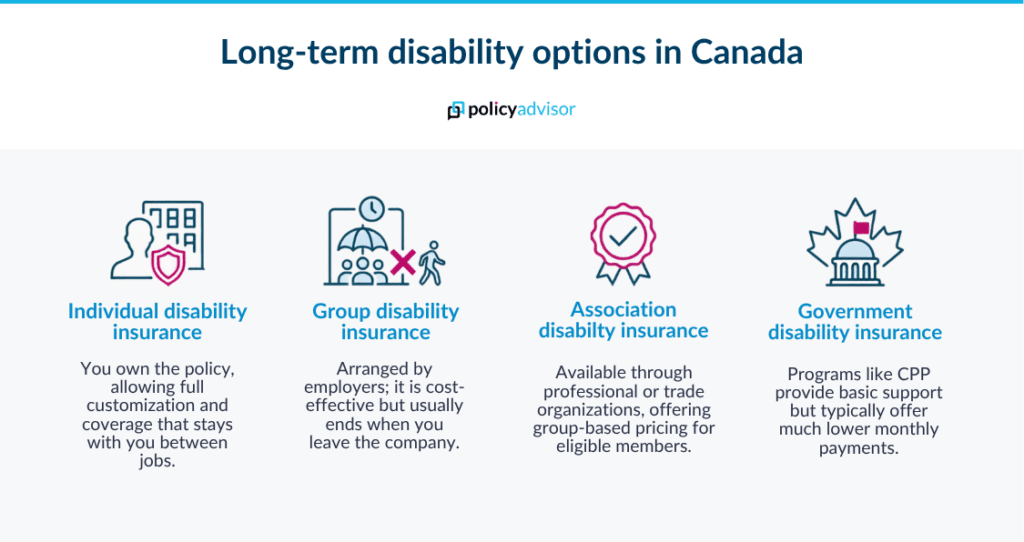
The long-term disability insurance options in Canada include individual long-term disability insurance, group long-term disability insurance, association disability insurance, and Government disability support programs. Each option differs in how coverage is obtained, who pays for it, how much income it can replace, and how much control you have over the policy.
-
Individual long-term disability insurance
Individual long-term disability insurance is purchased directly from a private insurer and is designed to provide income replacement if an illness or injury prevents you from working. This type of policy is portable, meaning you can keep it even if you change jobs or become self-employed.
One of the main advantages of individual LTD insurance is the ability to customize the policy to your needs. Depending on the insurer and plan, you may be able to choose the monthly benefit amount, waiting period, benefit period, definition of disability, and optional riders. Individual long-term disability premiums are paid with after-tax dollars and are generally not deductible on your personal tax return. As a result, the benefits received from the policy are tax-free.
Pros and cons of individual long-term disability insurance:
| Pros | Cons |
| Coverage is portable and independent of the employer | Premiums are higher than group coverage |
| Greater flexibility to customize coverage and policy features | Requires underwriting, depending on the insurer |
| Better policy features |
-
Group long-term disability insurance
Group long-term disability insurance is provided through an employer and replaces 60% to 70% of an employee’s base salary if the employee becomes disabled and is unable to work. The premium is paid by the employer or employee. Group coverage can be more affordable than individual insurance, but the coverage and policy terms are set by the plan and may end when you leave the group.
With group long-term disability coverage, the policy generally provides a predetermined percentage of your income up to a specified monthly maximum if you become disabled and meet the plan’s definition of disability. Moreover, the tax treatment for group long-term disability insurance depends on who pays the premiums. If you pay the full premium with after-tax income, benefits are generally tax-free; if your employer pays the premium, benefits are taxable.
Pros and cons of group long-term disability insurance:
| Pros | Cons |
| Often more affordable than other options | Coverage amounts and policy terms are determined by the employer’s plan, hence less customizable |
| Premiums may be partially or fully paid by the employer | Coverage typically ends when you leave the employer or the group |
| Easy to set up and requires less underwriting | |
| Provides a valuable source of income protection for employees who become disabled |
-
Association disability insurance
Association disability insurance is available through certain professional, trade, alumni, or other membership organizations. These plans are designed to provide disability coverage to eligible members and can be an alternative for people who do not have adequate employer-sponsored benefits.
For example, a professional association may negotiate disability coverage for its members, allowing eligible individuals to access a group-based insurance arrangement. The association and policy terms determine who can join an association disability insurance plan.
Pros and cons of association long-term disability insurance:
| Pros | Cons |
| Lower premiums due to group pricing | Eligibility depends on membership in the specific association |
| Can provide an additional layer of protection alongside existing group or individual coverage | Limited coverage as compared to individual policies |
| May be available to professionals, business owners, or self-employed individuals through an eligible association |
-
Government disability benefits
Government disability programs provide another potential source of income for Canadians who meet specific disability and eligibility requirements. These programs are different from private long-term disability insurance because they are designed as public income-support programs rather than individually purchased insurance policies.
The Canada Pension Plan (CPP) disability benefit, EI Sickness Benefits, and Quebec Pension Plan (QPP) disability benefit are examples of government programs for eligible workers with qualifying disabilities. These benefits have their own eligibility rules and generally provide less income replacement than private long-term disability insurance. Canada Pension Plan (CPP) and Québec Pension Plan (QPP) disability benefits are fully taxable as income.
What are workers’ compensation benefits and how do they work in Canada?
Workers’ compensation is different for every province and territory, but more or less works the same no matter the jurisdiction. The Ontario-specific compensation board, the Workplace Safety and Insurance Board (WSIB), like its geographic contemporaries, exists to protect employees from financial hardships that come with work-related permanent injuries and conditions; they are solely generally funded through employer premiums.
In cases where you have workers’ compensation coverage through your employer, it may not be what you think it is. Disability insurance offered through WSIB and others covers accidents that happen on the job. If you are injured outside of work, this insurance won’t cover you. Workers’ compensation may provide wage-loss benefits, medical and rehabilitation support, and, in some cases, a lump-sum payment for a permanent impairment resulting from a workplace injury or occupational illness.
Pros and cons of government long-term disability insurance:
| Pros | Cons |
| No private insurance policy needs to be purchased to access the program | Eligibility requirements can be strict |
| Can complement income from private or workplace disability insurance in some situations | Lower monthly benefits as compared to individual plans |
Individual vs. group long-term disability insurance
Individual and group long-term disability insurance can both replace part of your income if an illness or injury prevents you from working, but they differ significantly in ownership, portability, customization, cost, underwriting, and tax treatment. The main difference between individual and group long-term disability insurance is who owns and controls the policy. This distinction can affect how much control you have over your coverage and whether you can keep it if your employment or group membership changes.
| Features | Individual long-term disability insurance | Group long-term disability insurance |
| Provider | Purchased directly from a private insurer | Typically arranged through an employer, union, or other group sponsor |
| Ownership | You own the policy and control its terms | Usually owned and administered by the employer or plan sponsor |
| Portability | Remains in force when you change jobs, as long as you continue paying premiums | Coverage may end when you leave the employer or group, although some plans may offer conversion or continuation options |
| Customization | Greater choice of waiting period, benefit period, definition of disability, and optional riders like return of premium rider, cost of living adjustments (COLA), etc | Coverage features and limits are predetermined by the group plan |
| Coverage amount | You can generally select a benefit amount based on your income and financial needs, subject to insurer limits | Usually based on a percentage of your income and subject to the plan’s maximum monthly benefit |
| Coverage cancellation | Coverage generally remains in force, provided the premiums are paid | Can be cancelled or the benefits can be reduced if the insurer finds the group to be at high risk |
| Definition of disability | Can be purchased with an “own occupation” definition that lasts to age 65 | Covers “own occupation” (inability to do your specific job) for the first 24 months, and then legally shifts to an “any occupation” (inability to do any job you are reasonably suited for) thereafter |
| Premiums | Paid entirely by you | Employer may pay all or part |
| Underwriting | Generally requires individual medical and financial underwriting | May involve limited or no individual medical underwriting, depending on the plan and amount of coverage |
| Tax treatment | Benefits are tax-free (premiums are non-deductible personal expenses) | Tax-free if employees pay 100% of the premium; Taxable if the employer pays the premium |
| Best for | Those wanting portable, personalized coverage | Employees seeking affordable workplace coverage |
How does long-term disability insurance work?
The way benefits work depends on whether you have an individual LTD policy, group coverage through an employer, or government disability support.
How does individual long-term disability insurance work?
Individual LTD insurance is purchased directly from a private insurer and is owned by you. It works as follows:
- Choose your coverage: Select a monthly benefit, elimination period, benefit period, and definition of disability based on your income and needs. The definition of disability is particularly important, and you can choose between ‘own-occupation’ or ‘any-occupation’
- Pay the premium: You pay the policy premiums to keep your coverage active
- In case of disability: If an illness or injury prevents you from working and meets the policy’s definition of disability, you can submit a claim
- Complete the elimination period: Long-term disability benefits have a waiting period, typically 90 days. Depending on your policy, this period may overlap with or begin after available sick leave and/or short-term disability benefits from your employer end. LTD benefits generally begin once the elimination period is satisfied, and your claim is approved
- Submit supporting information: The insurer reviews medical and employment information to determine whether you qualify under the policy
- Receive monthly benefits: If your claim is approved, you receive a monthly benefit for as long as you remain eligible. Depending on the policy, benefits may continue for 2 years, 5 years, until age 65, or until you can return to your regular employment, whichever comes first. The specific benefit period and eligibility requirements vary by policy
How do group benefits work for disability insurance coverage in Canada?
Group long-term disability insurance is provided through an employer as part of an employee benefits plan or through an association. If you become disabled, you generally need to satisfy the plan’s elimination period (typically 90-180 days) and meet its definition of disability before benefits begin. Once your claim is approved, the insurer pays a monthly benefit based on the group plan’s terms, usually as a percentage of your pre-disability income up to a specified maximum.
How does government disability insurance work in Canada?
The federal government provides disability-related income support through programs such as EI Sickness Benefits and CPP Disability Benefits.
- EI Sickness Benefits provide short-term income support if you cannot work because of illness, injury, or quarantine. Eligible applicants can receive up to 55% of their earnings, up to a maximum of $729 a week, for up to 26 weeks under current 2026 rules
- CPP Disability Benefits are available to eligible CPP contributors who are between 18 and 65 years of age and who have a severe and prolonged disability that prevents them from regularly working. The benefit amount depends on your base monthly amount and CPP contributions and can continue until age 65 if you remain eligible. You can receive a maximum of $1,741.20 monthly through this program
These government programs have specific eligibility requirements and may not replace enough of your income to cover your regular expenses. Private disability insurance options can provide additional income protection, depending on your policy and how it coordinates with other disability benefits.
Who is long-term disability insurance for?
Long-term disability insurance (LTD) benefits people who rely on their income to support themselves or their families. The following groups should consider long-term disability insurance:
- Employees with jobs that provide their primary source of income
- Self-employed individuals (business owners or freelancers) without employer-provided benefits
- Primary breadwinners whose families depend on their income for daily living expenses
- People with mortgages, loans, or other significant debts
- High-income professionals whose lifestyle and financial responsibilities require substantial income protection
- Individuals lacking savings who would face financial hardship if they were unable to work due to a disability
Do you need individual long-term disability insurance if you have group benefits?
Yes, you may still need individual long-term disability insurance even if you have group benefits. This becomes particularly essential if your employer’s plan does not provide enough income replacement or has limited coverage. Your employer’s plan may have limits on the monthly benefit, benefit period, or definition of disability, and coverage may not continue if you leave the job. An individual policy can help fill these gaps and provide portable coverage.
Can you have individual and group long-term disability insurance at the same time?
Yes, you can have both individual and group long-term disability insurance at the same time. In fact, many individuals combine the two to receive more comprehensive income protection. Your group plan can provide a base level of coverage through your employer, while an individual long-term disability coverage policy can supplement gaps such as a low monthly benefit. Moreover, while you can have both, you cannot combine them to replace 100% of your income. Across all your combined policies (group + individual + government), insurers will legally cap your total allowable tax-free benefit at roughly 60% to 85% of your pre-disability net income.
Can you get long-term disability insurance if you already have short-term disability coverage?
Yes, you can have long-term disability insurance even if you already have short-term disability (STD) coverage. In fact, short term disability coverage or EI Sickness Benefits can help bridge the elimination period (waiting period) before LTD benefits begin.
Employer-sponsored STD plans typically provide income replacement for 15 to 26 weeks, while long term disability policies commonly have elimination periods of 90, 112, or 120 days. This allows short-term disability or EI Sickness Benefits to provide income during the initial period of a disability while you wait to become eligible for LTD benefits. The exact timing depends on the terms of your short-term and long-term disability policies.
How to buy long-term disability insurance in Canada?
You can buy long-term disability insurance by comparing quotes from different insurers based on your income, occupation, health, desired monthly benefit, and coverage needs. Our advisors at PolicyAdvisor will help you compare available long-term disability coverage options from multiple insurers, understand the differences in policy features, and choose coverage that fits your needs. Schedule a call now to get started and get affordable long term disability insurance quotes in Canada!

Call 1-888-601-9980 to speak to our licensed advisors right away, or book some time with them below.
Frequently asked questions
What is the difference between short-term and long-term disability insurance?
In Canada, Short-Term Disability (STD) and government EI Sickness benefits are specifically designed to cover the first 15 to 26 weeks of a disability. Long-Term Disability (LTD) policies typically have an “elimination period” (waiting period) of 90 to 120 days before they begin paying out disability benefits.
Is long-term disability insurance worth it in Canada?
Yes, long-term disability insurance is worth it. It can be worthwhile if you rely on your income to pay for everyday expenses, debts, or support your family. It can provide financial protection if an illness or injury prevents you from working for an extended period.
Can self-employed people get long-term disability insurance?
Yes, self-employed Canadians can purchase individual long-term disability insurance directly from a private insurer. This can provide income protection without relying on an employer-sponsored benefits plan. The individual long-term disability plan can also be easily customized for better coverage.
What does long-term disability insurance cover?
Long-term disability insurance generally provides a monthly benefit if an illness or injury prevents you from working and you meet the policy’s definition of disability. Coverage, exclusions, and eligibility requirements vary between policies.
How long do long-term disability insurance benefits last?
The benefit period depends on the policy and may last for a set period, such as two or five years. Some policies can provide benefits until a specified age, such as 65, as long as you continue to meet the eligibility requirements.
Can you receive long-term disability insurance and CPP disability benefits at the same time?
Yes, you can receive both private long-term disability insurance and CPP disability benefits at the same time. You just need to remember that your long-term disability insurance policy may reduce its payments based on CPP disability or other income you receive.
Long-term disability insurance provides income protection if an illness or injury prevents you from working for an extended period. In Canada, there are different coverage options including individual, group, association, and government disability plans. The right option depends on your income, employment situation, coverage needs, and financial responsibilities.