1-888-601-9980


- Group disability insurance generally replaces about 60 to 70 percent of your base salary before tax, but when considering taxes and excluded income components like bonuses or commissions, it may effectively replace only 35 to 50 percent of your actual take-home pay
- Disability benefits may be taxable when the employer pays the premiums, reducing the amount available for monthly expenses
- Group disability coverage is tied to your employment, while an individual policy is personally owned and can generally remain in force when you change jobs
- Individual disability insurance can supplement workplace benefits with features such as customizable waiting periods, benefit periods, partial disability coverage, future insurability options, and COLA riders
Many Canadians assume employer disability insurance will replace their income if they are unable to work for several months or years due to an illness or injury. However, workplace disability insurance usually replaces only part of your income and may also be affected by additional factors, such as monthly benefit limits, taxes, offsets, exclusions, and the policy’s definition of disability.

Need insurance answers now?
Call 1-888-601-9980 to speak to our licensed advisors right away, or book some time with them below.
Do I need disability insurance if I already have coverage through work?
Yes, you may need disability insurance even if you have coverage through work. Group disability plans often cover only part of the base salary and may exclude bonuses or other commissions. Additionally, it can be taxable if the employer pays for it. As a result, the real income replacement could come down to as low as 35% to 50% of your usual earnings.
Employer disability coverage is a valuable starting point, but it may not provide enough coverage, especially for higher-income earners and commissioned professionals. If your employer offers disability insurance, it is important to review whether it is enough to protect your lifestyle if you are unable to work for an extended period.
What is the difference between individual and group disability insurance in Canada?
Individual disability insurance is a policy you buy and own yourself. It is underwritten based on your health, income, and occupation, and it lets you customize how much income you want to protect, how long the benefit lasts, and how quickly payments start. Since you pay the premiums personally, benefits are usually tax-free. The coverage follows you throughout your career, even if you change employers or become self-employed.
Group disability insurance is provided through your employer or association. Enrollment is usually automatic and requires little to no medical underwriting, which makes it easier to qualify. However, the plan design is fixed: benefit amounts, maximums, waiting periods, and definitions are predetermined. Benefits are typically taxable when the employer pays the premiums, and coverage ends when your employment ends unless the plan offers a rare conversion option.
Here’s an overview of Individual and group disability insurance in Canada:
| Feature | Individual disability | Group disability |
| How it is obtained | Purchased personally through an advisor or insurer | Provided by an employer or association as an off-the-shelf benefit; sometimes mandatory |
| Ownership and portability | You own the contract, and it usually stays with you if you change jobs or become unemployed | Employer or association owns the master policy; coverage typically ends when you leave the group |
| Underwriting | Full medical and financial underwriting; can be declined or rated, but generally remains in force once issued | Minimal or no medical evidence up to a non-evidence limit; medical evidence only for higher amounts |
| Premium cost | Higher per dollar of benefit because it is tailored and individually underwritten | Lower cost per dollar because risk is pooled and design is standardized |
| Who pays premiums | You personally; benefits are generally tax-free if premiums are paid with after-tax dollars | Employer, employee, or both; if employer pays, benefits are usually taxable |
| Benefit level | Customizable amount and period, with higher maximums (for example, up to $10,000 per month) | A fixed percentage of salary (for example, 60 to 70 percent) up to a plan maximum |
| Definition of disability | May offer stronger regular-occupation or own-occupation definitions along with partial or residual disability features | Often shifts to “any occupation” after a set period (for example, 2 years) and may pay only total disability |
| Tax treatment of benefits | Usually non-taxable when you pay with after-tax dollars | Taxable if employer pays; can be non-taxable if employee pays with after-tax dollars |
| Contract guarantees | Terms and premiums can be guaranteed (for example, non-cancellable or guaranteed renewable) | Employer or insurer can change or cancel plan; terms are not individually guaranteed |
| Riders and customization | Many optional riders (COLA, own-occupation extensions, partial disability, future insurability, etc.) | Limited or no individual riders; features are built into the group plan |
| Coordination with other income | Designed to stack up to a maximum income-replacement limit; less offsetting | Often offsets CPP-D, WSIB, EI, and individual DI so the benefit may be reduced |
| Stability if employer changes | Unaffected by job changes, layoffs, or plan redesigns | Coverage and terms may change if the employer changes insurers or benefit plans; coverage usually ends when you leave the employer |
| Ideal for | High-income earners, self-employed individuals, business owners, professionals seeking strong guarantees | Employees wanting basic, lower-cost income protection included within a benefits package |
How does employer disability insurance work in Canada?
Group disability insurance is an employer-sponsored benefit that provides income replacement if you become unable to work because of illness or injury. Coverage is tied to your employment. When you leave the company, your protection usually ends.
Group disability insurance usually covers:
- Short-term disability (STD) insurance in Canada replaces income for the first weeks or months of disability
- Long-term disability (LTD) insurance in Canada begins after a waiting period and can last for years
Short-term policies typically pay benefits for 15 to 26 weeks, while long-term disability insurance can continue paying income replacement until age 65 if the disability persists.
Types of disability coverage available to employees in Canada
Canadian employees may have access to two primary types of disability coverage: employer-provided benefits and government programs like Employment Insurance sickness benefits and workers’ compensation.
Employer-provided benefits
- Benefits are usually taxable when the premiums are paid by your employer. As a result, the benefit amount may be limited to as low as 35% to 50% of usual salary
- Employers choose the plans and benefits, leaving employees without any control over customization or addition of policy features like riders
- Benefits are tied to your employment, leaving employees vulnerable if they incur a disability after changing employers or between jobs
Government programs
- EI sickness provides short-term income support for up to 26 weeks for qualifying medical conditions
- CPP/QPP disability offers benefits only for disabilities that are both severe and prolonged
- Workers’ compensation benefits, such as WSIB in Ontario, provide support exclusively for injuries or illnesses that occur at work
- Provincial disability programs offer basic income assistance for individuals with long-term severe disabilities
- These programs provide helpful support, but they do not replace full earnings for most Canadians
Is employer disability insurance enough coverage?
No, employer disability insurance is usually not enough to cover your expenses, especially if you are a high-income earner or have variable income from bonuses and commissions.
Understanding the following limitations helps you see where additional individual protection may be necessary:
Income-based gaps
- Group LTD calculates coverage on base salary only
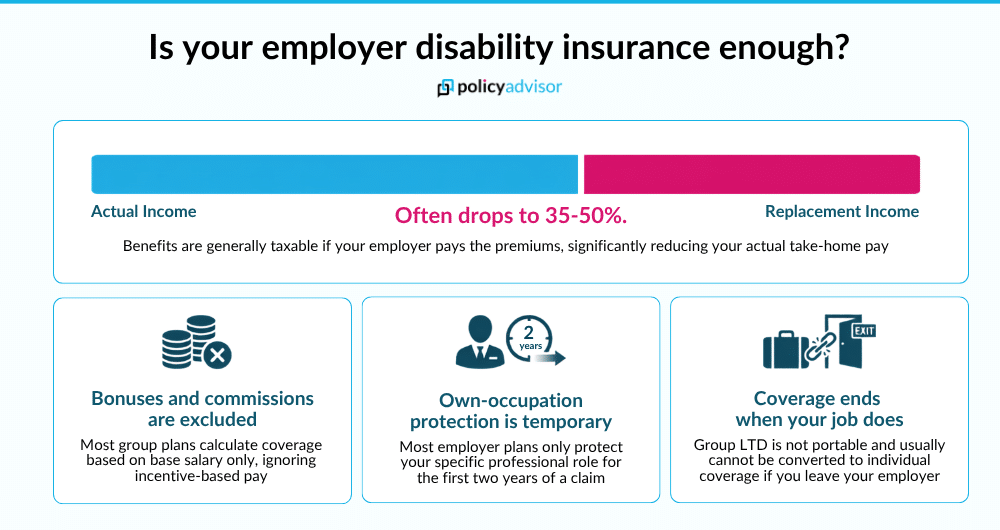
- Bonuses, commissions, and incentive pay are not included under most plans
- Monthly maximums can significantly reduce benefits for higher-income earners
Tax-related gaps
- If your employer pays all or part of the LTD premium, the benefits are generally taxable
- After tax, your actual replacement income often drops to only 35 to 50 percent of your usual take-home pay
Contract and definition gaps
- Most group LTD plans provide own-occupation protection for only the first two years of a claim
- Some plans place duration limits on mental health-related disabilities
- Pre-existing condition clauses may restrict coverage for new employees during the initial period
- Benefits are reduced if you qualify for CPP-D, WSIB, or other government programs
Employment-related gaps
- Group LTD coverage ends immediately when you leave your job
- Many employer plans cannot be converted into individual coverage when employment ends
- If your health declines later in life, you may no longer qualify for private disability insurance at standard rates
How individual disability insurance helps Canadians
Individual disability insurance offers stronger, more reliable protection because it is tailored to your income, occupation, and long-term financial requirements. With individual disability insurance, you can:
- Choose the benefit amount or income percentage that reflects your real earnings
- Select a waiting period such as 30, 60, 90, or 120 days based on your savings and risk tolerance
- Choose a benefit period of 2 years, 5 years, or to age 65 for long-term protection
- True own-occupation coverage is available as a rider on some individual DI policies, but not all policies include it by default
- Add partial or residual disability benefits to protect against reduced income
- Include future insurability options to increase coverage as your income grows
- Add a cost of living adjustment (COLA) to keep benefits aligned with inflation
Access specialized riders designed for professionals and business owners
Additionally, when you pay the premiums personally, disability benefits are generally tax-free, which provides a higher true income replacement even at the same coverage percentage.
Our advisor’s take: Should I supplement a group disability plan with individual disability insurance?
Yes, you should consider supplementing a group disability plan with individual disability insurance. At PolicyAdvisor, we recently helped a 30-year-old employee purchase an individual disability insurance policy to bridge the gap between their salary and group disability benefits. They were seeking to maintain sufficient income during disability alongside the freedom to change employment without fear of coverage.
Client profile
- Employment: Full-time professional with employer-provided disability insurance
- Income: Higher earnings, including bonuses or commissions
- Primary concern: Maintaining sufficient income during a long-term disability
- Existing coverage: Group long-term disability benefits
- Additional priority: Portable coverage that is not dependent on the employer
Why we recommend supplementing group disability coverage:
- Individual insurance can supplement group benefits that cover only part of your earnings or impose a monthly benefit maximum
- Bonuses, commissions, and other earnings may not be fully included when workplace disability benefits are calculated
- Individual policy offers stronger disability definitions and benefits suited to professional commitments
- Portable policy offers the individual the freedom to pursue other employment without worrying about coverage expiry.
How much additional disability insurance do I need if I have coverage through work?
The amount of additional disability insurance you need depends on the gap between the income available under your workplace plan and the amount you would need to cover your financial obligations and maintain your standard of living during a period of disability.
It is recommended to check your existing LTD workplace benefits and monthly maximums, and then compare them with your essential monthly expenses. It is also worth noting that workplace benefits may be taxable, further reducing the actual amount you get in hand.
Once you have made that comparison, you can purchase additional coverage to match your monthly expenses as needed. However, insurers generally limit total disability income from multiple sources to the usual range of 60% to 85% of regular pay.
For example, an employee may earn $120,000 annually but have workplace LTD capped at $5,000 per month, which is less than the usual 60% to 85%. An individual disability insurance policy may be used to cover the deficit up to the required amount.
If you are still unsure how much additional disability insurance you need, our advisors can help you understand policy limits, benefits, and other features.
How to check your group disability coverage at work?
You can check your group disability coverage at work by contacting your human resources (HR) representative or plan administrator to request your specific policy booklet and group contract details.
Here are a few things you can check to assess the strength of your current plan:
- Confirm whether your workplace plan includes short-term disability, long-term disability, or both
- Check the percentage of income the plan replaces and determine whether bonuses, commissions, or variable pay are excluded
- Review the monthly maximum benefit to see whether it limits your eligible coverage, especially if you have higher earnings
- Examine the definition of disability and identify when it transitions from own occupation to any occupation
- Verify whether LTD benefits would be taxable based on how premiums are paid
- Look at the waiting period and the length of the benefit period to understand how long support would continue
- Review the offsets that apply if you receive EI sickness, CPP-D, WSIB, or similar government benefits
- Check for mental health limitations, duration caps, or pre-existing condition restrictions that could affect eligibility
How PolicyAdvisor can help you understand your disability coverage
Most Canadians do not know how much income they would receive if they were unable to work for a year or longer. At PolicyAdvisor, we can analyze your workplace plan, calculate your true after-tax replacement income, and identify any gaps that could affect your financial security. Our advisors compare individual disability policies across major Canadian insurers and help you build a coordinated strategy that protects your long-term earning potential.
Schedule a call today, and get quotes from the best disability insurance providers in Canada!
Frequently Asked Questions
How much disability insurance do I need if I am covered through work in Canada?
Most Canadians need 60% to 85% of their total income to maintain their lifestyle during a disability. Employer plans usually insure only base salary, and the benefits are taxable, which reduces the actual replacement amount. Adding an individual policy can help you reach the level of protection you actually need.
What is the difference between short-term and long-term disability through work?
Short-term disability replaces income during the first weeks of an illness or injury. Long-term disability begins after the waiting period and can continue paying benefits for several years or until age 65, depending on the plan.
Does CPP disability mean I do not need private disability insurance?
No, CPP-D has very strict medical and contribution requirements, and the monthly benefit is modest. It is not designed to replace employment income and is often deducted from group LTD payments.
Is disability insurance taxable in Canada?
Disability benefits are taxable when the employer pays the premiums for the plan. When you personally pay the premiums for an individual disability policy, the benefits are generally tax-free.
Can my employer change or cancel my disability coverage?
Yes. Employers can change insurance carriers, reduce the scope of benefits, or cancel coverage entirely. Individual disability insurance remains stable because the contract is owned by you, not your employer.
What happens to my disability insurance if I change jobs?
Employer disability insurance is tied to your workplace benefit plan and generally ends when your coverage under that plan terminates. On the other hand, individual disability insurance policies continue as long as premiums are paid, regardless of employment status.
Workplace disability insurance can provide valuable income protection, but it may not always be enough. Group plans can have monthly benefit limits, and restrictive disability definitions. The benefits are generally taxable when the employer pays all or part of the premium. Individual disability insurance can supplement workplace coverage and provide personally owned, portable protection tailored to your income and occupation.