1-888-601-9980


- An extreme disability benefit allows you to access part of your life insurance death benefit while you are still alive if you become permanently and severely disabled
- Receiving a payout typically reduces the remaining death benefit your beneficiaries will get
- Most insurers require you to meet a strict definition of extreme disability, often based on the inability to perform multiple activities of daily living (ADLs)
- The benefit typically pays a tax-free, lump-sum that can be used for home modifications, caregiver costs, rehabilitation, medical equipment, or other disability-related expenses
An extreme disability benefit ( EDB) is a built-in living benefit included with some life insurance policies in Canada that allows you to access a portion of your death benefit while you are still alive. If you become permanently and severely disabled or have a severe loss of independent existence, the policyholder receives an early payout of the death benefit.

Need insurance answers now?
Call 1-888-601-9980 to speak to our licensed advisors right away, or book some time with them below.
What is an extreme disability benefit?
An extreme disability benefit is a built-in living benefit available with some Canadian life insurance policies that allows you to receive a portion of your life insurance death benefit early if you suffer a permanent and severe disability.
Usually, life insurance policies pay the death benefit after you pass away. With an extreme disability benefit, you can access part of that payment to cover major medical expenses, adjustment costs, and other immediate financial obligations. Since the early payout is deducted from your death benefit, your beneficiaries will receive less by the amount paid under the benefit.
Unlike disability insurance, which may pay when an illness or injury prevents you from working, an EDB generally applies only to catastrophic and irreversible disabilities. Select insurers like Beneva and Assumption Life provide it as a built-in benefit with select policies.
How does an extreme disability benefit work?
The extreme disability benefit is a form of accidental death benefit. It provides an advance payment of your life insurance payout in the event of an extreme physical disability. For instance, it could be either 50% or 25% of your death benefit, up to a maximum of $250,000. The payment is made after a predetermined waiting period that varies by insurance provider.
Here is how an Extreme Disability Benefit typically works:
Step 1: Purchase a life insurance policy
You buy a life insurance or critical illness insurance policy that includes an Extreme Disability Benefit
Step 2: Have a disability that meets the policy definition
If you suffer a severe, permanent disability that meets your insurer’s definition of extreme disability during your policy period, you may be eligible to claim benefits
Step 3: Submit a claim
Submit the necessary documentation to qualify for the extreme disability benefit. The insurer assesses whether your condition satisfies the policy’s eligibility criteria.
Step 4: Receive a lump-sum benefit
Once approved, the insurer pays a lump sum representing a portion of your life insurance coverage in the form of an accelerated death benefit. When you eventually pass away, your beneficiaries receive the remaining death benefit after deducting the amount already paid as part of the benefit.

What qualifies as an extreme disability in Canada?
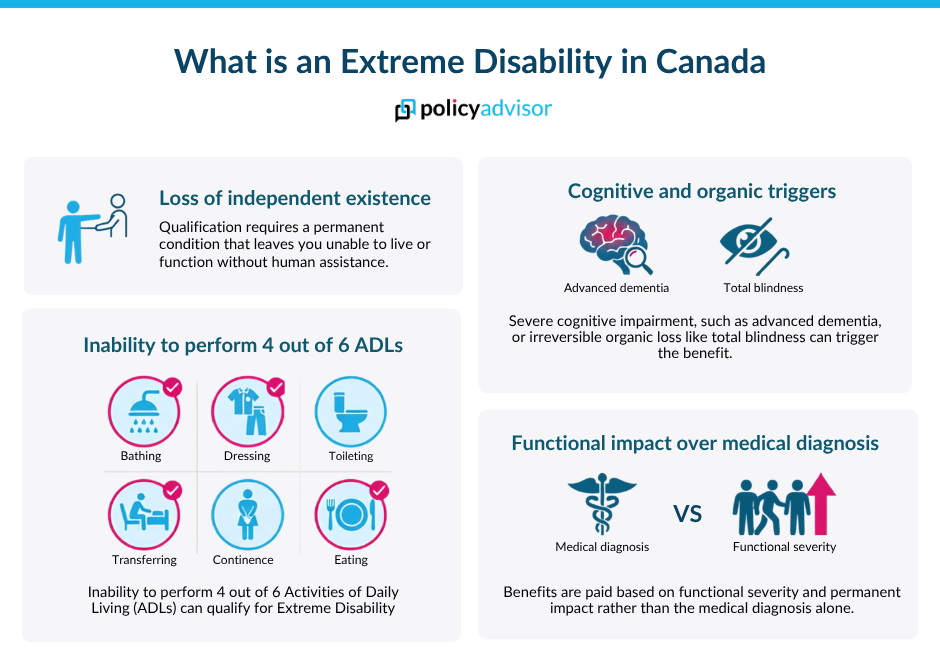
While the definition of extreme disability varies by insurer, it generally refers to a permanent physical or cognitive condition that leaves you unable to live or function independently. You must be completely unable to perform a specific number of activities of daily living (ADLs) without human assistance to qualify for the benefit.
Most Canadian insurers require an inability to perform at least 4 of the following 6 activities:
- Bathing: Washing your body in a tub or shower
- Dressing: Putting on and taking off necessary clothing
- Toileting: Getting to and from the toilet and maintaining hygiene
- Transferring: Moving into or out of a bed, chair, or wheelchair
- Continence: Controlling your bowel or bladder functions
- Eating: Feeding yourself prepared food
Unlike a disability insurance policy that factors in any situation that affects your inability to work, an Extreme disability benefit generally requires a much higher level of impairment. This makes the policy much more limited in its offering. For example, a broken bone or displaced hip can offer you disability insurance benefits, but will not qualify for an extreme disability.
Can cognitive impairment qualify for an extreme disability benefit?
Apart from ADLs, severe cognitive impairment may also qualify individuals for the extreme disability benefit. Situations such as advanced dementia and irreversible organic loss (such as total blindness or the loss of two limbs) can also trigger a payout. Note that the benefit does not pay out based on a medical diagnosis alone. Instead, insurers assess the functional severity and the permanent physical or cognitive impact caused by these conditions.
Severe cognitive impairment may qualify for an extreme disability benefit only when it results in the level of permanent functional impairment as stated in the policy. For example, back pain or depression can trigger disability insurance, while extreme disability benefits are activated only under debilitating medical conditions.
Is there a waiting period before an extreme disability benefit is paid?
Yes, there is a waiting period before an Extreme Disability Benefit is paid. Before the insurer approves a claim, you must satisfy the benefit’s eligibility requirements, provide medical evidence, and remain in a state of continuous extreme disability for a set period specified in your policy. This waiting period varies by insurer and is outlined in the policy contract, typically ranging from 3 to 6 months.
Many Canadian insurers define eligibility based on a permanent and irreversible disability, typically requiring the policyholder to be unable to perform activities of daily living and with no reasonable expectation of recovery. Once it is medically certified and the waiting period is over, the accelerated death benefit is paid out to the insured.
How much does an extreme disability benefit pay in Canada?
The payout of the Extreme Disability Benefit depends on the terms set by your insurer and your policy’s death benefit. Typically, it pays a one-time, lump-sum amount, allowing you to cover major disability-related expenses and other living costs.
In many cases, the amount paid by the Extreme Disability Benefit is calculated as a percentage of your life insurance coverage, subject to a maximum limit. Many insurers pay up to 50% of the policy’s death benefit, subject to a maximum dollar limit (typically ranging between $50,000 and $250,000, depending on the insurer and coverage amount).
Here are some illustrative examples of how your Extreme Disability Benefit is calculated:
| Life insurance coverage | Maximum benefit* | % of death benefit paid early | Remaining death benefit |
| $250,000 | $100,000 | 40% | $150,000 (60%) |
| $500,000 | $250,000 | 50% | $250,000 (50%) |
*Maximum amount is subject to policy terms and insurer discretion.
Does the extreme disability benefit payout reduce your death benefit?
Yes, an Extreme Disability Benefit is considered a form of accelerated death benefit. This essentially means that the money is paid from your existing life insurance coverage and not in addition to it. Once the policyholder passes away, the beneficiaries will receive the remaining amount.
Additionally, the extreme disability benefit payout may affect your premiums. Some insurers may adjust premiums to reflect the reduced amount of coverage, while others may continue charging the original premium. If your policy also includes a Waiver of Premium rider, your future premiums may be waived entirely while your coverage remains in force.
Pros and cons of an Extreme Disability Benefit
Which Canadian Life Insurance companies offer a built-in extreme disability benefit?
Extreme disability benefits are included with certain Canadian life insurance and critical illness insurance policies. However, availability, eligibility rules, payout limits, and definitions vary by insurer and product.
Here’s a list of some of the major Canadian insurers that offer built-in Extreme Disability Benefits in Canada:
- Beneva: Beneva offers an extreme disability benefit which pays 50% or 25% of the initial insurance amount for up to $250,000 before the age of 60, if you face a state of extreme disability for at least six months
- UV Insurance: UV Insurance provides a form of the extreme disability benefit as Severe Loss of Independent Existence in their T-20 Superior+ policy and other products. It provides 50% of the insurable amount, up to $100,000, if you face a severe loss of independent existence before your 60th birthday..
- Assumption Life: Assumption Life includes an Extreme Disability Benefit with eligible life insurance policies. If you are diagnosed with an extreme disability and remain in that state for a continuous period of six months, you may receive up to 50% of the life insurance death benefit in advance, up to $250,000 for ages 18to 59 or $125,000 for ages 60 to 70.
Is it possible to add a rider to an existing life insurance policy?
There is no straightforward answer here. Whether you can add a rider to an existing life insurance or disability policy depends on your insurer and your policy’s terms and conditions. It could further vary between riders.
Adding a rider to an existing application often requires submitting a new application. You may have to take a medical exam or submit an Attending Physician’s Statement (APS) to qualify.
Dropping a rider from your policy is much easier than adding one. Your insurer generally will need additional information, and it is commonly a matter of filling out an application or informing your insurer. After you drop the rider, your insurer adjusts your premiums accordingly.
If you are interested in a life insurance policy with an extreme disability benefit or another rider, our expert advisors can help. We can assess what life or disability insurance policies are right for you. Schedule a call with one of PolicyAdvisor’s insurance experts today and learn more about our competitive rates and coverage options.
Frequently Asked Questions
Is an extreme disability benefit included with every life insurance policy?
Some insurers like Beneva, Assumption Life, and UV Life insurance include it on eligible policies. Availability varies by insurer and policy type.
How much does an extreme disability benefit pay?
The payout for an Extreme Disability Benefit depends on your insurer and policy. Many policies provide up to 50% of your life insurance coverage, subject to a maximum benefit limit.
Can I add an extreme disability benefit after purchasing life insurance?
Some companies allow riders to be added later, while others require you to select them when you first purchase your policy. Speak to our advisors to learn which riders can be added to your policies and if you can supplement an existing policy with more options.
Can seniors qualify for this benefit?
Yes, but eligibility depends on the insurer’s issue age limits, underwriting rules, and the terms of the benefit. Many insurers limit the ages at which you can access the benefit in a life insurance policy. Additionally, some benefits and features expire at a specified age.
Is extreme disability benefit taxable in Canada?
An extreme disability benefit is typically not taxable in Canada. However, the amounts received by a policyholder while alive can create a taxable policy gain if proceeds exceed the policy’s adjusted cost basis.
Is the extreme disability benefit the same as disability insurance?
No, the Extreme Disability benefit is not the same as disability insurance. The benefit advances a portion of your life insurance death benefit as a lump-sum payment in case of a permanent, catastrophic condition. Meanwhile, disability insurance replaces lost income as monthly payments during a temporary or long-term inability to work, usually with a much shorter waiting period.
Is an Extreme Disability benefit the same as a Compassionate Benefit or Compassionate Advance?
No. While both allow you to access part of your life insurance death benefit before you pass away, they are triggered by different circumstances.
An Extreme Disability Benefit pays a lump sum if you become permanently and severely disabled and meet the policy’s definition of extreme disability. Meanwhile, a Compassionate Benefit pays a portion of the death benefit if you are diagnosed with a terminal illness. However, both of these benefits are accelerated death benefits, essentially reducing your final payout.
An extreme disability benefit adds living benefits to a life insurance policy by allowing you to access part of your death benefit if you experience a qualifying severe disability. For Canadians seeking more comprehensive financial protection, an extreme disability benefit can help provide peace of mind for you and your loved ones.