1-888-601-9980


- Life insurance death benefits are generally tax-free when paid to a named beneficiary
- Permanent life insurance may create taxable events through cash value withdrawals, policy loans, policy surrenders or transfers
- Cash value grows tax-deferred, but gains above the policy's Adjusted Cost Basis (ACB) may be taxable
- Naming a beneficiary and planning your policy carefully can help reduce probate costs and unnecessary tax liabilities
In Canada, life insurance death benefits paid to a named beneficiary are tax-free. Taxes can arise, however, when you withdraw cash value, borrow against the policy, transfer ownership, or surrender the policy. Proper structuring of your policy can help your loved ones continue living their lives with minimal tax liabilities.
Quick overview:
| Scenario | Tax treatment |
| Death benefit to the beneficiary | Tax-free |
| Cash-value growth | Tax-deferred |
| Withdrawal>Adjusted Cost Basis (ACB) | Taxable |
| Policy surrender with a capital gain | Taxable |
| Interest earned on a death benefit after payout | Taxable |

Call 1-888-601-9980 to speak to our licensed advisors right away, or book some time with them below.
Is life insurance payout taxable in Canada?
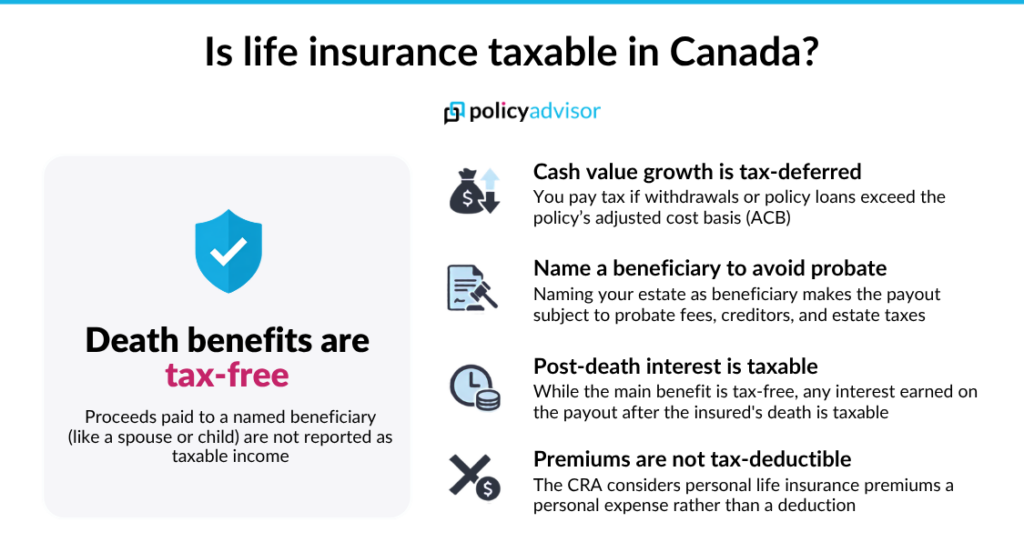
No, life insurance payout is not taxable. In Canada, a life insurance death benefit is generally tax-free when it is paid directly to a named beneficiary, regardless of the payout amount.
While the death benefit is generally tax-free, taxes can apply in certain situations. For example, interest earned on the death benefit after the insured’s death is taxable, and accessing the cash value of a permanent life insurance policy through withdrawals, surrender, or certain policy loans may trigger taxable income. Policy dividends may also have tax implications depending on how they are received or used. There are different tax rules when a corporation owns the policy or when the proceeds are paid to the estate instead of directly to a named beneficiary.
Do beneficiaries pay tax on life insurance in Canada?
No, beneficiaries do not pay tax on life insurance proceeds in Canada. If you name your spouse, child, or any other individual or entity (like a charity) as a beneficiary on your life insurance policy, the proceeds will be tax-free when paid to them. The beneficiary does not have to declare the proceeds as taxable income on their annual Canada Revenue Agency (CRA) return.
Appointing a beneficiary in your life insurance policy has several advantages:
- Proceeds are paid tax-free
- Proceeds do not have to go through probate
- Proceeds do not become a matter of public record
You should always appoint a beneficiary on your policy to ensure that the proceeds from your life insurance policies go to the beneficiaries of your choice, rather than directly to your estate or creditors. If you choose not to appoint a beneficiary, your estate will automatically be designated as the beneficiary.
What happens if you name your estate as the beneficiary?
If you name your estate as the beneficiary, the death benefit itself remains tax-free. However, the funds will be subject to provincial probate fees, exposed to creditors, and any interest they earn while the estate is being settled will be subject to income tax.
Additionally, naming the estate as the beneficiary could expose the death benefit to creditors if the estate has outstanding debts. The life insurance money may then be used to cover any outstanding debts of the estate and may be subject to other administrative fees and probate fees, meaning less money for your family. To avoid these issues, it is often recommended to name specific individuals or entities as beneficiaries instead of the estate.
When is life insurance taxable in Canada?
There are situations where the CRA may tax part of the policy’s value or related income. These taxes usually arise when you access your policy’s cash value, cancel (surrender) the policy, receive policy dividends, or earn investment income from the policy proceeds.
Withdrawals from the cash value
Permanent life insurance can grow in cash value and provide you with a potential source of future funds. Most policies with cash values allow you to withdraw some or all of the cash value (for a fee). However, these withdrawals are generally taxable. A withdrawal is taxed when the amount withdrawn exceeds the policy’s Adjusted Cost Basis (ACB). The ACB represents the policy’s tax cost for CRA purposes.
For example: If your policy has an ACB of $40,000 and you withdraw $55,000, the $15,000 gain may be taxable.
Policy loans
Whole life insurance policies allow policyowners to borrow against the cash value accumulated in their policy. Unlike a cash value withdrawal, a policy loan can be repaid, allowing you to restore the full death benefit. However, if the policy lapses while there is an outstanding loan, the CRA may treat it as a taxable disposition, and part of the amount may become taxable.
Policy loan amounts that are equal to or less than the policy’s ACB are non-taxable. However, policy loans taken in excess of the policy’s ACB will be taxable. In such a case, the insurance company will issue a T5 slip to report the taxable gain.
| Policy details | Value |
| Policy cash value | $100,000 |
| Policy loan | $80,000 |
| Adjusted Cost Basis | $75,000 |
| Taxable gain (same as the amount in excess of ACB) | $5,000 |
Policy as collateral
A policy owner can take a loan from a third-party institution, such as a bank, using the cash value as collateral on the loan. Generally, loans will be structured as a line of credit, and the loan proceeds will be received tax-free.
Upon the death of the insured, the proceeds from the life insurance policy are used to pay off the line of credit and any unpaid interest on the loan. If you repay the policy loan during your lifetime using your own funds, then there will be no tax impact.
Difference between policy withdrawal, policy loan, and collateral assignment
| Features | Policy withdrawal | Policy loan | Policy as a collateral assignment |
| Access to cash value (%) | Up to 100% (minus any surrender fees) | Up to 90% | 50-90% |
| Taxable | Only amount in excess of the policy ACB | When loan amount exceeds ACB | Tax-free |
| Uses your credit score to determine loan amount | No | No | Yes |
| Reduces death benefit | Yes | Yes | Yes |
Surrendering
Upon surrendering or cancelling the policy before the policy end date to receive its cash value or surrender value, it can attract tax. The policy gain upon surrender [Gain = cash value – ACB] is considered income and hence, taxable.
For example, if your policy’s cash surrender value is $90,000 and its ACB is $70,000, the $20,000 gain is generally taxable.
Transferring your policy
Transferring ownership of a life insurance policy to another person or selling the policy can trigger a taxable disposition. CRA may calculate a policy gain based on the policy’s value and ACB, and any gain may be taxable.
Tax rules for policy transfers vary depending on whether the transfer is made to a family member, a corporation, or another individual. Transferring to a spouse is mostly tax-free (provided the spouse is a Canadian resident); on the other hand, if you transfer to anyone else or a corporation of your own, taxes can be triggered.
Interest on death benefit
While the death benefit itself is tax-free, any interest earned after the insurer pays the proceeds is taxable.
For example, if a beneficiary receives a $500,000 death benefit and leaves it with the insurer or invests it in an interest-bearing account, the original $500,000 remains tax-free. However, any interest earned from that amount must be reported as taxable income in the year it is received.
Receive policy dividends
Participating whole life insurance policies may pay policy dividends based on the insurer’s financial performance. In most cases, these dividends are not taxable when they are used to purchase Paid-Up Additions (PUAs), reduce your premiums, or are paid directly as cash, as they are generally treated as a return of premium. However, if you leave the dividends on deposit with the insurer, any interest earned on those dividends is taxable and must be reported as income.
Is life insurance tax deductible in Canada?
No, life insurance premiums are generally not tax deductible in Canada. If you purchase a personal life insurance policy, you cannot claim the premiums as a deduction on your personal income tax return because the Canada Revenue Agency (CRA) considers them a personal expense.
However, there are a few exceptions where life insurance premiums may qualify for a tax deduction, particularly for businesses or self-employed individuals who use a life insurance policy as collateral for a business loan.
When can businesses claim life insurance premiums?
Businesses may be able to deduct a portion of life insurance premiums if all of the following CRA conditions are met:
- The policy is required by a lender as collateral for a business loan
- The policyholder must be the borrower
- Assignment of the death benefit must be made to the lender as collateral for the debt
- The loan is used to earn business or investment income
- The amount deducted is limited to the lesser of the premiums paid or the net cost of pure insurance for the year
In addition, businesses can deduct premiums paid on behalf of their employees. These costs are deductible and are treated as payments to employees, like health and dental benefits, or disability insurance. A corporation can pay a shareholder’s life insurance premiums if the shareholder is also an employee, with the premiums paid in the shareholder’s capacity as an employee.
How are corporate-owned life insurance payouts taxed?
When a private Canadian corporation owns a life insurance policy, the death benefit is generally received by the corporation tax-free. The corporation may then credit its Capital Dividend Account (CDA) by an amount equal to the death benefit minus the policy’s Adjusted Cost Basis (ACB) at the time of death. The CDA balance can be distributed to Canadian-resident shareholders as a tax-free capital dividend, making corporate-owned life insurance an effective estate and tax planning tool.
Are employer-paid group life insurance premiums taxable in Canada?
Yes, employer-paid group life insurance premiums are generally considered a taxable benefit for employees in Canada. Although you don’t pay tax on the premiums themselves, you will pay income tax on the value of the employer-paid benefit.
On the other hand, if an employer provides group life insurance as part of an employee benefits plan, the employer can generally deduct the premiums as a business expense. However, the value of employer-paid group term life insurance premiums is typically considered a taxable benefit for the employee and must be included in their taxable income.
How does life insurance help in tax planning?
Life insurance offers several tax advantages that make it an effective financial planning and estate planning tool in Canada. Key tax benefits of life insurance include:
- Tax-free death benefit: In most cases, beneficiaries receive the death benefit tax-free
- Tax-deferred cash value growth: The cash value in eligible whole life and universal life insurance policies grows on a tax-deferred basis while it remains in the policy
- Estate planning advantages: Naming a beneficiary can help the death benefit bypass the estate, potentially avoiding probate fees and delays (where applicable)
How can I avoid paying taxes on life insurance?
While most life insurance death benefits are already tax-free in Canada, these strategies can help minimize taxes on your policy and estate:
- Name a beneficiary: Avoid having the death benefit paid to your estate, which may result in probate fees and delays
- Avoid unnecessary cash value withdrawals: Withdrawals exceeding the policy’s Adjusted Cost Basis (ACB) can be taxable
- Limit policy surrenders and transfers: Surrendering or transferring ownership can trigger a taxable policy gain
- Use policy loans carefully: Some policy loans may create tax consequences, especially if the policy lapses
- Consult a tax or insurance professional: Get advice before making withdrawals, policy changes, or estate planning decisions to minimize potential tax liabilities
Our experts at PolicyAdvisor can inform you what life insurance products are best for your situation and how to reduce the taxability of your death benefit. Book some time with our expert advisors below to see how you can structure your life insurance needs in the most tax-efficient manner.
Frequently asked questions
Is the cash value of life insurance taxable?
The cash value of a permanent life insurance policy isn’t taxed while it grows. In Canada, the cash value in whole life and universal life insurance policies grows on a tax-deferred basis, meaning you don’t pay taxes on the growth each year as long as the funds remain within the policy.
However, accessing the cash value can trigger taxes. If you withdraw funds, surrender the policy, or take certain policy loans, the portion that exceeds the policy’s Adjusted Cost Basis (ACB) is generally considered a policy gain and is taxable as income.
Is life insurance payout taxable on death?
In Canada, life insurance payouts are generally not taxable when received by the beneficiary upon the insured’s death. The death benefit is typically tax-free and can be used for various purposes, such as covering funeral costs or paying off debts.
What is the tax implication of withdrawing cash from a life insurance policy?
Withdrawing cash from a life insurance policy in Canada may trigger tax implications. If the withdrawal exceeds the policy’s adjusted cost basis (ACB), the excess amount is considered a taxable gain and must be reported as income. This taxable portion is subject to the individual’s marginal tax rate. However, withdrawals within the ACB are tax-free.
Are life insurance death benefits included in calculating an estate’s taxes in Canada?
Life insurance death benefits are not included when calculating an estate’s taxes, as they are generally paid directly to a named beneficiary and bypass the estate. However, if the estate is the beneficiary, the death benefit may form part of the estate’s value, potentially subjecting it to probate fees.
Can I transfer ownership of a life insurance policy without triggering a taxable event?
Transferring ownership of a life insurance policy can trigger a taxable event if the policy has a cash surrender value (CSV). The transfer is treated as a disposition, and any gain (CSV exceeding the adjusted cost basis) is taxable.
When can I claim my life insurance on my tax return?
The rules around reporting your life insurance premiums and payouts on your tax return depend on how you are using your insurance and the kind of policy you have. For example, a life insurance death benefit payout is not reported as taxable income. However, interest earned on policy dividends left on deposit is taxable. Similarly, any gains on policy withdrawals or loans have to be reported.
Is death benefit taxable in Canada?
In Canada, life insurance death benefits are generally not taxable. Beneficiaries receive the full amount tax-free, making life insurance an effective tool for financial protection.
However, if the death benefit is paid to the estate rather than a named beneficiary, it may be subject to probate fees and used to cover the estate’s debts. Additionally, in rare cases, any interest earned on delayed payouts may be taxable.
What happens if I don’t name a beneficiary on my life insurance policy?
If you don’t name a beneficiary, the death benefit is generally paid to your estate. While the death benefit is usually still tax-free, it may be subject to probate fees, estate administration, and delays before it reaches your heirs.
Life insurance death benefits are tax-free when paid to a named beneficiary in Canada. However, withdrawals from a policy’s cash value, policy loans, surrenders, transfers, employer-paid group life insurance, and interest earned on death benefits may trigger taxes. Learn when life insurance is taxable and how to reduce potential tax liabilities.