

 1-888-601-9980



- Physicians should consider disability insurance crucial for protecting their income and financial stability in the event of an illness or injury that prevents them from working
- Physicians can get disability coverage through employer, provincial, association, individual plans, or government-sponsored plans
- The coverage needs for physicians depend on income, specialty, existing benefits, practice expenses, and future earning potential
- Riders such as residual disability, COLA, future increase, and catastrophic disability can provide additional protection based on individual needs
Recent data from the CMA 2025 National Physician Health Survey highlights the high prevalence of disability among physicians in Canada. The survey also highlights why protecting income against long-term disability can be an important part of financial planning for physicians. Disability insurance, sometimes known as income protection insurance, helps protect physicians against income loss by replacing between 60% and 85% of their income.
Do physicians need disability insurance in Canada?
Yes, disability insurance is important for physicians in Canada because their ability to earn depends on specialized medical skills and, for many specialists, hands-on clinical or procedural work. An illness or injury that prevents a physician from practising can create a significant income gap, even with savings or existing employer-sponsored benefits. This risk can be particularly important for surgeons, procedural specialists, emergency physicians, and self-employed or incorporated physicians.
Disability insurance can help protect against lost income while covering ongoing financial obligations such as mortgages, family expenses, professional debt, and practice costs. Group or association plans may also have benefit limits, may replace only part of a physician’s income, or may not be portable when changing employers or practice arrangements. An individual policy can provide additional income protection tailored to the physician’s income, occupation, and coverage needs.
What disabilities can prevent a physician from working?
A physician may be unable to work because of physical, cognitive, or mental health conditions that affect the duties of their specialty. The following conditions may affect a physician’s ability to practise:
- Musculoskeletal conditions: Back, joint, or muscle problems can limit movement, standing, or procedural work
- Neurological conditions: Disorders that affect coordination, concentration, memory, or motor skills
- Mental health conditions: Depression, anxiety, bipolar disorder, PTSD, and other disorders can impair concentration, decision-making, and ability to maintain a clinical workload
- Cancer and serious illnesses: Treatment and ongoing symptoms (e.g. fatigue, pain, cognitive changes) can make regular practice difficult
- Vision or hearing loss: Can interfere with patient assessment, communication, reading diagnostic information, or performing procedures safely
- Hand or fine-motor injuries: Particularly important for surgeons and other procedure-based specialists
How does disability insurance work for physicians in Canada?
Disability insurance provides physicians with a monthly income benefit when an illness or injury prevents them from performing their medical duties. Here’s how disability insurance works for physicians:
- A physician becomes disabled: An illness or injury prevents them from performing their usual medical duties or significantly limits their ability to work
- Submit a claim: The physician provides medical evidence and information showing how the condition affects their ability to practise
- The insurer assesses the claim: The insurer determines whether the physician meets the policy’s definition of disability. The waiting period, also called the elimination period, usually runs from the onset of disability until benefits become payable
- Benefits begin: If approved, the physician receives a monthly benefit after the policy’s waiting period. The benefit helps cover personal and professional expenses while the physician is unable to earn their usual income
Definition of disability for physicians
Choosing the right definition of disability insurance for doctors and other health-care professionals. This helps determine when a policy will pay benefits if a physician can no longer perform the duties of their specialty. In the section below, we take a look at own vs. any occupation in disability insurance:
Own-occupation
- Definition: Pays if you cannot perform substantial and material duties of your specific occupation or medical specialty, even if you can work in another occupation
- Example: A surgeon develops a hand condition that prevents them from performing surgery but can still work as a medical consultant. The policy may pay the disability benefit because they can no longer perform their specific surgical occupation
- Who it suits: Almost all physicians, particularly surgeons, anesthesiologists, emergency medicine physicians
Any occupation
- Definition: Pays only if you cannot work in any occupation for which you are reasonably suited by education, training, or experience
- Example: A physician who can no longer practise medicine but could perform administrative or consulting work may not qualify
- Who it suits: Physicians looking for lower-cost coverage who have other sources of financial protection and are comfortable with a stricter definition of disability
Types of disability insurance for physicians in Canada
Physicians can access disability benefits through different providers and programs. Coverage can also vary based on whether it is designed for short-term or long-term disability.
Based on the length of coverage:
- Short-term disability insurance (STD): It covers the loss of income from a temporary health condition arising from a sickness or accident. The benefit payout can start as early as one to 14 days after the elimination period, and the coverage can last from 6 to 26 weeks. Short-term disability insurance is used for minor accidents and health issues, such as back problems, that might prevent physicians from being able to work for a few weeks
- Long-term disability insurance (LTD): It covers serious, more persistent health issues. The coverage usually begins right after STD insurance coverage ends (or after a 90- or 120-day elimination period), and the coverage period can be from two, five, or ten years. Most long-term disability insurance coverage continues till the insured reaches the age of 65. LTD insurance is commonly used for serious cardiovascular and cerebrovascular issues, mental health trouble, serious accidental injuries, and more
Based on who provides the coverage:
- Individual disability insurance: It is purchased directly from a private insurer and tailored to the physician’s income, occupation, and coverage needs. It can supplement other disability benefits and may offer stronger own-occupation-based protection, especially for self-employed doctors
- Employer-sponsored disability insurance: Provided through an employer as part of a group benefits plan. Because the vast majority of Canadian physicians are not traditional employees, this is typically only relevant for medical residents, fellows, or physicians in specific salaried hospital or academic roles. The definitions of disability are often stricter than individual plans
- Government disability benefits: Physicians may also qualify for government programs such as Employment Insurance (EI) sickness benefits or Canada Pension Plan (CPP) disability benefits. EI sickness benefits can provide up to a maximum of $729 a week, for up to 26 weeks. Canada Pension Plan (CPP) disability benefits provide up to $1,741.20 per month (2026 maximum) and continue until age 65, but require a severe and prolonged disability that prevents you from working at any job
- Provincial or medical association disability insurance: It is offered through provincial medical associations such as Ontario Medical Association, Doctors of BC, or others. They offer good baseline coverage but are group contracts, meaning the association can change definitions or raise rates
Provincial disability plans for physicians
- Alberta Medical Association (AMA): The AMA offers a physician-focused disability insurance plan that provides a monthly income benefit ranging from $500 to $25,000, based on income. Physicians can also choose an elimination period of 30, 60, 90 or 120 days on their own. The AMA also has extra advantages such as guaranteed acceptance (up to a limit), survivor benefits, waiver of premiums, recurrent disability benefit, and the option to include riders. Note for new physicians: The AMA offers a guaranteed acceptance of up to $1,500 in monthly coverage (no medical evidence required) if you apply within your first six months of full-time practice in Alberta, subject to a 24-month pre-existing condition limitation on that portion
- Ontario Medical Association (OMA): OMA Insurance provides disability insurance solutions for Ontario physicians and residents. Its resident program offers $4,500 per month in disability insurance. Once in practice, physicians can increase this coverage to protect against the financial impact of sickness or injury, with maximum monthly benefits of up to $25,000, subject to income qualification
- Doctors Manitoba: Doctors Manitoba coverage is available to full-time physicians in Manitoba who are under age 65. As members of Doctors Manitoba, physicians can receive monthly disability benefits of up to $15,000 if they are under age 60 and $10,000 if they are over 60 years. Their disability insurance also offers additional coverage through the Cost of Living Adjustment Option (COLA), Future Insurance Option, and Retirement Protection Option
- Doctors of BC: British Columbia has both a government-funded Physicians’ Disability Insurance (PDI) plan and the personally paid INCOMEprotect plan. PDI provides a basic monthly benefit of up to $6,100, while INCOMEprotect can provide monthly benefits of $500-$25,000
How much disability insurance coverage do physicians need?
The effective income replacement percentage for physicians ranges from approximately 60-85% at lower income levels, dropping to 40-55% at higher income levels. To determine the right coverage amount, listed below are the factors that you need to consider:
- Start with your income: Calculate how much of your monthly after-tax income would need to be replaced during a disability
- Account for existing coverage: Subtract benefits available through an employer, provincial medical association, or government program to identify any coverage gap
- Include practice expenses: Physicians who own a clinic may need separate protection for ongoing business expenses such as staff wages, rent, and utilities. They can get Business Overhead Expense (BOE) that reimburses fixed business costs so the physician does not have to drain their personal disability benefits to pay their lease
- Consider future earnings: A young physician may need more coverage because a long-term disability could eliminate decades of future income. With features like Future Insurance Option (FIO) or Guaranteed Insurability Benefit (GIB), young doctors can increase their coverage as their income grows without having to undergo new medical underwriting
- Review coverage as income changes: Physicians should reassess their disability insurance after major changes in income, specialty, practice ownership, or existing group benefits
Disability insurance riders for physicians in Canada
Some of the riders physicians can add include:
- Own-occupation rider: Pays benefits if physicians cannot perform the duties of their specific occupation or specialty, even if they can work elsewhere
- Residual or partial disability rider: Provides benefits when a disability reduces the income but does not prevent physicians from working completely
- Cost-of-living adjustment (COLA): Increases disability benefits while physicians remain disabled to help keep pace with inflation. The Cost-of-Living Adjustment (COLA) only kicks in after a physician has been disabled and receiving benefits for a full 12 months
- Future increase option: Allows disability coverage to increase as income grows. Physicians do not need to undergo new medical underwriting to increase the coverage, but increases are subject to plan limits and higher premiums on the additional coverage.
- Catastrophic disability rider: Provides an additional benefit if a severe disability results in significant loss of independence or ability to perform certain daily activities
How much does disability insurance cost for physicians in Canada?
The disability insurance for physicians in Canada can cost between $86 and $707 per month for a physician in occupation class 4A. A $5,000 monthly benefit costs about $86 per month at age 30 and $353 per month at age 60. A physician with the same profile but with double monthly benefit ranges from $171 to $706 per month.
Monthly premiums by occupation class – Physician – 4A
| Age (in years) | 5k monthly benefit premium | 10k monthly benefit premium |
| 30 | $85.79/month | $171.59/month |
| 40 | $131.6/month | $263.20/month |
| 50 | $213.76/month | $427.53/month |
| 60 | $353.02/month | $706.04/month |
*Illustrative cost for a non-smoker male in good health, with a $5,000 and $10,000 monthly benefit, 90-day waiting period, and coverage to age 65.
Advisor’s take: What to look for in physician disability insurance
If you are a physician looking for disability insurance in Canada, the policy should account for the specialized nature of your work and the income you have built around your medical practice. The definition of disability is particularly important because being unable to perform clinical duties does not always mean you are unable to work in another capacity.
For example, a surgeon may develop an injury that prevents them from performing procedures but still allows them to teach, conduct research, or take on administrative work. Depending on the policy wording, an own-occupation definition can help protect their income when they can no longer practise their specific specialty.
At PolicyAdvisor, we recently helped a physician secure individual disability insurance to provide additional income protection beyond their existing coverage. The physician had substantial ongoing financial commitments and wanted coverage that would continue protecting their earnings if an illness or injury prevented them from practising.
Client profile
- Age: 38 years
- Occupation: Specialist physician
- Primary concern: Protecting professional income and meeting ongoing household and financial obligations
- Coverage goal: Long-term individual disability income protection
Why we recommended individual disability insurance:
- Own-occupation protection: This can help provide benefits if the physician becomes unable to perform the duties of their medical specialty, even if they remain capable of working in another role
- Long-term benefits: Coverage extending to age 65 can help protect a physician’s earning potential throughout their main working years
- Additional income protection: Individual coverage can supplement employer, association, or other disability benefits when existing protection does not replace enough of the physician’s income
- Future increase options: These can allow younger physicians or those early in their careers to increase coverage as their earnings grow, subject to the policy terms
Best disability insurance companies for physicians in Canada
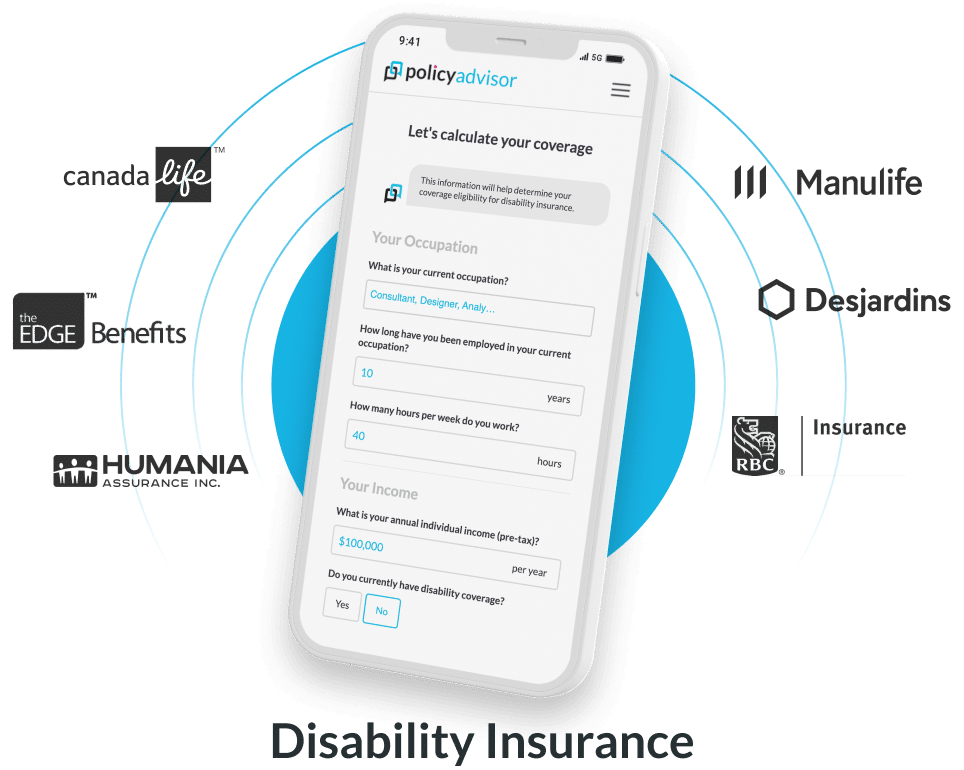
When comparing disability insurance for physicians, we recommend considering Canada Life, RBC Insurance, Manulife, Desjardins, Humania, and other Canadian insurers. While some companies provide better coverage at a lower price, others, such as Canada Life, allow physicians to customize their policies through riders. Beyond the basic comparison, we help our clients compare plans based on the definition of disability, own-occupation protection, monthly benefit limits, benefit periods, residual disability provisions, and other factors. To learn more about how the companies compare, read our blog on the best disability insurance companies in Canada.
Can incorporated physicians get disability insurance?
Yes, if you are an incorporated physician in Canada, you can buy a disability insurance plan through your corporation and get a monthly disability benefit in case the need arises. There are several different plans that insurers offer for corporations and that help cover different types of expenses. Some of the coverage that you can get as an incorporated physician is:
- Business overhead expenses (BOE): Your corporation owns and pays for a BOE policy, which provides a monthly benefit to the business if you become disabled. With this type of disability insurance plan, you can use your benefit payout to pay for eligible fixed business expenses (e.g, rent, staff salaries, utilities) while you are disabled
- Group disability plan: An incorporated practice can sponsor a group disability plan and offer it to eligible employees (e.g. nurses, administrative staff)
- Fund a buy/sell agreement: In case you or your partner are disabled, you can use a disability payout to purchase shares from a disabled shareholder or partner
Are provincial plans better than individual disability insurance for physicians?
No, provincial plans like the ones offered through the Ontario Medical Association (OMA) or Alberta Medical Association (AMA) are not inherently “better” than individual disability plans, but they can still provide valuable base coverage. The benefit amounts are often limited, and there is less flexibility to customize the plans. The other disadvantage is that the association owns the master contract, meaning they can technically alter definitions or cancel the group plan. Individual plans lock in a level premium for life with a “non-cancellable” guarantee.
Also, individual disability insurance can offer more control and help fill coverage gaps in provincial or group plans. In fact, it is a better option for physicians to get both provincial and individual disability insurance plans so that they can get comprehensive benefits.
Are the disability insurance benefits tax-free for physicians?
Yes, the disability insurance benefits are tax-free for physicians if they are paying 100% of the premiums personally with after-tax income. But if an employer or medical professional corporation pays the premiums and claims the expense, the benefits are generally taxable. If the premiums are shared between the employer and the employee, the tax treatment can depend on the portion of premiums paid by each, and part of the benefit may be taxable.
Do physicians need individual disability insurance if they have coverage through work?
Yes, having individual disability insurance along with coverage through work can be beneficial for physicians. Employer-sponsored disability insurance can provide valuable income protection; it typically only applies to medical residents, fellows, or physicians in salaried academic/hospital roles.
They may still have coverage gaps depending on the plan’s benefit limits, definition of disability, taxation, and portability. Individual disability insurance can help supplement employer coverage when the existing benefit does not adequately protect the physician’s income or specialty.
How do physicians get disability insurance?
Our licensed advisors will help you through the process of finding and choosing the right disability insurance for physicians in Canada. Here are the steps you need to follow:
- Share your medical specialty, income, employment or practice structure, and any existing disability coverage with our advisor
- Our advisors will help you compare plans from leading Canadian insurers based on different parameters
- Based on your comparison and your coverage needs, we will help you select and apply for a policy that is the best fit for you
Schedule a call with us today to buy disability insurance!

Call 1-888-601-9980 to speak to our licensed advisors right away, or book some time with them below.
Frequently Asked Questions
Do physicians need long-term disability insurance?
Yes, long-term disability insurance can be particularly valuable for physicians because a prolonged disability could result in a significant loss of income. Younger physicians may consider coverage that continues to age 65 to protect their future earning potential.
Can physicians have both group and individual disability insurance?
Yes, physicians can combine employer-sponsored, provincial or association coverage with an individual disability policy. Individual coverage can help fill gaps in monthly benefits, occupation protection, or portability. However, the total combined benefit you can receive across all policies is usually around 60% to 70% or sometimes up to 85% of your gross income to prevent you from earning more while disabled than while working.
Is own-occupation disability insurance important for physicians?
Yes, own-occupation coverage can be especially valuable for physicians. It may provide benefits when they can no longer perform the duties of their specific specialty, even if they can work in another occupation.
Can physicians get disability insurance for hand or fine-motor injuries?
Yes, an injury or condition affecting hand function can trigger disability benefits for physicians. The benefit kicks in if it prevents a physician from performing their insured occupation and meets the policy’s own occupation disability definition. This is particularly relevant for surgeons and other procedural specialists under own-occupation policies.
Can physicians increase their disability insurance coverage as their income grows?
Yes. Some policies include a future increase option that allows physicians to increase their coverage as their income rises, subject to the policy terms and maximum limits. While the insurer waives medical underwriting (no new tests or health questionnaires), the physician still has to pass financial underwriting (providing tax returns to prove their income has actually increased).
Disability insurance is essential for physicians in Canada to safeguard their income against unexpected accidents or illnesses. Physicians should ideally secure coverage early in their careers. Understanding the types of disability insurance, factors that affect premiums, and the definition of disability can help physicians choose the right plan for themselves.