1-888-601-9980

- Couples can choose separate, joint first-to-die, joint last-to-die, or combined/multi-life coverage, depending on the insurer and product
- Separate life insurance policies give each partner their own coverage amount, beneficiaries, and death benefit, offering greater flexibility for different financial needs
- Joint first-to-die life insurance generally pays one death benefit after the first insured dies, while joint last-to-die coverage pays after both insured individuals have died
- Couples should review their life insurance after major changes such as marriage, starting a family, buying a home, starting a business, or taking on new debt
Life insurance for couples in Canada can help protect shared financial responsibilities such as a mortgage, debts, child-care costs, and future family expenses. This applies whether you are married, common-law, newly married, or planning to start a family. When comparing life insurance for married couples, you can choose two separate life insurance policies or, depending on the insurer and product, joint or combined coverage.
While separate life insurance policies are the best fit for most couples due to their flexibility, joint life insurance can be a more suitable and cost-effective option for couples who want to protect shared financial obligations, simplify policy management, or reduce policy fees. The right type of couples life insurance depends on your incomes, mortgage and debts, dependants, and budget.

Call 1-888-601-9980 to speak to our licensed advisors right away, or book some time with them below.
Top 5 best life insurance companies for couples in Canada
Choosing the right life insurance company for couples in Canada is just as important as choosing the right type of policy. While many insurers offer great benefits, the following companies offer greater flexibility, built-in benefits, and features that make them particularly suitable for partners with shared financial goals.
Here’s an overview of the five best life insurance companies for couples in Canada:
BMO Insurance
BMO Insurance is an excellent choice for couples who want their coverage to remain stable even after a life-changing event. Even if one insured person in a joint policy passes away, the surviving insured member can continue coverage at the same premium, provided the coverage amount remains unchanged.
This feature is great for couples seeking hassle-free coverage, especially at older ages when premiums are higher. In addition, BMO also offers the Empathy service, which provides emotional and logistical support to the policyholder’s beneficiaries.
Beneva
Beneva is well suited for couples who want more than just a death benefit. The policies include valuable built-in features such as the Extreme Disability Benefit and Guaranteed Insurability Option, ensuring policyholders can increase coverage later on without additional medical underwriting (under qualifying circumstances).
Additionally, eligible policies also have the option to add valuable riders such as child coverage and accidental death benefits, allowing couples to customize their protection and help ensure the financial safety of their beneficiaries.
Empire Life
Empire Life has one of the most seamless application processes, combining a streamlined online application process with competitive policy features. Couples can benefit from policy fee savings, strong term conversion options, and the ability to choose from a wide selection of term and permanent life insurance plans.
Policyholders can also add critical illness insurance under the same policy, making it easier for them to build a comprehensive financial protection plan. Additionally, the joint first-death plan offers temporary insurance to the surviving partner for an additional 90 days. This gives the spouse time to figure out their next steps without suddenly being unprotected.
RBC Insurance
RBC Insurance stands out for its Pick-a-Term feature, which lets partners choose a customized term length rather than selecting only standard options such as 10 or 20 years. This flexibility allows them to match coverage with major financial obligations like mortgages, education, or even retirement planning.
Many eligible policies also feature a seamless conversion option, allowing couples to transition from term to whole life without additional medical underwriting. Couples can also benefit from policy fee savings when purchasing joint coverage.
Manulife
Manulife is an excellent option for couples who want to combine life insurance with wellness incentives. Through the Manulife Vitality program, policyholders can earn points and receive rewards for maintaining healthy lifestyle habits, such as exercising, participating in activities, and completing health assessments.
Additionally, Manulife life insurance offers a Waiver of Premium option for couples. If either partner becomes totally disabled due to injury or illness, the premiums for the entire joint policy are waived, ensuring coverage remains active while household income is impacted.
Quick overview of the five best insurance companies for couples in Canada:
| Insurer | Best for | Standout feature |
| BMO Insurance | Long-term flexibility | Surviving insured can continue coverage at the same premium (subject to policy conditions) |
| Beneva | Built-in policy benefits | Extreme Disability Benefit and Guaranteed Insurability Option |
| Empire Life | Fast digital applications | Digital underwriting, policy fee savings, Critical Illness integration |
| RBC Insurance | Custom term lengths | Pick-a-Term feature and joint policy fee savings |
| Manulife | Wellness-focused couples | Manulife Vitality rewards program and Waiver of Premium |
What is the best life insurance for couples in Canada?
The best life insurance for couples in Canada depends on a couple’s financial goals, family situation, and long-term plans. Leading insurers such as BMO, Empire Life, RBC Insurance, and Manulife offer unique features that suit couples seeking financial protection.
While many assume a joint policy is best, separate life insurance policies can offer greater flexibility, personalized coverage, and better long-term value. Joint first-to-die insurance covers two people but generally pays one benefit when the first insured dies. Meanwhile, joint last-to-die insurance generally pays the benefit after the second insured dies. This can make it useful for estate expenses and wealth transfer.
Here’s a quick overview of life insurance for couples in Canada:
| Feature | Details |
| Types of coverage |
|
| Separate policies |
|
| Joint first-to-die | Covers two people and generally pays once after the first death |
| Joint last-to-die | Pays after the last insured person dies |
| Combined/multi-life | Can include two separate policies under one contract |
| Best insurance companies |
|
| Can unmarried couples apply? | Common-law partners can purchase life insurance individually or jointly if they meet the insurer’s eligibility requirements |
Types of life insurance available for couples in Canada
In Canada, couples can choose between joint life insurance policies that cover both partners under a single plan or individual policies that provide separate coverage for each person. Based on the type you choose, the following options are available:
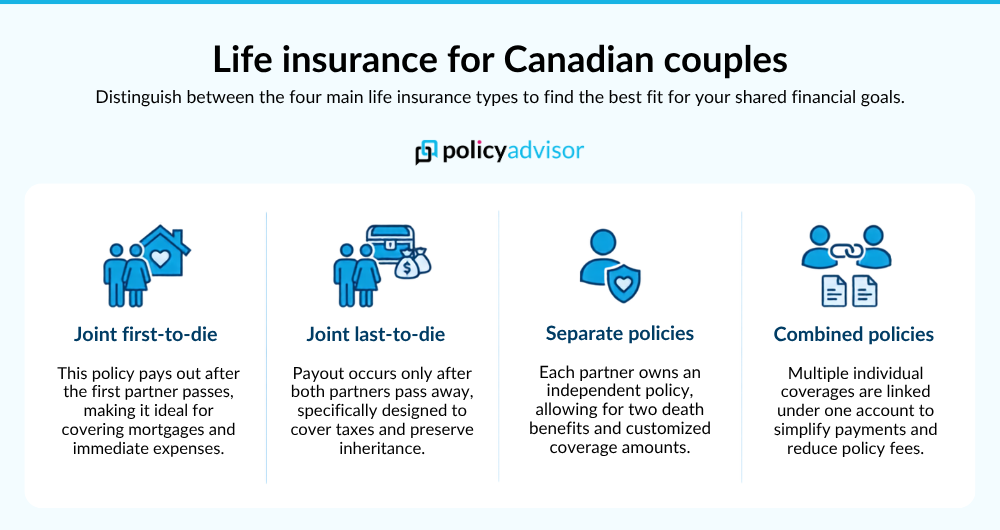
- Joint first-to-die life insurance
- Joint last-to-die (survivorship) life insurance
- Two separate life insurance policies
- Combined or multi-life insurance policy
Here’s a quick overview of the different policy types:
Joint first-to-die life insurance
A joint first-to-die life insurance policy covers two people under a single contract and pays the death benefit after the first insured person passes away. Once the benefit is paid, the policy ends, and the surviving partner no longer has coverage.
Couples commonly choose this option to ensure the surviving spouse has financial protection for living expenses, debts, child care, or mortgage payments. While it is comparatively less expensive than two separate policies, note that joint first-to-die life insurance only provides one death benefit.
Joint last-to-die (survivorship) life insurance
A joint last-to-die policy insures two people under one contract but pays the death benefit only after both insured individuals have passed away. Since the insurer does not pay until the death of both partners, premiums are often lower than buying two separate policies.
This option is great for parents or partners who wish to protect their children and other beneficiaries from debts and to support estate planning and wealth transfer.
Two separate or single life policies for couples
In this case, each spouse owns an individual policy with their own coverage amount, beneficiaries, and policy features. Each policy pays its own death benefit when the insured passes away, offering beneficiaries two separate payouts over time.
This is the most flexible option, working well for couples with different incomes, debts, health conditions, or long-term financial goals. Additionally, separate policies are easier to maintain in the event of a divorce or separation. Since they are not under a joint policy, the individuals continue to be insured without any complications or reassessment.
Combined or multi-life insurance policy
A combined or multi-life insurance policy allows two people to have two coverages within a single insurance contract. It combines features of joint policies while offering personalized and individual solutions under one policy.
Each insured person has their own benefit, but the policy is offered under one application and one premium payment schedule. Beneficiaries receive two death benefits, one for each policyholder. Despite being combined, the death benefits are separate for each individual. Since there are two policies under one contract, couples can save on policy or administration fees, reducing the overall costs.
Comparing life insurance options for couples in Canada
Each policy type has its own series of benefits and features. Separate term insurance for a husband and wife is ideal for families, while joint first-to-die life insurance is ideal for individuals seeking protection for mortgages and other major expenses. Meanwhile, a joint last-to-die policy is well suited for estate planning and creating a legacy.
Here’s a comparison of the major life insurance options available for couples in Canada:
| Feature | Joint first-to-die life insurance | Joint last-to-die (survivorship) life insurance | Two separate life insurance policies | Combined or multi-life insurance policy |
| Who is covered? | Two people under one policy | Two people under one policy | Two people have two separate policies, their own policy | Two individual policies linked under one account |
| When is the death benefit paid? | After the first insured person dies | After both insured individuals have passed away | When each insured person dies, according to their own policy | Single payout based on the policy type |
| Number of payouts | One | One | Two (one per policy) | Two (one per coverage) |
| Policy ends when | After the first claim is paid | After the second insured dies and the claim is paid | Each coverage ends independently according to its terms | Each coverage ends independently according to its terms |
| Best suited for | Income replacement, mortgage protection, and covering shared debts | Estate planning, wealth transfer, and leaving an inheritance | Couples who want flexible, personalized coverage | Couples who want separate coverage with simplified administration |
| Coverage flexibility | Low | Low | High | High |
| Premiums | Often lower than two comparable permanent policies | Often lower than two comparable permanent policies | Based on each individual’s age, health, and coverage needs | Similar to separate policies, though some insurers may offer administrative discounts |
| If one partner dies, does the surviving partner remain insured? | No, the policy ends after the payout. | Yes, but no benefit is paid until the surviving partner also passes away | Yes, the surviving partner’s policy remains active | Yes, the surviving partner’s policy remains active |
It is also worth noting that many insurers offer a conversion or survivor privilege when couples purchase life insurance. This allows the surviving partner to purchase a new individual policy within a short window (usually 30 to 90 days) without undergoing a medical exam or answering new health questions.
When are separate life insurance policies better for couples?
Separate policies can provide greater independence when each person has different insurance needs. It is also great for couples with different incomes, allowing them to customize the policy according to their financial obligations.
Here’s when a separate policy makes sense:
- You need different amounts of insurance: One partner may earn substantially more, carry more debt or have greater financial obligations. Separate policies allow each person to choose a different death benefit that covers their outstanding obligations.
- You need different coverage periods: One partner may have a mortgage that lasts 20 years, while the other has a car loan for 10 years. Separate policies can help couples choose a term that aligns with their obligations
- You want two separate death benefits: If you are a parent who wishes to leave behind a legacy for your children or help manage final costs, separate policies offer a death benefit for each death. This offers greater financial support than a joint policy
- You want independence: Separate policies offer increased flexibility after separation or divorce, allowing individuals to retain their policies without being affected
When does joint or combined life insurance make sense for couples?
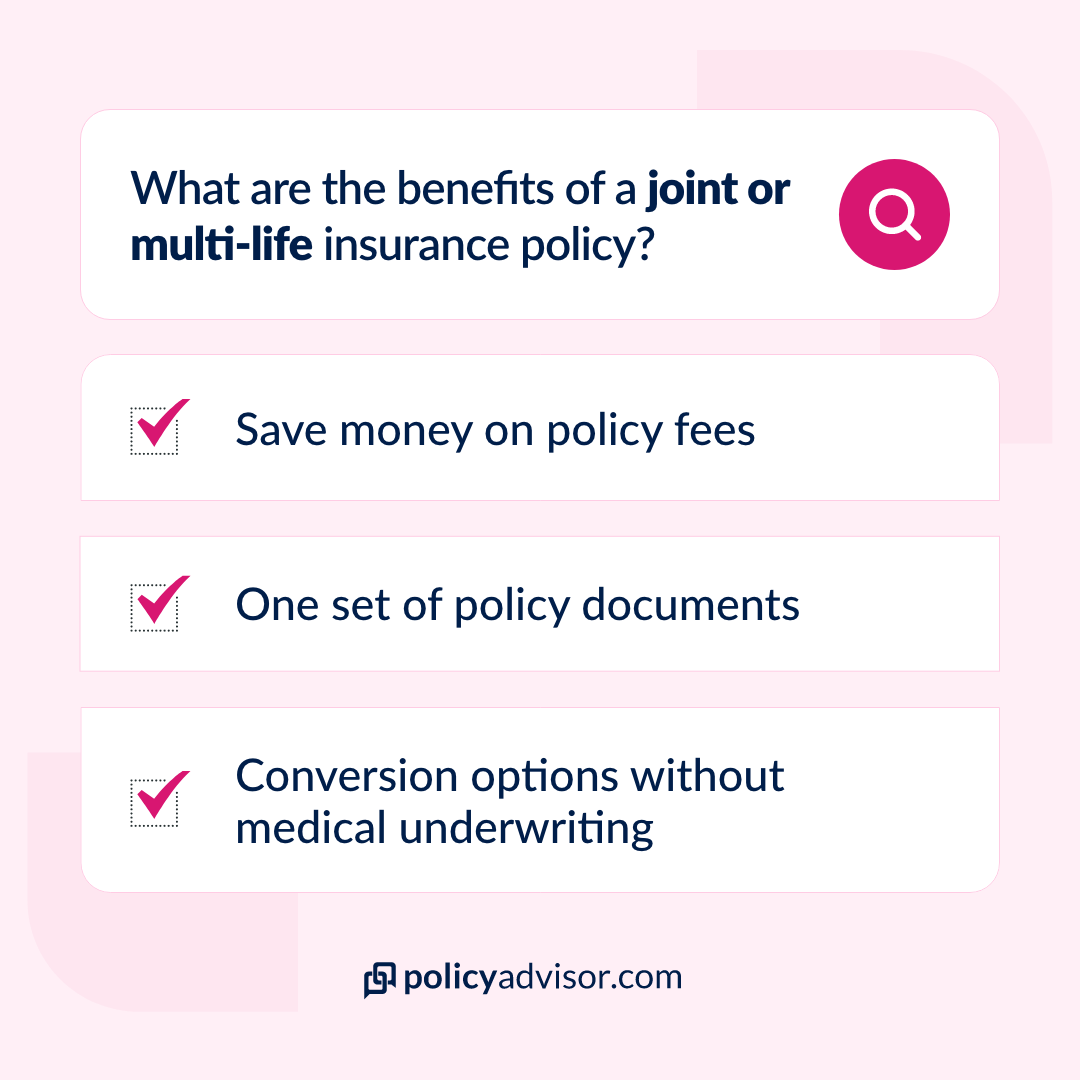
A joint or combined policy can make sense when both partners’ insurance needs are closely connected, or they wish to simplify the process and save on administration fees.
Here’s when a joint policy makes sense:
- You want to protect a shared debt: A joint policy is great if you wish to protect a shared obligation, such as a mortgage or a car loan. The benefit is paid after the first death and may provide the surviving partner with financial support to manage debts or replace household income
- You want one policy to manage: Many insurers allow two coverages to be kept under one contract instead of managing two entirely separate policies, reducing the complexity and paperwork
- You want to reduce policy fees: Many combined or multi-life products can reduce administrative or policy fees when couples purchase a joint policy. Insurers even offer savings on premiums when purchased as a family
What happens to joint life insurance after divorce or separation?
A joint policy cannot automatically be assumed to split into two individual policies following a separation. If a couple separates, they will have to reach out to the insurer regarding splitting the policy and associated administrative processes. Couples purchasing joint coverage should review the policy’s separation or conversion provisions before buying instead of assuming that coverage can always be divided later.
How much does life insurance cost for couples in Canada?
The cost of a life insurance policy for couples in Canada ranges from $224.10 to $615.15. The premiums depend on the plans chosen and the coverage, as well as personal factors such as age, smoking status, and health.
Here is a sample life insurance rate for two 35-year-olds for Term100 from Beneva:
| Feature | Individual life (Male) | Individual life (Female) | Combined/ Multi-life | Joint First to Die | Joint Last to Die |
| Beneva/ Monthly prem | $332.1 | $288.45 | $615.15 | $457.2 | $224.1 |
| Life covered | Single | Single | Both | Both | Both |
| Coverage Amount | 500k | 500k | 500k + 500k | 500k | 500k |
| Saving | – | – | 1% | 26% | 64% |
Cost of life Insurance for couples
Get instant quotes from Canada's top life insurance providers and find the perfect coverage for your family.
Powered by

Should couples buy joint or separate life insurance?
For most Canadian couples, it is recommended to obtain separate life insurance policies, as this allows each partner to customize their coverage and modify riders or terms independently. However, two individual policies for couples could cost as much as $620.55, whereas a joint policy costs as little as $224.1 per month.
Separate policies provide two death benefits and have customised features, making it easier to maintain coverage if the partners divorce or separate. On the other hand, joint policies can be a good option for couples seeking lower premiums or fewer complications.
Pros and cons of purchasing a joint policy for couples
Pros and cons of purchasing individual policies for couples

How much life insurance coverage do couples need?
For many Canadian families, a rule of thumb is to purchase life insurance worth around five to 10 times annual income. However, this is just a baseline and should be adjusted based on your financial situation.
Here are certain things to keep in mind before you decide how much coverage you need:
- Mortgage balance
- Other debts
- Income that would need to be replaced
- Child-care requirements
- Education costs
- Existing savings and investments
- Existing workplace or personal life insurance
Still confused? Use our life insurance calculator to estimate how much coverage you need.
What mistakes to avoid when purchasing life insurance for couples in Canada?
Many couples purchase life insurance to protect their loved ones, but choosing the wrong policy, waiting too long, or having insufficient coverage can leave their family financially vulnerable.
Here are some of the common mistakes you should avoid as a couple while purchasing life insurance in Canada:
- Waiting too long: Many couples postpone buying life insurance until they have children or purchase a home. Purchasing coverage early protects you from higher premiums later on due to age and health conditions
- Buying too little coverage: Some couples choose the lowest premium without considering how much coverage their family would actually need. Ensure the policy amount sufficiently covers debts, future income replacement, and living expenses
- Choosing the wrong type of policy: Many couples automatically choose a joint policy because it appears simpler or less expensive. However, a term life policy or a joint last-to-die policy might offer better estate planning and coverage in certain situations
- Forgetting the Stay-at-Home Partner: Many couples think they only need insurance on the person who earns the most money. If a stay-at-home partner passes away, the surviving partner must pay for child care, cleaning, and cooking.
- Not reviewing coverage after major life events: Many couples forget to review their coverage amount or duration after major events like child birth, starting a business, purchasing a home, or taking on significant debt. This can leave them without sufficient coverage or term in the future.
When should couples in Canada get or review life insurance?
Couples in Canada should get or review life insurance when their circumstances and stages of life change. This can include when you:
- Move in with your partner
- Start a family
- Buy or rent a home
- Start a business
- Take on a new loan or other financial obligation
Apart from this, major financial decisions such as buying a home, becoming parents or taking on additional debt are also good opportunities to review life insurance for married couples or new partners. Since age is an essential factor in evaluating life insurance premiums, purchasing coverage early can help you potentially unlock lower rates.
Can you change or cancel your life insurance policy as a couple in Canada?
Yes, most life insurance policies in Canada can be changed or cancelled. However, your available options depend on the type of policy you own and the rules specific to your insurer and policy. Common changes include increasing coverage, converting term coverage to permanent coverage, or replacing a joint policy with individual policies.
Here are some of the most common changes couples make to their life insurance coverage:
| Option | What it means |
| Increase your coverage | Purchase additional life insurance if your financial responsibilities grow |
| Replace your policy | Switch to a new policy with a different insurer or coverage amount |
| Convert a term policy | Many insurers allow you to convert eligible term life insurance into permanent coverage before a specified age or deadline |
| Replace a joint policy | Couples who have different goals, or who divorce or separate, may replace a joint policy with individual policies |
| Cancel your policy | Stop paying premiums and end your coverage if you no longer need life insurance |
It is also worth noting that many life insurance policies in Canada include a “free-look” period to review and cancel for a refund. As a couple, you should review your life insurance coverage and goals after major life events, such as purchasing property, having children, or planning for retirement. Contact our advisors today for a comprehensive plan based on your needs.
Our advisor’s take on the best life insurance for couples in Canada
At PolicyAdvisor, we recently helped a married couple in their early thirties secure life insurance after purchasing their first home and welcoming their first child. They were seeking coverage to ensure the surviving spouse could continue paying the mortgage, replace lost income, and support their child.
Client profile
- Ages: 32 and 34 years
- Family: Married with one young child
- Primary concern: Income replacement and mortgage protection
- Existing debt: $620,000 mortgage
- Coverage goal: $1.5 million in total life insurance
- Approximate monthly premiums: $332.1 (Male) and $288.45 (Female), respectively
Why we recommended separate term life insurance
- Different coverage needs: Each spouse required a different coverage amount based on their income and financial responsibilities
- Two death benefits: Each policy provides its own death benefit, offering greater financial support
- Conversion option: The policies included the option to convert to permanent life insurance if their long-term financial goals changed
- Affordable coverage: Lower monthly premiums allowed them to get higher coverage without exceeding their budget
How to purchase life insurance for couples in Canada?
PolicyAdvisor’s licensed life insurance advisors can help couples compare life insurance quotes from leading Canadian insurers based on their ages, budget, coverage needs, and financial goals. They can help you estimate your coverage and decide between joint and separate policies.
Whether you are a married couple in Canada, raising a family, or planning your estate, PolicyAdvisor can help you compare quotes and apply online with licensed advisors. We will compare policy types, term lengths, and riders to help you choose the right protection for you and your loved ones.
Frequently Asked Questions
What is the best life insurance for couples in Canada?
For most Canadian couples, two separate term life insurance policies are the best option. They offer better flexibility and allow each partner to choose their own coverage, beneficiaries, and riders with ease.
Is joint life insurance cheaper than separate policies?
Joint life insurance can sometimes have lower premiums than purchasing two comparable individual policies because both partners are insured under a single contract. However, it only pays one death benefit. Once it is paid, coverage ends.
Can common-law couples purchase life insurance together?
Yes, most Canadian insurers allow common-law partners to purchase either separate or joint life insurance policies if they meet the insurer’s eligibility requirements. Coverage options are usually the same as those available to married couples.
Can couples have different coverage amounts?
Yes, if you have separate life insurance policies. Since each policy is its own contract, you can choose to customize it based on your needs. Additionally, you can choose separate beneficiaries.
Can couples buy life insurance online?
Yes, couples can buy life insurance online. Our trusted advisors at PolicyAdvisor can help you compare quotes.
Can we name a minor child as beneficiary?
In most cases, appoint a trustee for any minor’s share so funds can be managed for the child’s benefit until they reach the age of majority in your province.
What if one of the partners has a health condition?
You can consider separate policies so one partner’s health does not influence the other’s pricing or approval. Consider exploring fully underwritten, simplified issue, or guaranteed issue options, depending on your situation.
What happens to joint life insurance after divorce or separation?
This depends on the policy terms and agreement between the policyholders. Some joint life insurance policies can be split into separate policies or transferred to one partner, while others may need to be cancelled.
What happens to joint first-to-die insurance after one partner dies?
Once the first partner passes away, the policy will pay the death benefit and then end. However, some insurers like RBC include a survivor privilege with these policies. Under this, the surviving insured can apply for new coverage within 60 days without providing evidence of insurability.
What is spouse life insurance?
Spouse life insurance generally refers to life insurance that covers your husband, wife, or partner. A spouse in Canada may have their own individual life insurance policy, be covered with their partner under joint life insurance, or be a dependant on an employer group benefits plan.
Is term insurance good for a husband and wife?
Term life insurance can be suitable for married couples seeking coverage for a temporary obligation for a defined period, such as while paying a mortgage or supporting dependent children.
What types of insurance are most common for couples in Canada?
Life insurance for couples in Canada can include two individual policies, joint first-to-die insurance, joint last-to-die insurance, and certain combined or multi-life policies. The right policy depends on your financial needs, income, and flexibility.
Life insurance for couples in Canada can be structured through two separate policies, joint first-to-die or last-to-die coverage, or certain combined/multi-life policies. The right option depends on each partner’s coverage needs, shared financial obligations, budget, and whether the couple wants one shared benefit or separate death benefits.