

 1-888-601-9980

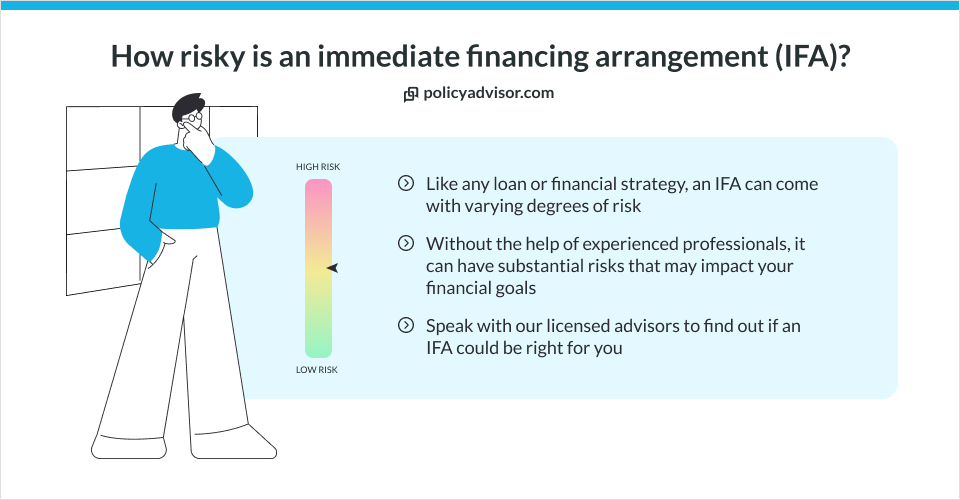
- An immediate financing arrangement can come with some risks, but this is no different than many other insurance or financial strategies
- The possible risks associated with IFA include high loan interest rates, dividend scale fluctuations, tax possibilities, and a few more
- Although an IFA can be risky, it's not necessarily a bad risk; you just have to be careful in your approach or consult a financial advisor
An immediate financing arrangement or IFA can be a convenient strategy for people with high incomes, but there are risks involved. While an IFA can offer liquidity, tax advantages, and long-term wealth benefits, it also has some complexities that may not suit every investor. Keep reading to find out what those risks are and how you can best avoid them.
What is your Whole Life Insurance worth?
Get instant quotes from Canada's top life insurance providers and find the perfect coverage for your family.
Powered by

What are the risks of an immediate financing arrangement?
Some of the biggest risks of using your life insurance policy for an immediate financing arrangement are:
Dividend scale fluctuations in the life insurance policy
Fluctuations in the dividends of a life insurance policy pose risks for an IFA by impacting the policy’s cash value growth. If dividends decrease or fail to meet the current projected dividend scale, the cash value may not accumulate as projected, potentially leading to insufficient funds for future collateral loan drawdowns.
If the dividend scale decreases, the policyholder may also need to fund more premiums out-of-pocket to keep the policy in force and maintain the desired death benefit level. This can strain financial resources and disrupt long-term planning, requiring policyholders to adjust their access to cash flow from the IFA and potentially delay debt repayment strategies.
Growth fluctuations
Most IFAs come with the expectation that your business growth will pay for the interest charges you’re responsible for. The biggest risk arises if you end up having a lower rate of return than expected. If returns aren’t sufficient to cover your interest, you could have out-of-pocket costs for those fees, and that’s financial capital you could have put to better use.
Changing loan interest rates
If interest rates or floating loan rates increase, the bank will pass that on to you. Just like with growth fluctuations, increasing interest could also leave you paying out more than you are bringing in. This can have a fairly significant impact if the interest is being capitalized. Depending on your arrangement, your lender could potentially also ask you to provide additional collateral to make up for the higher interest build-up than the projections.
Change in lender terms
An IFA is offered through a financial institution like a bank or third-party lender, and they can change the terms of the agreement in the future at their discretion.
Lower death benefit
Most IFAs are made to be paid out of your death benefit when you pass. But you should keep an eye on this. Remember, the entire point of life insurance is to give your surviving family a lump sum they can use to offset estate taxes or for anything else. Be careful that the amount deducted from your death benefit proceeds doesn’t leave your family without enough funds for their purposes.
Unexpected changes in your financial situation
A sudden sickness, injury, disability or other unexpected event could impact your ability to earn income and keep up with IFA interest payments or other loan obligations. Some lenders ask for proof of sufficient income to justify the credit every year, and a sudden drop in your income could impact that.
Loss of collateral or assets
Sometimes, a bank or external lender may ask for additional collateral for your IFA agreement with them. If you are unable to pay in the long run, they could acquire those assets entirely.
Fees
Depending on which bank or third-party lender you choose, there may be fees associated with an IFA. You should ask about these upfront and read the agreement’s details to make sure you are aware of any possible charges, late fees, admin fees, etc.
Possible credit impact
When you apply for an IFA, it can appear on your credit report. This may impact your credit score or the creditworthiness of your business, or have other far-reaching implications.
Change in tax laws and CRA interpretations
Tax regulations undergo frequent changes, leading to variations in how loans, interest deductions, and life insurance policies are treated over time. With the General Anti-Avoidance Rules (GAAR) in place, the Canada Revenue Agency (CRA) has the authority to classify a collateral loan as a policy loan, resulting in distinct tax consequences.
Each loan possesses its own distinctive attributes, making it essential for the policyholder to thoroughly assess the reasons behind obtaining a collateral loan. Moreover, given the intricate and ever-evolving nature of the tax landscape, consulting with a tax advisor is strongly recommended before proceeding with the transaction.
Why do people get immediate financing arrangements?
High-income earners in Canada use IFAs as a convenient way to get the benefits of life insurance coverage while also getting liquid assets right away.
It’s especially useful for business owners, private corporations, and other high-net-worth individuals. With an IFA, they can access immediate access to capital without tapping into current income.
Common uses for an IFA
Most people use the proceeds from an IFA for:
- Recouping insurance premium payments
- Estate planning or estate equalization
- Instant cash flow (and the flexibility that affords)
- Business continuity planning
- Real estate purchases
- Investment opportunities
- Small business capital
- Funding a buy-sell agreement
- Other business purposes
In a way, an IFA lets you recoup the amount you paid in premiums, so you can use those funds for revenue-building ventures. You can then use those returns for interest payments on the agreement.
How to avoid immediate financing arrangement risks?
We, as insurance professionals, understand the risks involved with immediate financing arrangements in Canada, even though they can’t be entirely avoided. Having said that, you can certainly mitigate the risks of getting immediate financing. Here are some tips on how to avoid IFA risks:
-
Research and think carefully
An IFA is a great financial strategy that works best when you spend some time mapping out how you want it to work. Start by thinking about the risks that may be involved and if the benefits of an IFA are worth it, based on your circumstances.
-
Work with professionals
For a complex strategy like an IFA, we strongly recommend that you speak with an experienced, licensed professional who can provide expert insurance insights.
Even if you haven’t made up your mind yet, but you’re just thinking about your options, you might want to speak with both your insurance provider and your accountant. They can help you avoid as many risks as possible and make the most informed decision to achieve your goals.
-
Be open to alternative arrangements
IFAs offer attractive benefits, but they’re not for everyone. If an IFA isn’t the best strategy for you, you can look for alternative financial arrangements. A licensed advisor will give you guidance about other products that best fit your needs. There may be other strategies or products you don’t even know about, but that are just what you’re looking for.
-
Understand the fine print
One of the best things about immediate financing arrangements in Canada is the flexibility, in that no two agreements are the same. But you should pay close attention to all of the terms and conditions laid out in your agreement with your lender.
Agreements can vary between lenders and even individuals, so you should make sure you fully understand exactly what you’re getting into before you commit. This is another area where you can rely on expert advice to make sure you clearly understand the details of your loan arrangement.
-
Borrow responsibly
With IFAs, your maximum loan amount is up to 100% of your annual life insurance premiums or the estimated cash surrender value amount stated in your life insurance illustration. This is a significant capacity that can be beneficial for high-net-worth individuals who need a large amount of insurance coverage.
But, remember to find balance. The outstanding loan balance will be deducted from your life insurance proceeds, so it’s best to avoid getting an IFA for an amount so large that it cuts too much into the funds you intend to leave behind for your beneficiaries.
-
Tax documentation
Document the use of funds and maintain tracing for deductibility. Keep invoices/statements, and get a written tax opinion before relying on interest deductions. Review annually as rules change.
Is getting an IFA risky in general?
Yes, an IFA can be a risky and complex financial strategy for the reasons we highlighted in this article. But this is not uncommon. Many financial and insurance strategies come with varying degrees of financial risk.
The more important question is what your risk appetite is like, and where an IFA fits on that scale. This is why we always recommend that you speak with a professional before deciding to start an IFA. An experienced advisor can help you ensure your IFA works as planned and gives you maximum benefits.
Let’s understand this with a case study:
Situation:
Meet Alex, a high-income business owner who wants to provide his family with estate tax protection after his passing, while keeping most of his capital working in the business.
Insurance needs:
Alex chooses a high-value whole life insurance policy for long-term benefit and protection. However, he prefers not to have large annual premiums drain his company’s operating cash.
Risks associated with IFA:
Alex uses an Immediate Financing Arrangement (IFA), borrowing 100% of the premium from a bank using the policy as collateral. This delivers instant liquidity but also has some risks:
- If policy dividends fall short, cash surrender value or CSV may not grow as projected, and the bank could demand additional collateral or limit future loans
- Loan interest rates may increase, raising monthly costs unexpectedly and reducing Alex’s profits
- If lender terms change, Alex may have to post extra collateral or repay part of the loan
- If business revenues fall or Alex’s personal finances change, making loan interest payments can become difficult, risking the forced surrender of the policy
How to mitigate the risks: Here’s how he can mitigate the risks:
- Borrow less than 100% of premiums to deal with fluctuating dividend rates
- Keep a surplus in case the return is lower than expected
- Diversify investments funding interest payments to avoid over-reliance on single returns
- Set a target payoff date for loans to protect the net death benefit
- Use gains to support loan payments, but must closely monitor with a financial advisor to mitigate the risks associated with IFA

Speak with a professional
If you’re thinking about starting an immediate financing arrangement, speak with one of our licensed insurance advisors.
As Canada’s best online insurance broker, we work with more than 30 of Canada’s best life insurance companies. We can help give you tailored guidance about what kind of permanent life insurance policy to use for an IFA or whether that may be the right strategy for your needs.
Frequently asked questions
What is an immediate financing arrangement?
An immediate financing arrangement is a unique insurance strategy where you use a whole life insurance policy as collateral to open a line of credit with a financial institution, such as a bank or lender. You can instantly access up to 100% of the premiums you paid for the insurance policy, or up to 100% of the cash value
What are the risks of an immediate financing arrangement?
An immediate financing arrangement carries risks like rising interest rates, cash value performance falling short of expectations, dividend scale fluctuations, change in lender terms, possible tax liabilities, and a few more.
What’s the maximum amount I can borrow through an IFA?
Immediate financing arrangements let you borrow up to 100%; however, the specific amount will depend on your individual policy details.
An immediate financing arrangement is an advanced strategy that can help business owners, investors, and other high-net-worth individuals put their whole life insurance policy to the best use. But, it’s not for everyone. Without the support of experienced professionals, there are substantial risks that may impact your desired financial outcomes. You could end up leaving less funds behind for loved ones, paying more interest than you intended, and more.