

 1-888-601-9980

- Approved refugees and protected persons can qualify for life insurance in Canada if they meet insurer-specific eligibility and underwriting requirements
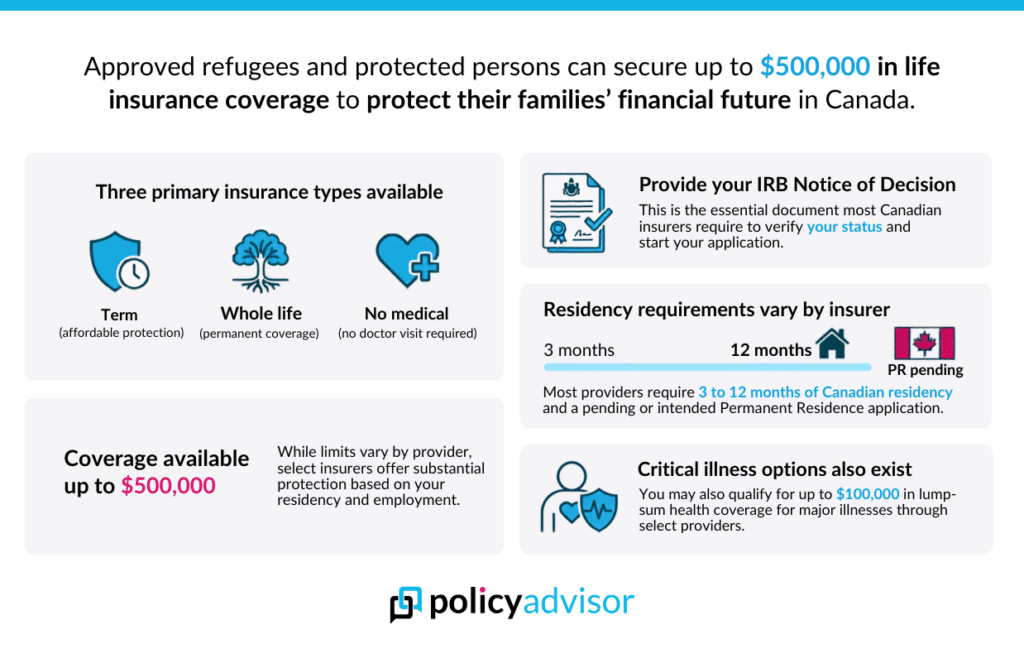
- Coverage of up to $500,000 is available, with eligibility depending on factors like residency, employment, and PR application status
- An IRB Notice of Decision is the key document most insurers require to verify refugee or protected person status
- Critical illness insurance is also available through select insurers
Many refugees and protected persons wonder if they must become Canadian citizens or permanent residents before they can qualify for life insurance. In reality, some Canadian insurers offer coverage to eligible refugees and protected persons, provided certain residency, documentation, and underwriting requirements are met.
Can refugees and protected persons get life insurance in Canada?
Yes, approved refugees and protected persons may be eligible to apply for life insurance in Canada. Some insurers, such as Assumption Life and Beneva, offer coverage if applicants possess a valid Notice of Decision from the Immigration and Refugee Board of Canada (IRB).
Additional factors like minimum residency period, health, age, employment status, and financial circumstances can affect eligibility as well.
Life insurance for refugees and protected persons in Canada: At a glance
| Eligibility | Approved refugees and protected persons may qualify |
| Maximum coverage available | Up to $500,000 with select insurers |
| Key document required | IRB Notice of Decision or proof of protected person status |
| Permanent residence required? | Not always, but some insurers require a PR application or intent to apply |
| Pending refugee claim eligible? | Generally, no. Coverage usually requires an approved decision |
For the purpose of life insurance, this article refers to approved refugees and protected persons who have received a Notice of Decision from the Immigration and Refugee Board of Canada (IRB).
Who is considered a refugee in Canada?
A refugee is any person who has fled their home country and come to Canada because of a well-founded fear of persecution, war, violence, or risk to life. They may arrive through government-assisted programs, privately sponsored resettlement programs, or a refugee claim after arriving in Canada.
Who is considered a protected person in Canada?
A protected person is an individual who has been recognized by Canadian immigration authorities as needing protection because they would face persecution, torture, risk to life, or cruel and unusual treatment if returned to their home country.

Need insurance answers now?
Call 1-888-601-9980 to speak to our licensed advisors right away, or book some time with them below.
What are the eligibility requirements for life insurance for refugees and protected persons in Canada?
Eligibility requirements vary by insurer, but refugees and protected persons generally need to meet the following criteria:
- Time in Canada: Many insurers require applicants to have resided in Canada for a minimum period, typically between 3 and 6 months. Some insurers may require up to 1 year.
- Stable employment: Some insurers require applicants to demonstrate stable employment or a reliable source of income in Canada.
- Permanent residence application: Depending on the insurer, you may need to confirm that you have applied for permanent residence (PR) or intend to apply.
- Underwriting requirements: Like all life insurance applicants, refugees and protected persons must meet the insurer’s medical and financial underwriting requirements.
Documents you need to apply for life insurance as a protected person or refugee in Canada
Depending on the insurer, you may be asked to provide one or more of the following documents:
- Notice of Decision issued by the Immigration and Refugee Board of Canada (IRB)
- Proof that you have applied for permanent residence (PR), if required
- A valid work permit, if applicable
- Government-issued identification
- Medical or financial documents requested during the underwriting process
Note: Eligibility requirements and documentation vary by insurer.
What types of life insurance are available to refugees and protected persons in Canada?
Most refugees and protected persons who meet insurer requirements and have IRB approval may qualify for different types of life insurance, depending on the insurer and the product available. The right policy depends on your financial goals, budget, and coverage needs.
Here are the life insurance options available to refugees and protected persons in Canada:
Term life insurance
Term life insurance provides coverage for a specified period, such as 10, 20, or 30 years. It is often the most affordable option since it offers substantial coverage at relatively low premiums.
Permanent life insurance
Permanent life insurance provides lifelong coverage to the holder as long as premiums are paid. These policies usually include a guaranteed death benefit and may accumulate cash value over time, making them great for long-term financial planning and protection.
Permanent life insurance includes whole life insurance and universal life insurance. Whole life insurance is a popular option since it provides lifelong coverage, a guaranteed death benefit, fixed premiums, and cash value that grows over time. These features make it suitable for long-term financial planning and protecting your family’s financial future.
No medical life insurance
No medical life insurance allows applicants to obtain coverage without completing a medical exam. It is great for those with pre-existing health conditions, individuals seeking a simplified application process, or those who may have difficulty qualifying for traditionally underwritten life insurance.
How much life insurance can a refugee or protected person get?
Refugees and protected persons in Canada can get up to $500,000 in coverage, depending on the insurer and their requirements.
Here’s a quick glance at how much life insurance you can get in Canada as a refugee or a protected person:
| Insurer | Maximum Coverage | Requirements |
| Assumption Life | Up to $250,000 |
|
| Beneva | Up to $250,000 |
|
| Canada Life | Up to $250,000 |
|
| Desjardins | Up to $250,000 |
|
| Empire Life | Up to $250,000 |
|
| Equitable Life | Up to $250,000 |
|
| iA Financial Group | Based on financial underwriting |
|
| Manulife | Up to $250,000 |
|
| RBC Insurance | Up to $500,000 |
|
| Sun Life | Up to $250,000 |
|
Note: Ranges are illustrative. Contact our advisors for a coverage plan tailored to your needs.
Factors affecting life insurance coverage for refugees or protected persons in Canada
The amount of life insurance you can qualify for as a refugee or protected person depends on several factors that help insurers assess your long-term ties to Canada and overall risk profile.
In addition to your Notice of Decision, income, and health, insurers often look at indicators that show your long-term ties to Canada. The following factors can help increase the amount of coverage you qualify for:
- Your occupation and income level: Higher and more stable earnings can support larger coverage amounts, especially for insurers like Assumption Life and iA
- Permanent residence (PR): An active PR application can demonstrate your intention to remain in Canada long-term. It is also mandatory for some insurers, like Equitable Life and Assumption Life
- Residency: Some insurers like Empire Life and Equitable Life require applicants to stay in Canada for at least one year before applying for life insurance, while others have a three- or six-month requirement
Can you qualify for critical illness coverage as a refugee or protected person in Canada?
Yes, you may qualify for critical illness insurance as a refugee or protected person. A limited number of insurers, like Beneva and Canada Life, will offer coverage based on your status and Notice of Decision. Some policies might require additional documentation and requirements for eligibility.
Here’s the maximum critical illness coverage currently available from participating insurers:
| Insurer | Maximum Critical Illness Coverage |
| Beneva | $100,000 |
| Canada Life | $50,000 |
| iA Financial | $100,000 |
| Sun Life | $100,000 |
How much does life insurance cost for a refugee or protected person?
The cost of life insurance for refugees or protected persons can range from $16.11 to $203.76. However, the premium is based on age, coverage amount, duration, and health status.
The sample monthly premiums below are based on a $200,000, 20-year term life insurance policy:
| Age | Premium (Male) | Premium (Female) |
| 25 | $16.11 | $12.96 |
| 35 | $18.00 | $14.40 |
| 45 | $36.45 | $27.27 |
| 55 | $99.18 | $73.80 |
| 65 | $281.34 | $203.76 |
It must be noted that once you are approved, some insurers apply specific rating adjustments to your premium. Discuss with your advisor if it applies to you.
Cost of Life Insurance for refugees and protected persons
Get instant quotes from Canada's top life insurance providers and find the perfect coverage for your family.
Powered by

Why does life insurance matter for refugees and protected persons?
Starting over in Canada often comes with significant financial and personal responsibilities, especially for refugees and protected persons. Since they are focused on securing housing, finding employment, and creating a life, a life insurance policy can act as a safety net if the policyholder passes away unexpectedly.
Here’s why life insurance matters for refugees and protected persons in Canada:
- Supporting family members: Many refugees arrive in Canada with spouses or family members, hoping to build a new life. A life insurance policy ensures they continue to receive financial support even if the policyholder passes away
- Protection from financial setbacks: Refugees and protected persons face major expenses due to housing, transportation, and settlement costs. A policy can help cover outstanding debts and protect surviving members from financial burdens
- Funeral and final expenses: A funeral in Canada costs an average of about $9,150 and can run as high as $20,000. A life insurance payout can cover these costs directly.
- Locking in lower premiums: Buying life insurance earlier can help you secure lower rates and maintain affordable coverage as your financial responsibilities grow.
Why do life insurance applications for refugees in Canada get declined or delayed?
While refugees and protected persons can qualify for life insurance in Canada, applications may be delayed, restricted, or declined if certain residency, immigration, or underwriting requirements are not met.
Here’s an overview of major reasons why life insurance applications for refugees and protected persons get declined or delayed:
| Reason | What it means | Potential impact |
| Insufficient time living in Canada | Many insurers require applicants to have lived in Canada for a minimum period before considering an application. | Application may be postponed until the residency requirement is met. |
| Refugee or protected person status cannot be verified | Required immigration documents, such as an IRB Notice of Decision, cannot be verified or are missing. | Application may be delayed or declined. |
| No permanent residence (PR) application on file | Some insurers require proof of a PR application or intent to apply. | Coverage may not be available until the requirement is met. |
| Full-time employment requirement not met | Some insurers require applicants to have stable full-time employment and income. | Coverage may be postponed or declined. |
| Missing or incomplete documentation | Required immigration, identity, employment, or financial documents are incomplete or unavailable. | Additional document requests and longer underwriting times. |
How to purchase life insurance as a refugee or protected person in Canada?
PolicyAdvisor’s licensed advisors can help refugees and protected persons find the right life insurance policy by comparing coverage amounts, eligibility requirements, and insurer guidelines based on their unique circumstances. Our advisors can also help you compare quotes from leading Canadian insurers and help you understand how factors such as your immigration status, income, and time in Canada may affect your coverage options.
Whether you’re a new refugee or an approved protected person in Canada, our team can guide you through the application process and help you choose a policy that satisfies your financial goals and family needs.
Frequently Asked Questions
Do I need permanent resident status to get life insurance?
Not always. Some insurers offer coverage to eligible non-permanent residents, including refugees and protected persons who do not yet have permanent resident status, provided they meet the insurer’s underwriting requirements.
Which life insurance companies offer coverage to refugees and protected persons?
Many insurers, such as Assumption Life, Beneva, Canada Life, Manulife, Sun Life, Desjardins, etc., offer coverage to refugees and protected persons as long as applicants meet the eligibility requirements. Coverage and eligibility requirements vary by insurer.
Can refugees buy life insurance in Canada?
Yes, refugees can buy life insurance in Canada if they have a valid Notice of Decision from the Immigration and Refugee Board of Canada (IRB) and meet the insurer’s other eligibility requirements.
How long do I need to live in Canada before applying for life insurance?
Requirements vary by insurer. Many insurers require applicants to have lived in Canada for at least 3 to 6 months, while some require a 1-year of residence before they will consider an application.
Do I need a Canadian job to get life insurance as a refugee or protected person?
Not always. Some insurers, such as Assumption Life and Empire Life, require applicants to be employed full-time to qualify for life insurance. Other insurers may not require full-time employment but will still consider your employment and income during the underwriting process.
Learn how refugees and protected persons can qualify for life insurance in Canada. This guide explains eligibility requirements, required documents, coverage amounts of up to $500,000, insurer-specific rules, costs, and common reasons applications are delayed or declined. Compare life insurance options and find the right coverage to protect your family’s financial future.