1-888-601-9980


- Critical illness insurance pays a lump sum when you are diagnosed with a covered condition
- Disability insurance provides recurring income-replacement benefits when an illness or injury causes you to meet the policy's definition of disability
- Disability insurance can cover a broader range of health conditions because eligibility generally depends on your ability to work rather than a specific diagnosis
- You may qualify for both CI and DI benefits from the same health event if you independently meet each policy's claim requirements
Critical illness insurance and disability insurance are both types of living benefits that can provide financial protection if your health changes. Critical Illness insurance provides a lump-sum payment if you are diagnosed with a covered illness. At the same time, Disability Insurance offers monthly payments when a covered illness affects your ability to work.
While both offer benefits if you are affected, they work differently and address different financial risks.

Need insurance answers now?
Call 1-888-601-9980 to speak to our licensed advisors right away, or book some time with them below.
What is the difference between critical illness insurance and disability insurance in Canada?
Critical illness insurance and disability insurance can both help protect your finances if your health changes, but they work differently. Critical illness insurance offers financial protection if you are diagnosed with a covered critical illness, while disability insurance offers monthly payments if a disability prevents you from working.
Here is a detailed comparison of critical illness insurance and disability insurance in Canada:
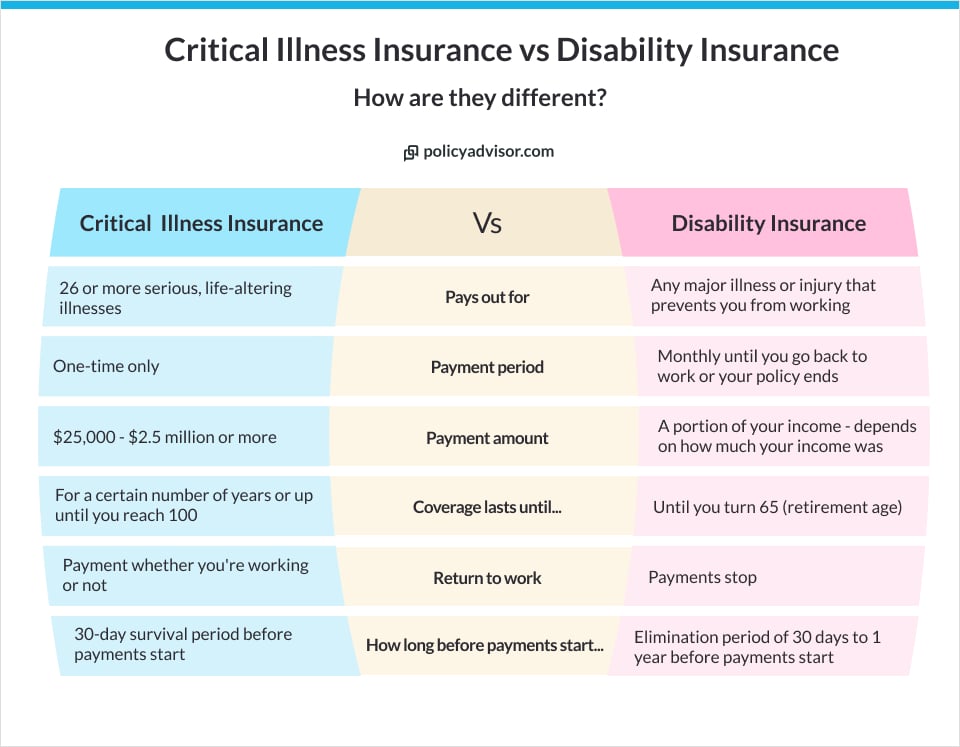
| Aspects | Disability Insurance | Critical Illness Insurance |
| Primary purpose | Replace part of your income when a disability affects your ability to work | Provide additional funds following a covered serious illness |
| Claim event(s) | Any covered illness or injury that leads to a loss of income | Diagnosis of a covered life-threatening illness or condition (severe disability may be included) |
| Covered conditions | Any covered medical condition that would prevent you from working, including:
|
26+ common conditions, including:
|
| Benefit amount (how much your payout would be) | Replaces a part of your monthly income | $25,000 to $2.5 million or more, depending on your policy |
| Payment frequency | Monthly payments | One lump-sum payment |
| Benefit duration | Continues during the disability, up to the policy’s benefit period | Generally paid once for a covered claim |
| Coverage term | Most LTD policies end when you turn 65 | Often to age 75 or 100, depending on the insurer |
| Ability to work | Monthly payments stop once you return to work (although partial payments may be available) | You may still qualify even if you continue working |
| Period before benefits begin | Waiting period (or elimination period) of 30 days to 1 year | Survival period of 30 days |
| Income replacement | Meant for ongoing income replacement | Not meant as income replacement, but can help |
| Tax status | Tax-free if paid personally. Employer-paid disability benefits will be subject to income taxes | Benefits from a personally owned CI policy are generally received tax-free in Canada. |
What is a critical illness insurance policy in Canada?
Critical illness insurance (CI) is a type of insurance that provides a lump-sum payment when you are diagnosed with a covered serious illness and satisfy the policy’s claim requirements. The benefit is called a living benefit, since it does not depend on your recovery. Once the insurer confirms that you have a covered illness or have experienced a covered medical event, it pays the benefit.
Depending on the policy terms, some insurers may impose a waiting period before the policyholder is eligible for a payout. This survival period is typically 30 days after the diagnosis, requiring policyholders to survive for the specified period before the critical illness benefit becomes payable. Unlike disability insurance, your ability to continue working does not determine whether a claim is payable.
Essentially, you can continue working and still receive your CI benefit. Additionally, many Canadian insurers also offer an optional Return of Premium (ROP) rider, which can refund up to 100% of the premiums paid if the policy ends without a claim.
Here is a quick overview of critical illness insurance in Canada:
| Feature | Critical illness insurance |
| Benefit amount | $25,000 to $2.5 million or more, depending on the coverage amount selected with your insurer |
| Payment | One-time, tax-free lump-sum benefit. Some insurers may allow multiple claims in specific circumstances, for instance, if you get the same serious illness twice after a period of time |
| Survival period | Typically requires the policyholder to survive for at least 30 days after diagnosis of a covered condition for the insurer to pay you |
| How the benefit can be used | Payout can be used in any manner, including:
|
What does critical illness insurance cover?
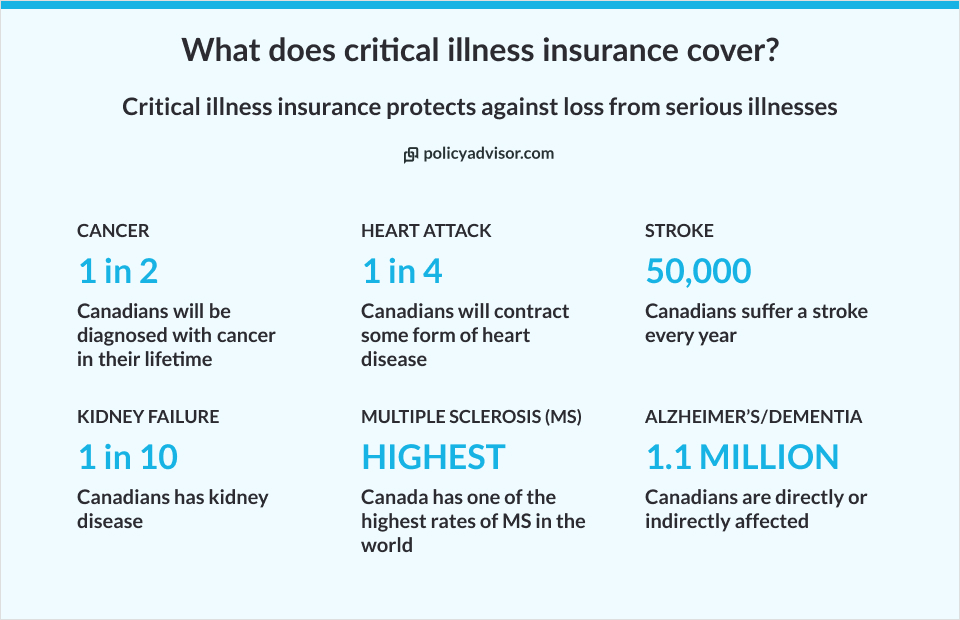
Critical illness insurance will typically cover 26 or more types of diseases in Canada, like cancer, heart attack, kidney failure, and more. In some cases, a condition that causes a disability may also qualify as a covered critical illness. For example, blindness and paralysis are disabilities that may also be included among the covered critical illness conditions.
Depending on the policy, commonly covered conditions may include:
- Life-threatening cancer
- Heart attack
- Stroke
- Kidney failure
- Multiple sclerosis
- Major organ transplant
- Coronary Artery Bypass
- Paralysis
- ALS
- Parkinson’s
- Dementia/Alzheimer’s
- Severe burns
Is critical illness insurance covered in health insurance?
No, critical illness insurance is not included in health insurance plans and must be purchased separately. Standard health insurance in Canada covers medical treatments, prescriptions, and other medically necessary physician and hospital services. Meanwhile, Critical illness covers costs that are not typically addressed by health insurance, such as lost income, home modifications, or experimental treatments.
What is disability insurance in Canada?
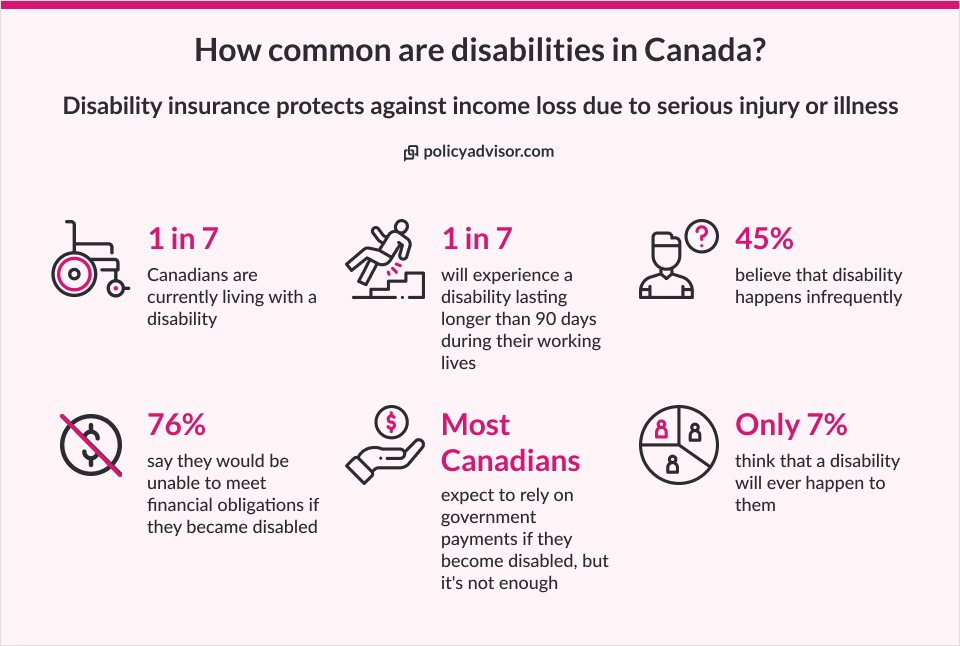
Disability insurance is a type of insurance in Canada that provides recurring income-replacement benefits if an eligible illness or injury causes you to meet the policy’s definition of disability and affects your ability to work. It is primarily meant to replace lost income and provide financial stability to the policyholder.
Rather than paying a large one-time amount like Critical Illness insurance, disability insurance is designed primarily to replace part of the income the policyholder would otherwise earn while working. There are two broad types of disability insurance in Canada:
- Short-term disability insurance: Provides benefits for shorter periods following an eligible disability
- Long-term disability insurance: Provides benefits for longer-lasting disabilities, potentially for several years or to a specified age
The maximum disability benefit you can get depends on factors such as your income, occupation, and the insurer’s coverage limits.
Here is a quick overview of disability insurance in Canada:
| Feature | Disability insurance |
| Benefit amount | Based on monthly income and the coverage amount selected, typically ranging between 60 to 85% of pre-disability earnings |
| Payment | Monthly payments that generally continue while you remain disabled, up to the end of the policy’s benefit period |
| Waiting period | Waiting period of 30 days to 1 year or more (your disability must last longer than this period before your insurance payments can begin) |
| How the benefit can be used | Payout can be used in any manner, including:
|
What does disability insurance cover?
A disability insurance policy can cover injuries or illnesses that prevent you from working, subject to policy definitions and exclusions. Depending on the policy, it may include:
- Musculoskeletal conditions
- Injury or poisoning
- Serious illnesses like asthma, COPD, and Parkinson’s disease
- Mental health conditions
- Other medical conditions that affect your ability to perform your work
Unlike critical illness insurance, which relies on a fixed list of health conditions and diagnoses, disability insurance evaluates how a medical condition affects the policyholder’s ability to work. If your condition satisfies the insurer’s definition of disability, you receive monthly payments during the benefit period.
Does disability insurance cover mental health conditions?
Disability insurance commonly provides coverage for qualifying mental health conditions, such as depression and anxiety, when they meet the policy’s definition of disability and prevent the policyholder from working. On the other hand, critical illness insurance generally does not cover mental health conditions, since benefits are limited to the specific illness and conditions listed in the policy.
Do I need both disability and critical illness insurance?
Yes, you need both disability insurance and critical illness insurance because they cover two completely different financial risks.
When critical illness insurance may pay but disability insurance may not:
Events such as a qualifying cancer diagnosis or a stroke may trigger a Critical Illness benefit without necessarily meeting a disability insurance requirement.
Since the applicant can still work and perform their job, the disability insurance benefit is not paid, even if a critical illness insurance payout is triggered.
When disability insurance may pay but critical illness insurance may not
A diagnosis of depression, migraines, or fibromyalgia may prevent you from performing your job, triggering a disability insurance benefit.
Even if a medical condition triggers a disability insurance payout, it might not trigger a critical illness insurance payout. The illness or its severity might not be covered under the list of CI eligibility, preventing benefits from being paid.
Can you claim both Critical Illness Insurance and Disability Insurance for the same illness or injury?
Yes, if you have both policies and the same medical event meets each policy’s claim eligibility, you may receive a critical illness lump-sum benefit, while also receiving monthly disability insurance payments. The two benefits can be in force at the same time, since they provide different financial protection.
Critical illness vs disability insurance: Which one should you choose?
If you can afford both, critical illness and disability insurance can work together to protect different financial needs, such as income replacement and coverage during critical illnesses. However, if your budget does not allow you to purchase both types of coverage, consider which event would create the greater financial burden for you and your family.
When disability insurance may be worth it
Disability insurance is worth it for most income earners, especially sole earners or self-employed, and if:
- Your household relies heavily on your employment income
- You are the sole or primary income earner
- You have little or no long-term disability insurance through work
- You have limited paid sick leave
- You have limited emergency savings
When critical illness insurance may be worth it
Critical illness insurance may be particularly useful if you lack emergency savings, have dependants, or if:
- You already have strong disability coverage through your employer
- You want funds available for large expenses following a serious diagnosis
- You have significant mortgage or debt obligations
- You have income protection but limited savings for unexpected large expenses
Are critical illness and disability insurance offered as a part of group benefits?
Yes, some Canadian employers offer disability insurance and critical illness insurance as part of group benefits plans. However, the type and amount of coverage are generally lower than those of individual insurance plans. Group plans typically offer 60-70% of the salary, while individual policies may pay as much as 85% of the pre-disability income. Group plans also offer less flexibility, while personal plans can be customized for each individual. Additionally, an individual plan remains in force even if you change employers, offering you extended coverage during the gap period.
Where can I compare critical illness and disability insurance quotes in Canada?
PolicyAdvisor’s licensed advisors can help you compare critical illness and disability insurance quotes from leading Canadian insurers based on your age, income, health, budget, coverage needs, and financial goals.
Whether you want lump-sum benefits after a critical illness or income replacement after a disability, our advisors at PolicyAdvisor can help you compare coverage amounts, benefits, waiting periods, and policy features to find the right fit for you and your family.
Frequently Asked Questions
Which is cheaper: disability coverage or critical illness coverage?
Neither disability insurance nor critical illness insurance is always cheaper, as premiums depend on factors such as age, health, occupation, coverage amount, policy features, and optional riders. Both policies serve duif
Does critical illness insurance cover disability?
Critical illness insurance does not cover disability in the same way disability insurance does. Certain disabilities may be triggers for a critical illness policy, but they do not trigger a payout unless they meet the specific definition in the policy.
Is it better to get disability or critical illness insurance?
It really depends on your needs. Both types of insurance policies serve different needs in different ways, so there is no answer as to which one is “better” to get. The right policy depends on your financial needs and the type of protection you are seeking.
Does disability insurance cover cancer?
Disability insurance may provide benefits if cancer prevents you from working and your condition satisfies the policy’s definition of disability.
Can critical illness insurance pay if I am still working?
Yes, critical illness insurance can still pay if you are working. As long as the covered illness satisfies the insurer’s definition, the policyholder will receive the payout, regardless of whether they are working.
Do I need personal disability insurance if I have coverage through work?
It depends. If you want higher coverage amounts or more customization to suit your needs, an individual policy may offer more flexibility and options than group or employer-sponsored insurance.
Is it better to get disability or critical illness insurance?
The better option depends on your coverage needs. People in high-risk jobs may prioritize disability insurance, while those with strong disability coverage through an employer or union may choose an individual critical illness policy for additional protection.
Critical illness insurance provides a lump-sum payment when you are diagnosed with a covered condition and meet the policy requirements, while disability insurance replaces part of your income when an illness or injury prevents you from working.