1-888-601-9980


- Standard term life insurance does not cover disability or replace your income if you become unable to work
- You can include disability riders to your life insurance policy that can add limited protection against disability
- Disability riders and disability insurance are not the same; riders provide specific benefits tied to the life insurance policy
- Having both term life and disability insurance can protect your family after your death and your income during your working years
If you become disabled and can no longer work, term life insurance will not replace your lost income. Term life insurance pays a death benefit to your beneficiaries, while disability insurance provides monthly income benefits if an illness or injury prevents you from working. Understanding these options can help you determine whether your existing coverage is enough to protect your income.
Understanding disability and term life insurance
Term life insurance and disability insurance protect against two different financial risks. Term life insurance can help your loved ones manage financial obligations such as a mortgage, debts, and living expenses after your death.
Disability insurance, on the other hand, helps you maintain your financial commitments while you are alive but unable to earn your regular income. It works as income protection insurance. While both policies can be tailored to your financial needs, they differ in their coverage periods, benefit triggers, and payout structures.
Does term life insurance cover disability?
Term life insurance does not cover you if you are dealing with long-term disability, as the policyholder has to be deceased before the death benefit can be paid. However, some life insurance companies in Canada offer optional disability riders. These life insurance riders can be added to your coverage at the time of application and provide options and coverage for the future, should you find yourself dealing with disability. The disability riders, however, are available at additional premiums.
Disability waiver of premium rider
Under this rider, life insurance premiums are waived if the life insured suffers a total disability. A total disability waiver of premium covers disabilities caused by accidents as well as illnesses. To claim under this rider, the life insured must:
- Not be able to perform essential duties of their occupation
- Not be engaged in any other occupation
- Need ongoing medical care, depending on the policy wording
Generally, disability waiver riders only pay out after the individual has been totally disabled for at least 4 or 6 consecutive months. The rider is valid until a certain age of the person to be insured, most often up to the age of 60 or 65.
Disability income rider
A disability income rider provides monthly payments to the life insured in the event they become disabled and unable to work. The policyholder will need to choose the time period for which the payments are to be made and the monthly payment (which is usually capped). This rider typically has a 30- or 90-day waiting period, with retrospective payments that start after the waiting period is over.
Disability credit rider
A disability credit rider covers all or part of the life insured’s line of credit or monthly mortgage payments in the event of their temporary or permanent disability. The payments are made for a specified period of time, such as 2 years from disability, 5 years from disability, or up to the age of 65. Credit riders typically have a waiting period of 90 days, although they can be retroactive to 31 days in the event of disability from an accident. Proof of the outstanding loan is usually required at the time of the claim.
What is an extreme disability benefit?
An extreme disability benefit is a built-in feature that lets you access a portion of your life insurance death benefit while you are still alive and experience a permanent and severe disability that meets the insurer’s definition. Instead of waiting for the life insurance policy to pay after your death, you can receive part of the benefit early to help manage significant expenses associated with your disability.
Both Beneva and Assumption Life offer an extreme disability benefit with their life insurance policies. Beneva includes the benefit and provides an advance of up to 50% of the initial insurance amount, subject to a $250,000 maximum, if the insured remains extremely disabled for six consecutive months. Assumption Life also offers an advance of up to 50% of the insured amount. The maximum benefit is $250,000 for insureds aged 18 to 59 and $125,000 for those aged 60 to 70.
Standalone disability insurance vs. disability insurance riders
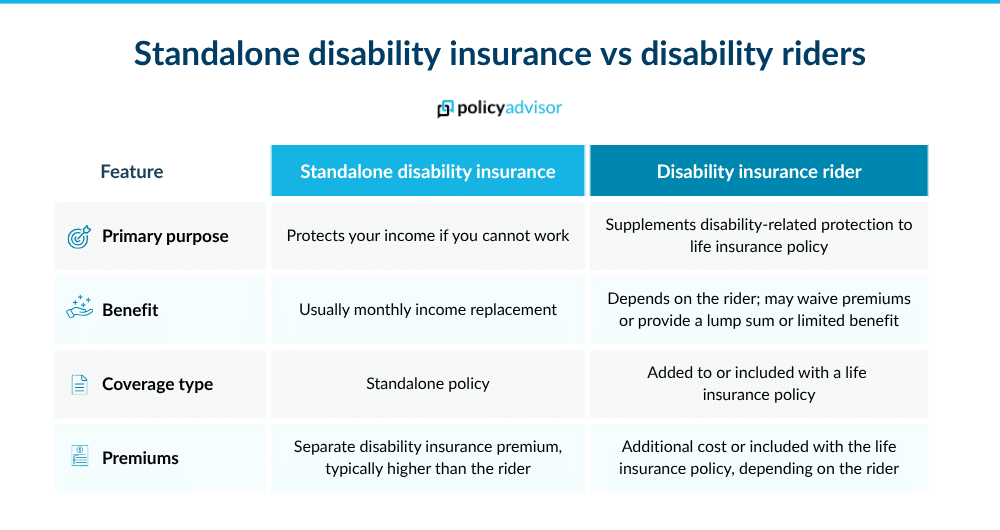
The main difference between disability insurance and a disability insurance rider is that disability insurance is a standalone policy, while a disability insurance rider is an optional feature attached to a life insurance policy.
Life insurance companies offering disability riders in Canada
Examples of insurers that offer these riders include:
- Disability waiver of premium rider: Assumption Life, Beneva, Canada Life, Empire Life, Manulife, Wawanesa, and a few other insurers offer disability waiver of premium riders. Most of these insurers have a 4-6 month waiting period
- Disability income rider: Assumption Life offers a disability income rider. It provides an income benefit of up to $3,500 per month, subject to policy limits
- Disability credit rider: Beneva, Empire Life, and iA are the top companies offering this rider
What if your term life insurance policy doesn’t offer a disability rider?
Listed below are the options available if your term life insurance doesn’t offer a disability rider:
- Buy standalone disability insurance: A separate disability insurance policy is the most direct way to replace lost income during a disability
- Add a rider later: Some insurers may allow certain riders after issue, but often require new medical evidence, age eligibility, and insurer approval
- Switch policies: You may be able to apply for a new policy with the rider you want, then replace the old one if the new coverage is approved and in force
What should I choose between disability vs life insurance?
Comparing disability insurance with life insurance is not quite an apples-to-apples comparison. Both are valuable protection products with very different use cases, and each can shield you or your loved ones from financial hardship.
Choose disability insurance if:
- You need protection when illness or injury prevents you from working
- Your family relies on your regular income
- Your employer provides little or no disability protection
Choose life insurance if:
- Your family would need financial support if you pass away
- You want to help cover a mortgage, loans, or other liabilities after your death
Instead of choosing between them, we would recommend having both. You can have both disability and life insurance to protect your income during your lifetime and your loved ones after your death.
Why is a standalone disability policy the better choice for income protection?
A standalone disability insurance policy is generally a better choice for income protection because it is specifically designed to replace a portion of your income if an illness or injury prevents you from working. Disability riders, on the other hand, usually provide more limited protection and may only waive life insurance premiums or provide a specific lump-sum or monthly benefit.
A standalone disability policy can provide ongoing monthly payments for a longer period, helping you cover essential expenses and everyday living costs while you are unable to work. With a standalone policy, you can also choose coverage based on your income, occupation, waiting period, and benefit period, making it more adaptable to your financial needs.
What happens to your term life insurance if you become disabled?
Becoming disabled does not normally affect or cancel your term life insurance policy. As long as you continue paying your premiums and meet the policy’s requirements, your life insurance coverage generally remains in force.
If your policy includes a qualifying waiver-of-premium rider, you may be able to stop paying premiums while disabled without losing your coverage. Without such a rider, you would still be responsible for paying your life insurance premiums even if your disability prevents you from working.
How to buy disability and term life insurance in Canada?
Our advisors can help you compare term life insurance and disability insurance based on your income, financial responsibilities, existing coverage, and protection needs. They can also help you understand the differences between standalone disability coverage and disability riders available with life insurance.
With PolicyAdvisor, you can compare quotes from leading Canadian insurers and get expert guidance on choosing the right coverage for your situation. This can help you build a combination of life and disability insurance that protects both your family and your income. Schedule a call to get started!

Need insurance answers now?
Call 1-888-601-9980 to speak to our licensed advisors right away, or book some time with them below.
Frequently asked questions
Does term life insurance cover disability in Canada?
No, standard term life insurance does not provide income replacement if you become disabled. It pays a death benefit if you die while the policy is active. Some policies may offer disability-related riders for additional protection.
Is a disability rider the same as disability insurance?
No, a disability rider and disability insurance are not the same. A disability rider provides a specific benefit attached to a life insurance policy, while standalone disability insurance is designed primarily to replace a portion of your income when you cannot work because of a qualifying illness or injury.
Can you add disability coverage to a term life insurance policy?
Some insurers offer disability-related riders that can be added to a life insurance policy. Depending on the rider, it may waive premiums, provide a limited benefit, or allow you to access part of your death benefit after a qualifying disability.
Does a disability waiver of premium rider replace your income?
No, a disability waiver of premium does not replace your income. A waiver of premium rider generally helps keep your life insurance policy active by waiving premiums during a qualifying disability. It does not normally provide monthly income replacement.
Is disability insurance worth it if I already have life insurance?
Yes, having disability insurance is worth it even if you have a life insurance policy. This is because life insurance does not normally protect your income while you are alive and disabled. If losing your ability to work would create financial difficulties, disability insurance can provide an additional layer of protection.
Can self-employed Canadians get disability insurance?
Yes, self-employed individuals can purchase individual disability insurance to protect their income. This can be particularly important if they do not have access to employer-sponsored disability benefits.
What should you check before relying on a disability rider?
Review the definition of disability, waiting period, benefit cap, expiry age, exclusions, and whether benefits are paid monthly, as a lump sum, or through waived premiums. Doing so will help you get adequate coverage through disability riders.
Term life insurance does not cover disability or replace your income if you become unable to work. However, some policies offer disability-related riders, such as waiver of premium, disability income rider, or disability credit rider. Learn how these riders work, how they differ from standalone disability insurance, and why having both policies may provide more complete financial protection.