

 1-888-601-9980

- Canada's top dividend-paying whole life insurance providers include Equitable Life (6.40%), Manulife and iA (6.35%), Empire Life (6.00%), RBC Insurance (6.30%), Sun Life (6.25%), and Canada Life (6.00%)
- Dividend-paying whole life insurance policies offer guaranteed lifetime coverage, guaranteed cash value, and the potential to receive annual, non-guaranteed dividends from the insurer's participating account
- Policyholders can use annual dividends to buy paid-up additions, reduce premiums, earn interest, withdraw cash, or repay policy loans
- When comparing dividend-paying insurers, evaluate dividend history, participating account performance, financial strength, policy flexibility, and dividend options
The best dividend-paying whole life insurance companies in Canada for 2026 include Equitable Life, Manulife, iA, Sun Life, Canada Life, RBC Insurance, and Empire Life. These insurers offer participating whole life insurance policies that provide lifelong coverage, guaranteed cash value growth, and the potential to earn annual dividends. These companies have maintained relatively stable dividend scale interest rates (DSIRs) over the years, ranging from 5.75% to 6.40%. The dividend scale interest rate (DSIR) is an important measure of a participating policy’s performance, but it should not be the only factor you compare.
What is your Whole Life Insurance worth?
Get instant quotes from Canada's top life insurance providers and find the perfect coverage for your family.
Powered by

What is dividend paying whole life insurance?
Dividend-paying whole life insurance, also known as participating whole life insurance, is a type of permanent life insurance that provides lifelong coverage, guaranteed cash value growth, and the opportunity to receive annual dividends. These dividends in whole life insurance are not guaranteed and are based on the performance of the insurer’s participating account.
Who should consider dividend-paying whole life insurance?
Dividend-paying whole life insurance may be suitable for:
- Individuals looking for lifelong financial protection
- Families planning to leave a tax-efficient inheritance
- Business owners and high-net-worth individuals focused on long-term estate or succession planning
- Canadians who want guaranteed coverage with the potential for additional policy value through dividends
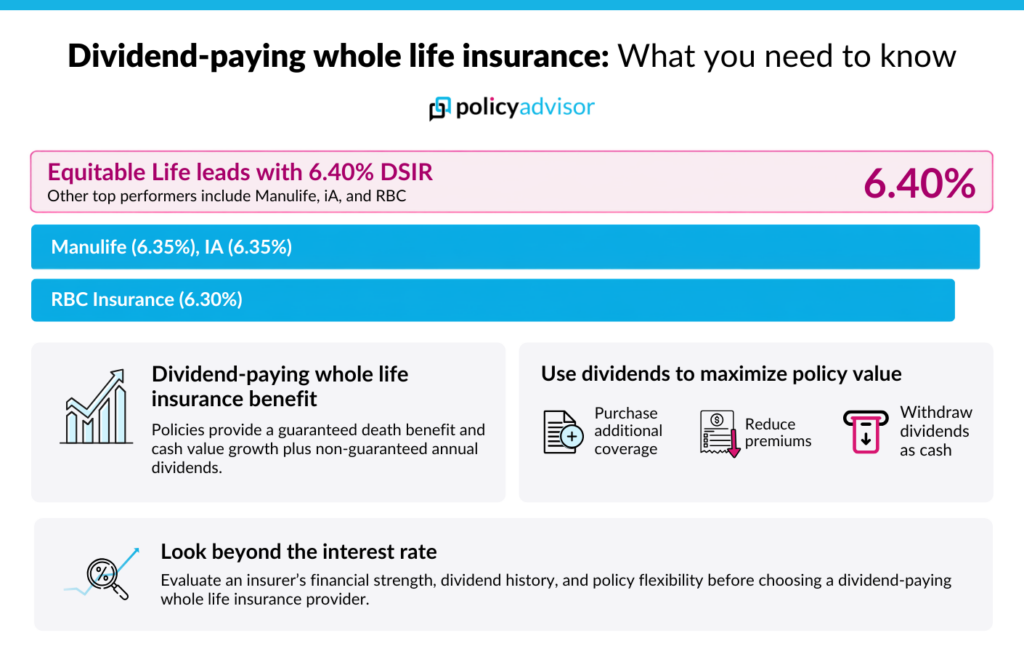
Which is the best dividend-paying whole life insurance company in Canada?
Equitable Life, Manulife, iA, RBC Insurance, Sun Life, Empire Life, and Canada Life are among the best dividend paying whole life insurance companies in Canada for 2026. These insurers are categorized as the best based on factors such as their participating whole life products, dividend scale interest rates (DSIRs), financial strength, participating account performance, policy flexibility, cash value growth potential, and reputation for long-term stability.
Dividend scale interest rates of Canada’s top participating whole life insurers (2026)
| Insurance company | Participating plans | Current dividend scale interest rate |
| Equitable Life | Equimax Estate Builder, Equimax Wealth Accumulator | 6.40% |
| Manulife | Manulife Par, Manulife Par with Vitality Plus™ | 6.35% |
| Industrial Alliance (iA) | iA Participating Life Insurance (iA PAR) | 6.35% |
| RBC Insurance | RBC Growth Insurance, RBC Growth Insurance Plus | 6.30% |
| Sun Life | Sun Par Protector II, Sun Par Accumulator, and Sun Par Accelerator | 6.25% |
| Empire Life | EstateMax, Optimax Wealth | 6.25% |
| Canada Life | Wealth Select, Estate Select | 6.00% |
*Note: Dividend rates are not guaranteed and may change annually. Always confirm the current dividend scale interest rate with the insurer or your advisor.
Equitable Life
Equitable Life is a mutual insurance company, meaning it’s owned by its participating policyholders, which can influence its dividend distribution. Its participating whole life insurance plan is popularly known as Equimax and has two variations: Estate Builder and Wealth Accumulator, designed to support different long-term financial goals. Equitable Life has consistently maintained one of the highest dividend scale interest rates (DSIRs) among Canadian participating insurers in recent years.
Quick overview:
- Participating whole life insurance plans: Equimax Estate Builder, Equimax Wealth Accumulator
- Dividend scale interest rate: 6.40%
- Participating account fund size: $3.32 billion
- AM Best financial strength rating: A
- Premium payment options: 10-pay, 20-pay, and pay to 100 options
Manulife
Manulife is one of Canada’s largest life insurers and offers Manulife Par, a participating whole life insurance plan that provides guaranteed lifetime coverage, cash value growth, and the potential to receive annual, non-guaranteed dividends. It also offers Manulife Par with Vitality Plus™, which combines a participating whole life insurance plan with the Manulife Vitality wellness program, allowing policyholders to earn rewards and discounts for healthy lifestyle choices while benefiting from other features.
Quick overview:
- Participating whole life insurance plans: Manulife Par, Manulife Par with Vitality Plus™
- Dividend scale interest rate: 6.35%
- Participating account fund size: $15.98 billion
- AM Best financial strength rating: A+
- Premium payment options: 10-pay, 20-pay, and pay to 90 or 100 options
iA
iA Financial Group is one of Canada’s leading providers of dividend paying whole life insurance. It has two participating plans, iA PAR Estate and iA PAR Wealth, to meet different long-term financial goals. While iA PAR Estate is designed to maximize the death benefit for estate planning, iA PAR Wealth focuses on accelerating cash value growth for those seeking greater long-term wealth accumulation.
Quick overview:
- Participating whole life insurance plans: iA PAR Estate, iA PAR Wealth
- Dividend scale interest rate: 6.35%
- Participating account fund size: $69.36 million
- AM Best financial strength rating: A+
- Premium payment options: 10-pay, 20-pay, and pay to 100 options
RBC Insurance
RBC Growth Insurance and RBC Growth Insurance Plus are RBC Insurance’s participating whole life insurance plans that have the potential to earn annual, non-guaranteed dividends. Premiums are invested in RBC’s participating account, which follows a diversified, long-term investment strategy designed to support stable dividend distributions over time. RBC Insurance has always maintained a good DSIR. While it was 6.00% in 2022, the current rate as of 2026 is 6.30%.
Quick overview:
- Participating whole life insurance plans: RBC Growth Insurance, RBC Growth Insurance Plus
- Dividend scale interest rate: 6.30%
- Participating account fund size: $51.39 million
- AM Best financial strength rating: A
- Premium payment options: 10-pay, 20-pay, and pay to 100 options
Sun Life
Sun Life offers a range of participating whole life insurance plans, including Sun Par Protector II, Sun Par Accumulator, and Sun Par Accelerator. Sun Life has a strong track record of maintaining dividend scales and providing flexible policy options. With flexible premium payment options and dividend choices, Sun Life’s participating policies are designed to help Canadians protect their loved ones while building long-term wealth and supporting estate planning goals.
Quick overview:
- Participating whole life insurance plans: Sun Par Protector II, Sun Par Accumulator, Sun Par Accelerator
- Dividend scale interest rate: 6.25%
- Participating account fund size: $24.2 billion
- AM Best financial strength rating: A+
- Premium payment options: 10-pay, 20-pay, and pay to 100 options
Empire Life
Empire Life offers two participating whole life insurance plans, EstateMax and Optimax Wealth. EstateMax focuses on maximizing the death benefit for estate planning, while Optimax Wealth is designed to accelerate cash value growth for wealth accumulation. With a 6.25% dividend scale interest rate (2026) and a diversified participating account, Empire Life offers flexible dividend options such as paid-up additions, premium reductions, or cash payments.
Quick overview:
- Participating whole life insurance plans: EstateMax, Optimax Wealth
- Dividend scale interest rate: 6.25%
- Participating account fund size: $1.32 billion
- AM Best financial strength rating: A
- Premium payment options: 10-pay, 20-pay, and pay to 100 options
Canada Life
Canada Life is one of Canada’s oldest and most established insurance providers, offering participating whole life insurance products designed for stability and long-term growth. Canada Life’s Wealth Select is designed to build higher cash values earlier in the policy, making it suitable for those focused on wealth accumulation. Estate Select, on the other hand, emphasizes higher long-term cash value and death benefit growth for estate planning.
Quick overview:
- Participating whole life insurance plans: Wealth Select and Estate Select
- Dividend scale interest rate: 6.00%
- Participating account fund size: $62.77 billion
- AM Best financial strength rating: A+
- Premium payment options: Max 10, Max 20, Pay to age 100
Current dividend scale interest rates in Canada (2026)
In 2026, the DSIR offered by participating life insurance companies in Canada ranges from 5.75% to 6.40%. The DSIR is one of the factors insurers use to calculate the annual dividends paid on participating whole life insurance policies. While it’s a useful benchmark for comparing participating insurers, it’s only one component of the dividend calculation. Each insurer uses its own dividend methodology, so policies with similar DSIRs can generate different dividend payouts and long-term cash value growth.
The table below compares the current dividend scale interest rates offered by whole life insurance companies in Canada over the years.
Dividend Scale - Participating Whole Life Insurance
Compare dividend rates from top Canadian insurers
| 2022 | 2023 | 2024 | 2025 | 2026 | |
|---|---|---|---|---|---|
| Equitable | 6.05% | 6.25% | 6.40% | 6.40% | 6.40% |
| Manulife | 6.10% | 6.35% | 6.35% | 6.35% | 6.35% |
| iA Financial Group | 5.75% | 6.00% | 6.25% | 6.35% | 6.35% |
| Desjardins Insurance | 5.75% | 6.20% | 6.30% | 6.30% | 6.30% |
| RBC Insurance | 6.00% | 6.00% | 6.25% | 6.30% | 6.30% |
| Sun Life | 6.00% | 6.00% | 6.25% | 6.25% | 6.25% |
| Empire Life | 6.00% | 6.00% | 6.00% | 6.25% | 6.25% |
| Foresters Financial | 5.50% | 5.50% | 5.50% | 6.25% | 6.25% |
| Co-operators | 5.90% | 5.90% | 6.00% | 6.00% | 6.00% |
| Assumption Life | 5.75% | 5.75% | 5.75% | 5.75% | 5.80% |
| Canada Life | 5.25% | 5.50% | 5.50% | 5.75% | 6.00% |
Powered by
How much does dividend paying whole life insurance cost?
The cost of dividend-paying whole life insurance in Canada typically ranges from about $138 to over $2,550 per month, depending on your age, coverage amount, health, premium payment option, and the insurer you choose. Because participating whole life insurance includes guaranteed lifetime coverage, guaranteed cash value growth, and non-guaranteed dividends, it generally costs more than term life insurance.
The table below shows illustrative monthly premiums for participating whole life insurance policies in Canada based on different ages and coverage amounts.
| Age (in years) | $100,000 coverage | $250,000 coverage | $750,000 coverage |
| 20 | $138.42 | $323.10 | $892.35 |
| 30 | $177.84 | $415.58 | $1,162.35 |
| 40 | $228.96 | $540.22 | $1,522.12 |
| 50 | $292.23 | $697.28 | $1,966.95 |
| 60 | $382.14 | $914.40 | $2,552.18 |
*Illustrative premiums for a male non-smoker are based on a participating whole life insurance policy before the impact of future dividends. Actual premiums vary, and future dividends are not guaranteed.
How do whole life insurance dividends work?
Whole life insurance dividends are annual, non-guaranteed payments that participating life insurance companies may distribute to eligible policyholders when their participating account performs better than expected. Insurers review the performance of their participating account each year and determine whether a dividend will be paid and how much.
Dividend calculations are based on several factors, including:
- Investment returns: Income earned from the participating account’s investments, such as bonds, equities, and other assets
- Mortality experience: Whether policyholders, as a group, live longer or shorter than expected
- Policy expenses: Administrative and operating costs compared with what the insurer originally anticipated
- Taxes: Changes in the insurer’s tax obligations that affect the participating account
- Lapse and claims experience: The number of policies surrendered or claims paid compared to expectations
How can you use whole life insurance dividends?
Policyholders with dividend paying whole life insurance policies in Canada have several flexible options for using their dividends. While insurance companies do not guarantee dividends, many companies have a long history of consistently paying them. Here are the most common ways you can use your dividends:
- Purchase paid-up additions: Use dividends to buy additional coverage that increases both your death benefit and cash value without paying additional premiums
- Reduce or pay premiums: Apply dividends to lower or cover your future premium payments, making the policy more affordable over time
- Accumulate with interest: Leave dividends on deposit with the insurer to grow at a guaranteed interest rate, creating a savings-like feature within the policy
- Withdraw as cash: Receive dividends in cash, which you can use freely, though they may be subject to taxation depending on the policy’s structure
- Repay policy loans: Use dividends to repay any outstanding loans taken against the policy’s cash value, preserving the long-term value of the policy
How are whole life insurance dividends taxed in Canada?
Whole life insurance dividends are generally not taxable in Canada when they’re considered a return of premium. However, the tax treatment depends on how you choose to use your dividends.
- Paid-up additions (PUAs): Generally not taxable when used to purchase additional paid-up insurance; these additions increase your policy’s cash value and death benefit
- Premium reductions: Generally not taxable, as the dividends are used to reduce your policy premiums
- Cash payouts: Usually not taxable if the payment does not exceed the adjusted cost basis (ACB) of the policy. Amounts above the ACB may be taxable
- Accumulated dividends with interest: The dividend itself is generally not taxable, but any interest earned on accumulated dividends is taxable in the year it is credited
- Policy loans or withdrawals: If you borrow against or withdraw from your policy’s cash value, part of the amount may be taxable depending on the policy’s ACB and Canadian tax rules
Tips to choose the best dividend-paying life insurance companies
Choosing the right dividend-paying whole life insurance company involves more than selecting the insurer with the highest dividend scale interest rate (DSIR). Compare each provider’s dividend history, participating account, policy features, financial strength, and dividend options to find a policy that aligns with your financial goals.
- Compare dividend scale interest rates (DSIRs): A higher DSIR may indicate stronger participating account performance, but it shouldn’t be your only deciding factor. Compare DSIRs alongside guaranteed values
- Review dividend performance history: Choose a company that consistently pays dividends and demonstrates stability through strong dividend scales, interest rates, and performance during market downturns
- Check dividend options: Look for flexible dividend options such as paid-up additions (PUAs), premium reductions, cash payments, and dividend accumulation with interest
- Evaluate the participating account: Consider the size, investment strategy, and long-term performance of the insurer’s participating account, as it plays a significant role in determining future dividends
- Assess financial strength: Select insurers with strong financial ratings from agencies such as AM Best, Moody’s, or S&P Global, reflecting their ability to meet long-term policy obligations
- Compare policy flexibility: Look for optional riders, flexible premium payment periods (10-pay, 20-pay, or life pay), and customization features that can adapt to your changing needs
- Review cash value access: Understand how easily you can access your policy’s cash value through loans or withdrawals, along with any associated conditions or charges
What happens if an insurer reduces dividends?
If an insurer reduces dividends, your whole life insurance policy may grow more slowly than expected. This means the cash value accumulation and death benefit growth could be lower than originally illustrated. However, your guaranteed values, such as the base death benefit and guaranteed cash value, remain unaffected.
Policyholders may need to adjust premium payments, reduce paid-up additions, or revise their long-term plans depending on how they use the dividends. It’s important to review your policy annually with your advisor to ensure it still aligns with your financial objectives.
What happens to dividends if I cancel my whole life policy?
If you surrender a participating whole life insurance policy, future dividend payments stop. What happens to previously earned dividends depends on how you choose to use them:
- Paid-up additions (PUAs): The value of any additional paid-up insurance purchased with dividends is typically included in your policy’s cash surrender value
- Accumulated dividends with interest: Any dividends left on deposit with the insurer, along with any accumulated interest, are generally paid out when you surrender the policy
- Cash payouts: If you have already received dividends as cash, they won’t be included in your surrender value
- Premium reductions: Dividends previously used to reduce your premiums have already been applied and won’t form part of your surrender payout
- Tax implications: If your cash surrender value exceeds the policy’s adjusted cost basis (ACB), a portion of the payout may be taxable under Canadian tax rules
How do I choose the best whole life insurance policy in Canada with PolicyAdvisor?
Choosing the best whole life insurance policy in Canada involves more than just comparing premiums. Since this policy comes with lifetime coverage and potential cash value growth, selecting the right policy can seem overwhelming.
PolicyAdvisor makes this process simpler and smarter for you! Our licensed advisors work closely with you to understand your unique needs and help you compare the top policies across Canada. Whether you’re looking for wealth transfer, estate planning, or guaranteed lifelong protection, our experts will guide you toward the best plan that aligns with your objectives. Schedule a call with us today to get customized quotes.
Frequently Asked Questions
Which company has the highest dividend scale interest rate (DSIR) in Canada?
Equitable Life has the highest DSIR at 6.40%. As of 2026, dividend scale interest rates among major Canadian participating whole life insurers range from 5.75% to 6.40%.
Are whole life insurance dividends guaranteed?
No, dividends paid on participating whole life insurance policies are not guaranteed. Insurers declare dividends annually based on factors such as investment returns, mortality experience, expenses, taxes, and the performance of the participating account.
Can I lose my guaranteed coverage if dividends decrease?
No, you will not lose guaranteed coverage if dividends decrease. A reduction in dividends does not affect your policy’s guaranteed death benefit, guaranteed cash value, or guaranteed premiums. However, lower dividends may reduce future paid-up additions, cash value growth, or the overall death benefit if dividends are used to purchase additional insurance.
Can I change my dividend option after buying a whole life policy?
Yes, most insurers allow you to change your dividend option after your policy is issued, subject to their rules. For example, you may switch from receiving cash dividends to purchasing paid-up additions or using dividends to reduce premiums. Contact your insurer or advisor to understand your available options.
How often do whole life insurance companies pay dividends?
Most participating whole life insurance companies in Canada declare dividends once a year. If your policy is eligible and the insurer declares a dividend, it is typically credited on your policy anniversary. While many Canadian insurers have paid dividends consistently for decades, dividends are not guaranteed and may increase, decrease, or not be declared at all depending on the performance of the insurer’s participating account, investment returns, expenses, mortality experience, and other factors.
Can I borrow against the cash value of a dividend paying whole life insurance policy?
Yes, most participating whole life insurance policies allow you to borrow against their accumulated cash value. The amount you can borrow depends on your policy’s cash value and the insurer’s loan rules. Keep in mind that unpaid policy loans and interest may reduce the death benefit paid to your beneficiaries.
What happens if I borrow against the cash value of my whole life policy in Canada?
Borrowing against the cash value of your policy is a common feature of whole life insurance. Additionally, you can take out a policy loan, often at competitive interest rates, without triggering immediate taxes.
However, the loan accrues interest, and if it’s not repaid, your death benefit will be reduced by the loan amount plus any interest due. Over time, unpaid loans can significantly impact the policy’s cash value and overall benefits, so it’s important to manage them carefully.
Canada’s leading dividend-paying whole life insurance providers include Equitable Life, Manulife, Industrial Alliance (iA), Sun Life, Empire Life, RBC Insurance, and Canada Life. As of 2026, their dividend scale interest rates are: Equitable Life at 6.40%, Manulife at 6.35%, iA at 6.35%, RBC Insurance at 6.30%, Sun Life at 6.25%, Empire Life at 6.00%, and Canada Life at 6.00%. These whole life insurance policies offer a guaranteed death benefit and tax-deferred cash value growth. The annual dividends are influenced by the company’s investment performance, mortality payouts, operational expenses, and more. Policyholders can utilize dividends to purchase paid-up additions, reduce premiums, accumulate interest, withdraw cash, or repay policy loans. This structure makes them suitable for long-term financial planning, wealth transfer, and estate planning strategies.
LIMRA. “Record Year for Canadian Life Insurance Sales in 2023.” LIMRA Newsroom, February 20, 2024.