

 1-888-601-9980

- Limited pay whole life lets you pay premiums for 5, 8, 10, 15, 20 years, or to age 65, while maintaining coverage for life
- Some of the top companies offering limited pay options in Canada include Equitable Life, Manulife, Empire Life, Sun Life, BMO Insurance, and a few others
- Equitable Life offers strong dividend performance and steady long-term growth, having credited participating policy dividends every year since 1936
- Desjardins offers a rare 5‑pay participating option, ideal for high‑income earners who want to finish premiums quickly and build early cash value
- Cash value access, dividend scale interest rate, and dividend options can vary significantly between insurers and should be considered alongside the premium-payment period
The best limited pay whole life insurance plans in Canada are offered by Manulife, Equitable Life, Empire Life, Sun Life, Canada Life, Desjardins, and a few others. Under their limited-pay offerings, these companies let you pay the whole life premiums typically in 5, 10, 15, or 20 years, or until age 65.
Based on our review of leading whole life insurers in Canada, the following five companies stand out for limited pay options, with detailed comparisons of each provider covered later in the guide.
Top 5 limited pay whole life insurance companies in Canada (2026)
- Equitable Life: Best for dividend stability
- Manulife: Best for flexible premium payment periods
- Empire Life: Best for long-term cash value growth
- Sun Life: Best for estate and legacy planning
- BMO Insurance: Best for guaranteed values
What is your Whole Life Insurance worth?
Get instant quotes from Canada's top life insurance providers and find the perfect coverage for your family.
Powered by

What is limited pay whole life insurance?
Limited pay whole life insurance is a type of whole life insurance plan where you only pay the premiums for a set number of years. Most Canadian insurers provide 10-pay and 20-pay options; fewer offer 5-pay or 15-pay plans.
Some of the key benefits of limited pay plans include the following:
- No premiums in retirement: Complete payments early and stay protected for life
- Faster cash value growth: Front-loaded premiums accelerate cash value accumulation
- Guaranteed lifetime coverage: Policy remains active even after payments end
- Tax-advantaged growth: Cash value grows tax-deferred, but you may owe taxes if you surrender the policy or it doesn’t meet Income Tax Act (ITA) exemptions. Beneficiaries usually receive death benefits tax-free, though some exceptions exist.
- Estate planning advantage: Fully paid-up policies simplify wealth transfer to beneficiaries
Best limited pay whole life insurance plans from top Canadian providers
Canadian insurers offer a range of limited-pay whole life insurance policies. Below are the best limited-pay whole life insurance plans offered by Canada’s leading insurers.
Limited-pay whole life insurance policies offered by Canadian insurers:
| Insurer | Product name | Premium payment terms |
| Equitable Life | Equimax Estate Builder | 10-pay, 20-pay, Life-pay |
| Equimax Wealth Accumulator | 10-pay, 20-pay, Life-pay | |
| Manulife | Manulife Par | 10-pay, 20-pay, pay-to-90, pay-to-100 |
| Manulife Par with Vitality Plus | 10-pay, 20-pay, pay-to-90, pay-to-100 | |
| Empire Life | EstateMax | 10-pay, 20-pay, Life-pay |
| Optimax Wealth | 8-pay, 10-pay, 20-pay, Life-pay | |
| Sun Life | Sun Par Protector II | 10-pay, 20-pay, Life pay |
| Sun Par Accumulator II | 10-pay, 20-pay, Life pay | |
| BMO Insurance | Estate Protector | 10-pay, 20-pay, pay-to-100 |
| Wealth Accelerator | 10-pay, 20-pay, pay-to-100 | |
| Canada Life | Estate Achiever | 10-pay, 20-pay, pay-to-100 |
| Wealth Achiever | 10-pay, 20-pay, pay-to-100 | |
| Wealth Achiever | 10-pay, 20-pay, pay-to-100 | |
| Desjardins Insurance | 5-Pay PAR | 5-pay only |
| Estate Enhancer | 10-pay, 20-pay, pay-to-100 | |
| Accelerated Growth | 10-pay, 20-pay, pay-to-100 | |
| Whole Life Guaranteed (Non-participating) | 10-pay, 15-pay, 20-pay, pay-to-65, pay-to-100 | |
| iA (Industrial Alliance) | iA PAR Wealth | 10-pay, 20-pay, pay-to-100 |
| iA PAR Estate | 10-pay, 20-pay, pay-to-100 | |
| RBC Insurance | RBC Growth Insurance | 10-pay, 20-pay, pay-to-100 |
| Growth Insurance Plus | 10-pay, 20-pay, pay-to-100 | |
| Wawanesa Life | Whole Life Participating | 20-pay, pay-to-100 |
Best limited pay whole life insurance companies in Canada
If you are considering a limited‑pay whole life plan, these insurers offer strong options that combine lifetime coverage with early premium completion. Our picks below reference publicly reported Dividend Scale Interest Rates (DSIR), participating account details, and product features as of 2026. Your best fit depends on age, health, budget and goals.
Best limited pay whole life insurance companies in Canada:
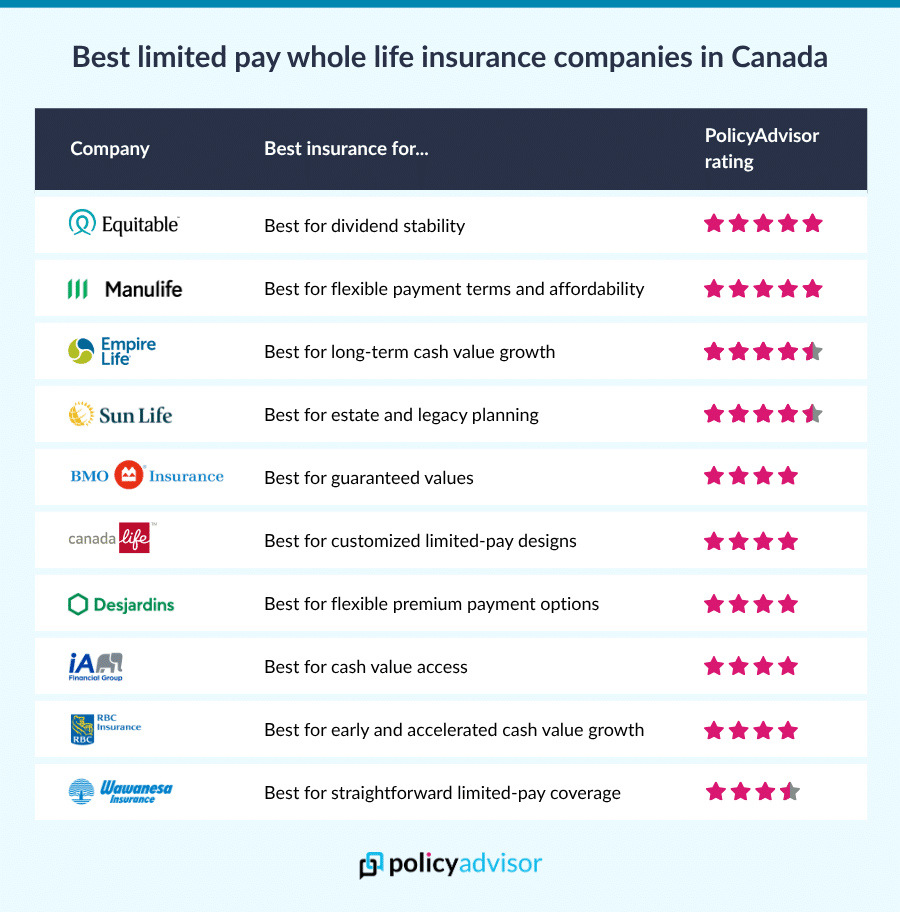
Let’s take a closer look at what makes these limited-pay whole life insurance plans among the best in Canada.
1. Equitable Life: Best for dividend stability

Equimax Wealth Accumulator
20-pay
pay-to-100
Our advisor’s take:
We give Equitable Life whole life insurance a 5/5 rating for its strong dividend track record and flexible limited-pay options. Its Equimax Estate Builder and Equimax Wealth Accumulator participating whole life policies offer 10-pay, 20-pay, and pay-to-100 options, allowing policyholders to choose how quickly they want to complete their premiums while maintaining lifetime coverage.
Equitable Life stands out for its dividend stability. The company has credited participating policy dividends every year since 1936, while its dividend scale interest rate has shown relatively low volatility over the long term. This makes Equitable a strong choice for Canadians who want to combine a defined premium-payment period with the potential for long-term participating policy dividends.
Equitable has maintained its 6.40% dividend scale interest rate (DSIR) for 2026-2027, continuing the same dividend scale for another year. The company expects to pay approximately $223 million in participating policy dividends between July 2026 and June 2027.
Unique selling point (USP): Equitable Life is best for dividend stability, combining a long history of participating policy dividends with 10-pay, 20-pay, and pay-to-100 options for Canadians who want to complete premiums on a defined schedule.
Equitable Life’s key financial strengths:
- Participating account size: Approximately $3.16 billion
- Dividend scale interest rate (DSIR): 6.40%
- Dividend history: Participating policy dividends credited every year since 1936
- Dividend-scale volatility: 1.70% since 1989
- Mutual company structure: Owned by participating policyholders rather than shareholders
Why choose Equitable Life
- Offers 10-pay, 20-pay, and pay-to-100 options to suit different premium-payment goals
- Holds a long-standing participating dividend history and maintains relatively low dividend-scale volatility compared with several other investment benchmarks
- Offers two Equimax products designed around different cash-value and estate-planning priorities
- Includes the in-built KIND program with new Equimax participating whole life policies, providing compassionate advance and bereavement counselling benefits
2. Manulife: Best for flexible payment terms and affordability

Manulife Par with Vitality Plus
Performax Gold
20-pay
pay-to-90
pay-to-100
Our advisor’s take:
We rate Manulife whole life insurance 5/5 and consider it best for flexible premium payment periods. If your priority is to adjust your premium commitment as your financial situation changes, Manulife is one of the stronger options to consider. You can choose from 10-pay, 20-pay, pay-to-90, and pay-to-100, and on eligible policies, you can later extend your payment period. For example, from 10-pay to 20-pay or pay-to-90, or from 20-pay to pay-to-90.
This can be particularly useful if you initially choose a shorter payment period but later want to reduce your premium burden. The option isn’t available for pay-to-100 policies. Manulife also has a long history of product innovation, including introducing coverage for controlled diabetics in 1940 and becoming the first Canadian insurer to use AI in underwriting in 2018. If you are also interested in being rewarded for healthy living, Manulife Par with Vitality Plus offers rewards for leading a healthy lifestyle.
Unique selling point (USP): Vitality program rewards policyholders for leading a healthy lifestyle
Manulife’s key financial strengths:
- Dividend Scale Interest Rate (DSIR): 6.35%
- Capital strength: Life Insurance Capital Adequacy Test (LICAT ratio) of 136%, among the highest capitalization levels of major Canadian insurers
- Company history: More than 130 years
Why choose Manulife:
- Offers 10-pay, 20-pay, pay-to-90, and pay-to-100 options
- Eligible policies can be changed to a longer premium-payment period after issue
- Global diversification reduces performance volatility
- Provides access to the Vitality program
3. Empire Life: Best for long-term cash value growth

Optimax Wealth
Solution Series
10-pay
20-pay
pay-to-100
Our advisor’s take:
We rate Empire Life whole life insurance 4.5/5 and consider it the best for long-term cash value growth. If you want to complete your premiums within a defined period while keeping your coverage for life, Empire Life is worth considering. Its participating whole life products offer 8-pay, 10-pay, 20-pay, and pay-to-100 options, giving you flexibility to choose how quickly you want to finish paying premiums. What we particularly like is the combination of guaranteed values and long-term growth potential. Empire Life has paid participating policy dividends every year since 1923, while its policies provide guaranteed cash values and premiums that cannot increase.
Unique selling point (USP): Empire Life combines a 100+ year dividend-payment history with guaranteed cash values and permanent coverage, making it a strong option for buyers focused on building long-term policy value.
Empire Life’s key financial strengths:
- Dividend history: Annual dividends paid to participating policyowners every year since 1923
- Participating fund size: $1.32 billion
- Dividend rate history: Above 6% for more than 10 years, showing exceptional long-term stability
Why choose Empire Life:
- More than 100 years of uninterrupted participating policy dividend payments
- Offers guaranteed cash values and premiums that cannot increase
- Enhanced Coverage provides a Lifetime Guarantee, subject to policy conditions
- Strong option for buyers who prioritize long-term cash value accumulation
- Provides substantial coverage amounts of up to $20 million
- Combines guaranteed policy values with the potential for non-guaranteed participating dividends
4. Sun Life: Best for estate and legacy planning

Sun Par Accumulator II
20-pay
Life-pay
Our advisor’s take:
We rate Sun Life whole life insurance 4.5/5 and consider it the best for estate and legacy planning. If your priority is building permanent coverage that can support your family’s financial needs or estate over the long term, Sun Life is one of the strongest options to consider. It has declared and paid dividends to eligible participating policyowners every year since 1877, giving it one of the longest dividend-payment histories in Canada.
For limited-pay buyers, Sun Life is particularly appealing because its participating whole life portfolio offers a wide range of premium-payment options, including 10-pay, 20-pay, and Life-pay depending on the product. This allows you to complete premiums well before retirement while keeping lifetime coverage in place, helping ensure a death benefit is available for beneficiaries when it is needed for estate equalization, tax and estate settlement costs, or transferring wealth to the next generation.
Unique selling point (USP): Sun Par Protector II and Sun Par Accumulator II suit Canadians who want lifetime protection paired with strong cash-value potential and effective estate planning.
Sun Life’s key financial strengths
- Participating account: Approximately $21.2 billion
- Dividend history: Dividends declared and paid every year since 1877
- Current DSIR: 6.25%
- Earnings diversified across Canada, the U.S., and Asia
Why choose Sun Life
- Offers one of Canada’s longest participating dividend histories, dating back to 1877
- Provides a wide range of limited-pay options, including 10-pay, 20-pay, and Life-pay
- Manages one of Canada’s largest participating accounts at approximately $21.2 billion
- Offers coverage of up to $15 million through Sun Par Protector II, subject to underwriting
5. BMO Insurance: Best for guaranteed values

Wealth Accelerator
20-pay
pay-to-100
Our advisor’s take:
We rate BMO whole life insurance 4/5 and consider it the best for guaranteed values. If you want limited-pay whole life insurance with a strong focus on predictability, BMO is worth considering. Its participating whole life policies offer 10-pay, 20-pay, and pay-to-100 options. What stands out to us is BMO’s Performance Bonus Rate, which is contractually guaranteed never to be negative. In other words, while the rate can be lower in a given year, it cannot reduce the policy values because of a negative bonus rate.
BMO also locks in the policy’s guaranteed and quicker cash value when you purchase the Estate Protector policy, giving you a clear foundation of guaranteed value from the first year. For someone using whole life insurance as part of a long-term estate or financial plan, this combination of guaranteed cash values, a guaranteed base death benefit, and limited-pay options can make BMO a particularly attractive choice when certainty is more important than maximizing non-guaranteed growth.
Unique selling point (USP): BMO’s Performance Bonus Rate is contractually guaranteed never to be negative, while guaranteed cash values are established when you purchase the policy.
BMO’s key financial strengths
- Performance bonus rate: 6% (as of 2026)
- Financial backing: BMO Insurance is part of BMO Financial Group, one of North America’s largest diversified financial services providers
- Net insurance income: $88 million (for Q3, 2026)
Why choose BMO
- Strong choice if guaranteed policy values are your priority
- Performance Bonus Rate cannot be negative, providing additional protection against declines in policy values from the bonus rate
- Guaranteed level premiums and base death benefit provide greater long-term predictability
- Integrates within BMO Wealth Management, adding operational scale, stability, and risk-management support
6. Canada Life: Best for customized limited-pay designs

Wealth Achiever
Balanced Achiever
20-pay
pay-to-100
Our advisor’s take:
We rate Canada Life whole life insurance 4/5 because it offers one of the most customizable limited-pay whole life insurance designs in Canada, backed by the industry’s largest participating account. If you want more control over how your whole life policy is structured, Canada Life stands out because you can combine different products, premium-payment periods, and multiple dividend options to create a design that better matches your financial and estate-planning goals.
In terms of limited-pay options, Canada Life offers 10-pay, 20-pay, and pay-to-100 options for its Estate Achiever, Wealth Achiever, and Balanced Achiever plans. You can also choose how participating dividends are used: buy extra paid-up coverage (paid-up additions or PUAs), increase enhanced coverage, take the dividend as cash, leave it on deposit, or use it to reduce your premium. This gives you greater flexibility in how your policy’s dividends support your cash flow, coverage, or long-term policy value.
Unique selling point (USP): Canada Life lets you combine Max 10, Max 20, or Pay-to-100 payment periods with different dividend options and product designs, giving you greater control over how your policy is structured.
Canada Life’s key financial strengths
- Participating account size: Approximately $62.8 billion as of December 31, 2025, which is the largest combined open participating account in the industry
- Number of participating policies: 1.4 million in-force policies
- DSIR: 2026 DSIR increased to 6.00% compared to 5.75% in the previous year
- Company history: More than 175 years of continuous participation in the participating life insurance market
Why choose Canada Life
- Offers pay 10, pay 20, and pay-to-100 premium-payment options
- Provides multiple ways to use participating dividends, including cash, paid-up additions, and enhanced dividends
- Manages the largest combined open participating account in the industry, providing significant scale
- Offers additional customization through joint coverage and optional riders
7. Desjardins: Best for flexible premium payment options

Estate Enhancer
Accelerated Growth
10-pay
15-pay
20-pay
pay-to-100
Our advisor’s take:
We give Desjardins 4/5 for its flexible limited pay options in Canada, combining a rare 5-pay participating option with the more standard 10-pay, 15-pay, 20-pay, pay-to-65, and pay-to-100 structures. Desjardins, in fact, offers one of the broadest ranges of payment periods in its lineup.
What particularly stands out is 5 Pay PAR, which lets you complete your premiums in just five years while keeping lifetime coverage in place. Its participating lineup includes three plans: 5-Pay PAR, Estate Enhancer, and Accelerated Growth. Estate Enhancer focuses on long-term estate value and strong future growth, while Accelerated Growth prioritizes earlier cash value access with long-term accumulation potential.
Unique selling point (USP): Desjardins offers a 5-pay participating whole life policy alongside 10-pay, 20-pay, and pay-to-100 options, giving considerable flexibility in how quickly they complete their premiums.
Desjardins’ key financial strengths
- Total value of the participating account: $2 billion
- Assets under management: Approximately $510.2 billion
- Financial strength ratings: A+ from S&P and AA from DBRS
- Company history: More than 125 years
- Market position: Largest cooperative financial group in Canada
Why choose Desjardins
- Offers one of the only 5-pay participating whole life plans in Canada, enabling rapid paid-up coverage and strong early cash values
- Large cooperative financial institution with approximately $510.2 billion in assets under management
- Operates a cooperative ownership model, meaning profits support members rather than shareholders
8. Industrial Alliance (iA): Best for cash value access

iA PAR Wealth
20-pay
pay-to-100
Our advisor’s take:
We give Industrial Alliance (iA) whole life insurance a 4/5 for iA PAR Estate and iA PAR Wealth, which build cash value early while supporting long-term estate growth. If you want limited-pay whole life insurance that can also provide access to your policy’s accumulated value during your lifetime, iA is worth considering. Its iA PAR products offer 10-pay, 20-pay, and pay-to-100 options, allowing you to choose a premium period that fits your financial timeline.
iA PAR Wealth provides guaranteed cash value from the first policy anniversary, compared with the fifth anniversary for iA PAR Estate. Its PAR account fund size is $330 million and is managed by iA Global Asset Management, which manages more than $100 billion in assets. You can also request a policy loan of up to 90% of the eligible surrender value, giving you access to capital without necessarily having to surrender the policy.
Unique selling point (USP): PAR Estate and iA PAR Wealth are ideal for Canadians who want a balance of cash access and long-term wealth accumulation
iA’s key financial strengths
- Company history: More than 130 years, dating back to 1892
- Solvency ratio: 137%
- Participating account fund size: $330 million
- Dividend Scale Interest Rate (DSIR): 6.35%
Why choose iA
- Allows policyholders to access up to 90% of eligible surrender value through policy loans
- iA PAR Wealth provides guaranteed cash value from the first policy anniversary
- Backed by a large Canadian financial group with more than 130 years of experience
- Multiple dividend options available, including paid-up additions, annual premium reduction, payable in cash, and deposit with interest
9. RBC Insurance: Best for early and accelerated cash value growth

RBC Growth Insurance Plus
20-pay
pay-to-100
Our advisor’s take:
We give RBC whole life Insurance 4/5 because it stands out for early cash value growth through its RBC Growth Insurance and Growth Insurance Plus plans. With RBC Growth Insurance Plus, guaranteed cash value starts building at the end of the very first policy year, which is earlier than the year-5 access on standard Growth. Moreover, RBC, like most other insurers, offers multiple limited-pay options, such as 10-pay, 20-pay, and pay-to-100.
RBC also offers an Enhanced Insurance dividend option, which combines one-year term insurance with paid-up additions to accelerate policy growth. For families considering coverage for children, RBC also offers a juvenile Guaranteed Insurability Benefit that can provide guaranteed cash value at year five for standard-risk applicants without an additional premium.
Unique selling point (USP): RBC Growth Insurance Plus builds guaranteed cash value from year one, while its Enhanced Insurance dividend option can accelerate policy growth
RBC’s key financial strength
- Dividend Scale Interest Rate (DSIR): 6.30%
- Investment expertise: Participating account managed by professionals with more than 100 years of collective asset-management experience
- Participating account fund size: $51.39 million
- A 50/50 target asset mix between fixed income and non-fixed income (including commercial real estate)
Why choose RBC
- Manages participating accounts using smoothing techniques that reduce short-term volatility and support consistent dividends
- Offers a Juvenile Guaranteed Insurability Benefit for eligible children
- Participating account is managed by experienced RBC investment professionals who have more than 100 years of collective asset-management experience
- Enhanced Insurance can accelerate policy growth by combining term insurance with paid-up additions
10. Wawanesa Life: Best for straightforward limited-pay coverage

pay-to-100
Our advisor’s take:
We give Wawanesa whole life insurance a 3.5/5 rating for its reliable and straightforward limited pay whole life insurance in Canada through Wawanesa Life Par. As a mutual company owned by its policyholders, Wawanesa operates with a focus on serving participating policyholders rather than shareholders. If you are someone who prefers a simple whole life policy without being confused by multiple payment structures or complex options, Wawanesa can be a good fit.
Its lineup keeps things straightforward with 20-pay and pay-to-100 options, allowing you to either complete premiums within 20 years or spread them over a longer period. Guaranteed cash value begins in year five.
Unique selling point (USP): Wawanesa Life Par delivers predictable, steady cash value growth and consistent dividend performance, supported by a disciplined bond-focused investment strategy
Wawanesa’s key financial strengths
- Dividend Scale Interest Rate (DSIR): 6.00%
- Life insurance asset base: $1.9 billion
- Group equity/surplus: $4.7 billion, providing strong capitalization across the mutual group
- Annual revenue: $4.1 billion (Wawanesa Mutual Insurance Company)
Why choose Wawanesa
- One of the few insurers to price premiums based on the current age
- Simple product lineup that is easy to understand
- Policyholder-focused mutual structure directs profits to reinforce stability instead of flowing to shareholders
- Flexible dividend options are available, including paid-up additions, cash payment, or on deposit
Methodology: How we ranked the best limited pay whole life insurance in Canada
Our team of licensed insurance advisors at PolicyAdvisor ranked the top limited pay whole life providers in Canada based on these factors:
- Premium payment options: Flexibility to pay over 5, 8, 10, 15, 20 years, to age 65 or 100
- Financial strength ratings: Third-party financial strength ratings, such as AM Best, along with the size and performance of the insurer’s participating account where applicable
- Cash value and dividend potential: Long-term cash value growth, participating dividend history, dividend scale stability, and available options for using dividends
- Dividend Scale Interest Rate (DSIR): Current DSIR, historical performance, and the stability of the dividend scale over time
- Flexibility after purchase: Options to change premium-payment periods, adjust coverage, access cash value, or modify how dividends are used after the policy is issued
What is the difference between limited pay policies and traditional whole life insurance plans?
The core difference between limited pay and traditional whole life is the payment period. With limited pay plans, you receive lifelong coverage while paying premiums for only a set period. In contrast, a traditional whole life insurance plan requires you to continue paying premiums for as long as you want coverage.
Limited pay policies usually cost more than traditional plans because the payment period is shorter. Furthermore, cash value grows faster in limited-pay plans since insurers concentrate premiums in the early years rather than spreading them over a lifetime. The following table summarizes the differences:
Limited pay vs. traditional whole life insurance
| Feature | Limited pay whole life insurance | Traditional whole life insurance |
| Premium payment period | Pay premiums for a fixed payment term (5, 10 or 20 years) | Pay premiums for life (no fixed term) |
| Premium amount | Higher annual premiums due to the shorter payment term | Lower annual premiums spread over a lifetime |
| Cash value growth | Builds faster due to front-loaded payments | Gradual growth in cash value due to slower payment schedule |
| Ideal for | Business owners, high-income earners, parents funding policies for children, pre-retirees, those who are focused on estate planning | Those who prefer smaller, ongoing premium payments and those seeking lower-cost lifetime coverage or using whole life for final-expense needs |
If you choose limited pay, the next step is selecting the right payment schedule. Shorter terms cost more upfront but build value faster.
Comparison of 5‑pay vs. 10‑pay vs. 20‑pay
| Feature | 5-pay whole life insurance | 10-pay whole life insurance | 20-pay whole life insurance |
| Premium payment options | 5 years | 10 years | 20 years |
| Annual premium | Highest (condensed into 5 years) | Moderate (spread over 10 years) | Lowest (spread over 20 years) |
| Cash value growth | Fastest | Balanced | Gradual |
| Ideal for | Those planning to finish payments very early and build wealth quickly | Those planning to complete payments before retirement or major milestones | Those who prefer lower annual payments with long-term flexibility |
| Availability | Limited to Desjardins | Widely offered by major insurers in Canada, including Equitable Life, Manulife, Empire Life, Sun Life, and a few others | Widely offered by major insurers in Canada including Equitable Life, Manulife, Empire Life, Sun Life, and a few others |
Key factors to consider when applying for limited pay whole life insurance
When applying for limited pay whole life insurance, you must consider factors such as premium payment period, cash value access, insurer stability, and a few other factors:
- Premium payment period: Compare how long you want to pay premiums, such as 5, 10, or 20 years, or to a specific age. Shorter payment periods generally mean higher premiums but allow you to be free from the burden of paying premiums sooner
- Cash value access: If you expect to use your policy during your lifetime, check how and when you can access its cash value through policy loans, withdrawals, or other options, and understand the potential impact on your coverage
- Dividend performance: If you choose a participating policy, compare the insurer’s Dividend Scale Interest Rate (DSIR), historical dividend performance, and dividend-scale stability. Remember that participating dividends are not guaranteed
- Dividend options: Find out how you can use participating dividends. Depending on the insurer, you may be able to purchase paid-up additions, increase coverage, take dividends in cash, leave them on deposit, or use them to reduce premium
- Policy features and riders: Compare available riders, additional benefits, and features such as guaranteed insurability, child coverage, disability benefits, or enhanced coverage
- Financial strength of the insurer: Review the insurer’s financial strength ratings and, for participating policies, the size and management of its participating account
How to get the best limited-pay whole life insurance quotes in Canada
Here’s how you can get personalized limited-pay whole life insurance quotes in three simple steps with PolicyAdvisor:
- Tell us about your needs: Share your age, health information, desired coverage amount, and preferred premium-payment period, such as 5-pay, 10-pay, or 20-pay
- Compare your options: We compare suitable plans from leading Canadian insurers, including their premiums, payment periods, guaranteed cash values, dividend potential, and key policy features, so you can evaluate your options side by side
- Choose your coverage with expert guidance: Our licensed advisor will walk you through your options, answer your questions, and help you select and apply for the policy that best fits your financial and insurance goals, all at no additional cost
Get in touch with our licensed advisors who will help you compare options, answer questions, and ensure your coverage aligns with your goals. Schedule a call now!
Frequently asked questions
What is limited pay whole life insurance in Canada?
Limited pay whole life insurance in Canada is a type of permanent life insurance policy that provides lifelong coverage and cash value growth while allowing you to pay premiums within a set term, typically 10 or 20 years. These are often called 10-pay or 20-pay whole life plans, depending on the payment term. Once the payment period ends, your policy is fully paid up, and your coverage continues for life with no additional premiums.
How does a 10-pay whole life insurance plan work?
A 10-pay whole life plan accelerates premium payments within 10 years while offering lifelong coverage. Cash value grows faster because premiums are paid early, making it ideal for Canadians who want to finish payments before retirement or other major goals.
Do limited pay whole life insurance policies build cash value?
Yes, limited pay whole life insurance policies in Canada build tax-deferred cash value. Shorter payment plans like 10-pay typically grow faster because more premium is invested earlier.
Who offers the best limited pay whole life insurance in Canada?
Leading providers such as Equitable Life, Sun Life, Canada Life, iA Financial, Manulife, Desjardins, Empire Life, RBC Insurance, BMO, and Wawanesa offer limited pay whole life insurance. Each offers flexible 10-pay, 20-pay, pay-to-100, and other options tailored for wealth building, estate planning, or early payment completion.
What is the shortest premium payment period for whole life insurance in Canada?
Desjardins offers the shortest 5-pay payment period for whole life insurance in Canada. However, it is important to note that the shortest payment period depends on the insurer and product and can vary from insurer to insurer. There are a few insurers, like Equitable Life, that offer a 10-pay payment period.
When can you stop paying premiums on a limited-pay whole life policy?
You usually need to complete the scheduled payment period for the policy to become fully paid up. If you stop paying before the end of the payment term, the policy may be affected depending on its terms, so check the available non-forfeiture options before stopping payments.
Do limited-pay whole life policies have higher premiums?
Yes, limited-pay policies generally have higher annual premiums than other whole life policies where premiums are spread over a lifetime because you are paying for the same permanent coverage over a shorter period. Moreover, a 5-pay or 10-pay policy will have a higher annual premium than a 20-pay or pay-to-100 option.
Can I change my premium payment period after buying a limited-pay policy?
Yes. Some insurers allow you to extend the premium-payment period after the policy is issued, subject to the product’s terms. For example, eligible Manulife policies may allow certain 10-pay or 20-pay policies to be changed to a longer payment duration.
Limited-pay whole life insurance lets you finish premiums in a set period while keeping coverage for life. This guide compares leading Canadian limited pay companies, including 5-pay, 10-pay, and 20-pay options, and explains how each structure impacts cash value growth, premium cost, and long-term flexibility. It also highlights which companies offer early cash value access, strong dividend performance, or estate-planning advantages. Whether you want lifelong protection with shorter payments or efficient, tax-advantaged growth, this comparison helps you evaluate your options and choose the plan that best fits your financial goals.