

 1-888-601-9980

- Whole life insurance provides lifelong coverage while building cash value, combining permanent protection with long-term policy value
- It can complement retirement and business planning for high-income, high-net-worth, and incorporated business owners
- Participating whole life policies may provide non-guaranteed dividends, creating additional opportunities to increase policy value or coverage
- The insurance offers tax-advantaged cash value growth and a death benefit that is generally received tax-free
Whole life insurance can be a good investment for Canadians seeking permanent life insurance who also want an additional tax-advantaged asset for long-term financial planning. Unlike term life insurance, whole life builds cash value over time, and participating policies may also provide non-guaranteed dividends.
According to the Life Insurance Marketing and Research Association (LIMRA), whole life new premiums reached $1.6 billion in 2025, increasing 10% year over year and accounting for 70% of total Canadian life insurance new annualized premiums.
From an investment perspective, whole life insurance is low-risk, flexible, and highly strategic. Policyholders can borrow against cash value, incorporate it into retirement planning, or use it for estate and business succession.
Is whole life insurance a good investment option in Canada?
Yes, whole life insurance can be a good financial asset for Canadians seeking permanent protection, especially high-net-worth individuals, business owners, and those seeking tax-advantaged estate planning solutions.
Unlike a conventional investment product, whole life insurance combines several financial benefits in one product. The guaranteed death benefit and cash value, along with the possibility of earning dividends, make it a comprehensive product. Additionally, this cash value can grow on a tax-advantaged basis and may be accessed through policy loans, withdrawals, or collateral arrangements.
Whole life insurance as an investment: At a glance
| Feature | Whole life insurance |
| Best suited for | Permanent insurance, estate planning, business planning, and long-term wealth preservation |
| Primary purpose | Permanent life insurance protection |
| Coverage period | Lifetime |
| Cash value | Yes |
| Guaranteed cash value | Available on many policies according to the policy schedule |
| Cash value growth | Generally increases tax-deferred over the long term |
| Participating dividends | Yes, but not guaranteed |
| Access to money |
|
How does whole life insurance work as an investment tool in Canada?
Whole life insurance is a permanent policy that combines the benefit of lifelong protection and a cash value component. The premiums cover the cost of providing lifelong insurance coverage and policy expenses, while the remainder contributes to the accumulation of cash value.
Here’s why whole life insurance can be a useful long-term wealth-building tool in Canada:
- Cash value growth: The cash value that grows over time helps you build an asset within the policy. The growth is generally modest during the early policy years but can become more substantial over time.
- Dividends: In a participating whole life insurance policy, the insurer pays dividends to policyholders by sharing a portion of its profits. The insurer determines dividends based on factors such as financial performance, mortality experience, and operating expenses, so they are not guaranteed. When paid, dividends can add significant value to the policy.
- Tax-advantaged growth: The cash value grows tax-deferred while it remains inside a tax-exempt life insurance policy. However, withdrawals, policy loans, or surrendering coverage may result in taxable income when they exceed the policy’s adjusted cost basis (ACB).
- Accessing the cash value: Policyholders can access the policy’s cash value through withdrawals, policy loans, surrendering coverage, or using the policy as collateral for a loan, where applicable.
What is your Whole Life Insurance worth?
Get instant quotes from Canada's top life insurance providers and find the perfect coverage for your family.
Powered by

Comparing whole life insurance with other investment options
Whole life insurance differs from conventional investments because it combines permanent life insurance protection with tax-advantaged cash value accumulation. Unlike many other investment options like stocks and real estate, it is more stable and low-risk.
| Feature | Whole life insurance | Stocks | Real estate | RRSP | TFSA | GICs |
| Purpose | Protection-first with stable, tax-advantaged cash value | Build wealth through ownership in a company | Multiply the wealth by owning property | Create a tax-deferred retirement savings account | For tax-free investment growth | Provide a fixed-income saving option |
| Risk level | Low-risk | High-risk | Low to medium risk | Depends on the investment option | Depends on the investment option | Low risk |
| Cash value | Guaranteed | High returns, but not guaranteed as they are dependent on the market performance | Market-based and property value | Growth depends on the selected investment option | The growth depends on the invested option | Growth at fixed interest rates |
| Tax benefits | Tax-deferred cash value | Capital gains are taxed | Capital gains and rental income are taxed | Withdrawals are taxed in retirement | Completely tax-free withdrawals | Interest income is taxable |
| Liquidity | Can borrow against the cash value | High, can usually sell the stocks | Dependent on the market conditions | Withdrawal is possible if the funds are not locked-in | Withdraw any time tax-free | Withdraw any time, but the return may be compromised |
| Ideal for | Those seeking lifelong protection and income growth | High-risk investors | Those seeking returns from tangible assets | Long-term retirement planners who want tax-deferred growth | Investors wanting tax-free growth and flexibility | Investors have a low-risk appetite |
Term life vs whole life insurance: Which is better for investment?
Term life and whole life are among the most popular policy choices in Canada and serve different needs for Canadians from an investment perspective. Term insurance is generally the more cost-effective solution, allowing policyholders to maximize coverage at lower premiums, while keeping more money available for market-based assets or putting into RRSPs or TFSAs.
Meanwhile, whole life insurance can suit Canadians seeking lifelong coverage alongside tax-advantaged cash value growth, estate-planning benefits, and more conservative long-term wealth transfer strategies. If you are seeking life insurance alongside the ability to utilise the cash value as an asset or use the non-guaranteed dividends to purchase paid-up coverage, whole life might be a great choice.
Read more about term vs whole life insurance and choosing the best option.
Whole life vs universal life: Which is better for investment?
Whole life and universal life are both permanent insurance products, offering lifelong coverage to policyholders. From an investment standpoint, whole life and universal life insurance offer different approaches to building value within a permanent policy structure.
In the case of whole life, the insurer manages the underlying assets and the policy generally offers more predictable cash value growth and guarantees, making it great for Canadians who prefer to automate the process and keep things simple. On the other hand, the policyholder has more control over how the investment portion is allocated in universal life insurance. This can offer greater flexibility and growth at the cost of increased investment risk and more active management.
Whole life insurance may be better suited to Canadians seeking guaranteed policy values with less active management of the investment component. Meanwhile, universal life insurance is suited for individuals seeking greater control over available investment options and risk.
Whole life insurance as an investment for estate planning in Canada
Whole life insurance can be particularly valuable for estate planning since it offers a permanent death benefit that can create liquidity when the policyholder passes away. Under the CRA’s deemed disposition rules, certain capital assets are generally treated as if they were sold at fair market value when a person dies. This can trigger capital gains tax, creating an additional burden for the policyholder’s surviving family members.
Beneficiaries can use the death benefit to pay these taxes and other final costs without having to sell investments or liquidate additional assets. Additionally, if there is a direct beneficiary, the proceeds usually bypass the estate and avoid probate fees. This makes it an ideal tool for efficient wealth transfer to heirs and other beneficiaries when estate liquidity and probate efficiency matter.
Can you use whole life insurance for retirement investment in Canada?
Whole life insurance can support long-term retirement and estate planning goals if permanent coverage is already part of your financial strategy. Participating whole life policies also accumulate cash value over time on a tax-advantaged basis, alongside non-guaranteed dividends, which can be used to reduce premiums or purchase paid-up coverage.
If you are using whole life insurance for retirement planning, it is advisable to complement it with conventional savings options such as registered retirement savings plans (RRSPs) and tax-free savings accounts (TFSAs). Whole life insurance may play a larger role in retirement planning for high-income or high-net-worth Canadians who already have significant investments in their RRSP and TFSA, and are seeking estate-planning or tax-planning options.
Here are some factors you should consider while using whole life insurance as a retirement tool in Canada:
- Budget whole life premiums as a retirement cost: If you plan to pay premiums after you retire, it is important to factor those payments into your projected retirement expenses
- Consider a limited-pay whole life policy: Limited-pay whole life policies allow you to complete your scheduled premium payment over a shorter period, while maintaining lifelong coverage. This helps you finish payments before retirement, reducing your financial obligations.
- Use participating policy dividends: If you earn dividends from participating policies, you can use that amount to purchase additional paid-up insurance or reduce premiums, further reducing financial obligations after retirement.
For a detailed overview, check out our guide on Whole life vs. RRSP vs. TFSA: Which builds more wealth in Canada?
Is whole life insurance a good investment for business owners in Canada?
Whole life insurance can be a good investment for incorporated business owners who are seeking lifelong coverage alongside support for long-term business, estate, or succession planning. A corporate-owned permanent policy can build cash value over time, allowing the business to access that value through policy loans or by using the policy as collateral.
Essentially, whole life insurance is a good investment for Canadian business owners who want to:
- Fund a business succession or shareholder buyout
- Protect the company against the loss of an owner or key employee
- Build cash value within a permanent insurance policy
- Create liquidity for estate or tax obligations
- Transfer wealth to the next generation
What are the tax benefits of whole life insurance in Canada?
Whole life insurance offers several tax advantages in Canada, particularly when the policy qualifies as an exempt life insurance policy under the Income Tax Act. The biggest benefit is that the cash value can grow without annual income tax implications while it remains inside the policy.
Apart from tax-deferred cash value growth, here are the other tax benefits of whole life insurance in Canada:
- Tax-efficient estate transfer: Since the death benefit is generally received tax-free, whole life insurance can offer liquidity for taxes, debts, or other estate expenses while preserving other assets for beneficiaries
- Benefits for incorporated business owners: If a private corporation owns the policy and receives the death benefit, the portion of the death benefit in excess of the Adjusted Cost Basis (ACB) of the policy will be credited to the company’s Capital Dividend Account (CDA). This can increase the entity’s capital dividend account, potentially offering a tax-free payout to shareholders.
What should you consider before using whole life insurance as an investment?
If you are selecting whole life insurance as an investment tool, you should consider the following factors:
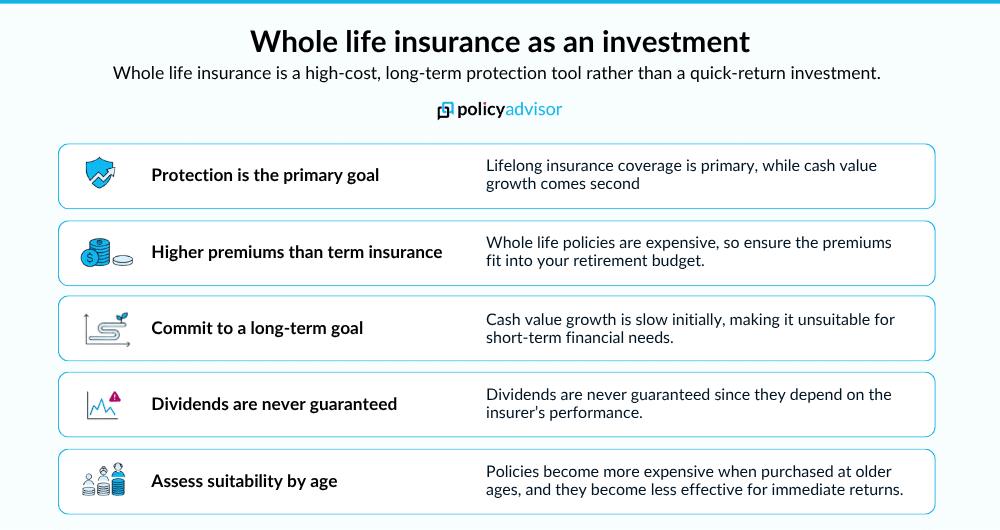
- Identify the needs: Whole life insurance is primarily for lifelong protection, while cash value growth and other investment-related benefits are secondary features
- Confirm that you have a long-term financial goal: Since cash value growth is slow in the initial years, a whole life policy serves as a good long-term financial tool. It is recommended that you review whether your financial goals align with short-term needs or long-term protection
- Premiums: The premiums for a whole life policy are higher than for a term life policy, making it an expensive choice. Make sure the ongoing cost fits within your budget before committing to a policy
- Dividends: Dividends depend on the performance of the participating account and are not guaranteed. This may result in some variability in the policy’s non-guaranteed growth.
- Assess suitability: Whole life insurance generally becomes more expensive when purchased at older ages. Cash value can also be relatively low in the early policy years, making it less effective if you are seeking short-term returns.
- Consider participating policies: A participating whole life policy can pay dividends. You can take them in cash, use them to reduce premiums, or use them to purchase paid-up additions, which can enhance cash value and the death benefit
Who should get whole life insurance in Canada?
Whole life insurance is a good choice for Canadians seeking lifelong insurance protection and who want to build cash value over the long term. It is especially suited for the following groups:
- High-income earners and business owners: Tax-deferred cash value allows wealth to grow and can be accessed later through loans or withdrawals when needed
- Parents looking for long-term financial security: The death benefit provides financial protection for dependants in the event of unforeseen circumstances, and the cash value can be used to meet immediate financial needs
- Canadians seeking conservative, low-risk growth: Compared with stocks, whole life insurance is a relatively stable choice in Canada
- Those needing estate planning solutions: The tax-free death benefit helps ensure that heirs receive a tax-free amount
How to purchase whole life insurance in Canada?
PolicyAdvisor’s licensed life insurance advisors can help you compare whole life insurance policies from leading Canadian insurers based on your age, budget, health, coverage needs, and financial goals.
Whether you are looking for lifelong protection, cash value growth, or a tax-efficient way to transfer wealth, our advisors at PolicyAdvisor can help you choose the right coverage amount, payment structure, and policy for your needs.
Frequently asked questions
Is a whole life policy a good investment in Canada?
Yes, a whole life policy can be a good long-term financial asset when you also need permanent life insurance. It combines a lifelong death benefit with cash value growth and potential non-guaranteed dividends in participating policies.
How does whole life insurance work in Canada?
Whole life insurance provides lifetime coverage with fixed premiums. It includes a savings feature called cash value, which grows over time and can be accessed through loans or withdrawals. If the policyholder dies, beneficiaries receive a tax‑free death benefit.
Is whole life insurance worth it in Canada?
Whole life insurance can be worth it when you need lifelong protection and value features such as cash accumulation, guarantees, estate-planning benefits, and want tax-free wealth transfer to your beneficiaries.
Can I access the cash value of whole life insurance?
Depending on the policy, cash value may be accessed through withdrawals or policy loans. It may also be used as collateral for an external loan.
Can whole life insurance build wealth?
Whole life insurance can build cash value over time and may support long-term wealth-transfer and estate-planning strategies.
Can whole life insurance pay dividends?
Participating whole life policies may pay non-guaranteed dividends based on the insurer’s performance. The dividend payout depends on factors such as the insurer’s participating account performance, investment results, and expenses.
What are paid-up additions in whole life insurance?
In whole life insurance, a paid-up addition is a dividend option that allows you to use policy dividends to purchase additional, fully paid-up life insurance coverage. They increase both the death benefit and the cash value of your whole life policy without requiring additional out-of-pocket premiums. Paid-up additions (PUAs) also earn dividends, which helps your policy grow faster through compounding over time.
How long does whole life insurance in Canada take to build cash value?
Whole life may begin building cash value within the first few years. However, the timing depends on the insurer and policy design. Most of your premiums in the first few years go into administrative costs and the cost of insurance. Over the years, the policy starts building cash value. However, some policies are designed to build value earlier.
Whole life insurance can be a good long-term financial asset for Canadians who need permanent coverage and want to build cash value over time. Participating policies may also provide non-guaranteed dividends, while the permanent death benefit can support estate planning, inheritance, business succession, and wealth-transfer goals.
LIMRA. “Canadian Life Insurance Sales Post Fifth Consecutive Quarter of Growth.” LIMRA News Releases, September 9, 2025.