

 1-888-601-9980


- Many cancer survivors can qualify for life insurance once treatment is complete and they meet an insurer's underwriting requirements
- Your eligibility depends on factors such as your cancer type, stage, treatment history, remission period, age, and overall health
- Term life insurance is often the most affordable option for survivors who qualify through traditional underwriting
- Simplified issue and guaranteed issue life insurance can provide coverage for survivors who do not qualify for fully underwritten policies
Most cancer survivors in Canada can qualify for life insurance once treatment is complete and they have remained cancer-free for a period determined by the insurer. Eligibility for coverage depends on the type and stage of cancer, treatment received, remission period, age, and overall health.

Need insurance answers now?
Call 1-888-601-9980 to speak to our licensed advisors right away, or book some time with them below.
Can you get life insurance after cancer in Canada?
Yes, cancer survivors can qualify for life insurance in Canada. Insurers assess each application individually, taking into account factors such as cancer diagnosis, treatment history, time since treatment, overall health, and the likelihood of recurrence.
Whether you are approved and what premiums you pay will depend on the insurer’s underwriting and approval processes. Even if you do not qualify for fully underwritten policies, you may be eligible for simplified or guaranteed issue coverage.
Life insurance for cancer survivors in Canada: At a glance
| Feature | Details |
| Can cancer survivors get life insurance? | Yes. Many cancer survivors in Canada qualify for life insurance after successful treatment and a period of remission |
| Best time to apply | After completing treatment and once you have been cancer-free for the insurer’s required waiting period |
| Available policy types |
|
| What insurers consider | Cancer type, stage, grade, treatment received, years since remission, age, and overall health. |
Can you get life insurance while being treated for cancer?
It is usually difficult to qualify for traditional life insurance while you are actively undergoing cancer treatment in Canada. Most Canadian insurers will postpone an application until treatment has been completed and there is a substantial period of recovery.
If you are currently receiving chemotherapy, radiation therapy, or recovering from cancer surgery, an insurer may wait until treatment is complete. However, this is different from a complete rejection. Once treatment is completed and you have remained cancer-free for a period, you may be able to apply for coverage.
How do insurers evaluate cancer survivors?
When you apply for life insurance after cancer, insurers evaluate your overall health profile and the likelihood that your cancer could affect life expectancy. Additionally, cancer survivors who qualify for traditional life insurance may sometimes be offered a rated (or substandard) policy instead of standard coverage.
A rated policy provides the same death benefit and policy features as a standard life insurance policy, but the insurer charges a higher premium because the applicant’s medical history presents a higher-than-average insurance risk.
Here are the major factors that affect your rating, eligibility, and coverage amount as a cancer survivor in Canada:
Type of cancer
Some cancers generally have higher long-term survival rates than others. Insurers consider this during underwriting, as recurrence risks vary considerably across diagnoses. Insurance companies may assess survivors of breast cancer and prostate cancer differently from colon cancer and thyroid cancer, with a focus on the severity and chances of recurrence.
Cancer stage and grade
Another factor that affects coverage and eligibility is the stage and grade of your cancer at diagnosis.
Here’s a quick overview of how cancer stage and grade may affect your underwriting:
- Cancer stage: Earlier-stage cancers generally have better underwriting outcomes, while late-stage cancers often require longer waiting periods before you can qualify for coverage
- Cancer grade: Higher-grade cancers are more likely to trigger additional medical review and may affect eligibility or premium rates
Additionally, many insurers might also use a TNM classification alongside checking if the cancer was localised or had spread. Applicants may also be required to submit additional pathology and follow-up reports to accurately assess the risk profile.
Treatment received
Insurers also factor in the treatment you receive, since different medical procedures have varying effects on the human body. Insurers might have varying underwriting criteria for treatments such as surgery, chemotherapy, radiation therapy, or even stem cell therapy.
How long you have remained cancer-free
One of the biggest factors that affect your coverage and underwriting for life insurance as a cancer survivor in Canada is how long you have remained cancer-free and the duration since treatment ended. Being cancer-free for several years significantly improves eligibility and ability to access higher coverage amounts.
Risk of recurrence
Alongside treatment and remission, insurers also focus on the risk of recurrence, since it directly affects quality of life and the level of risk they assume. Applicants whose reports show no evidence of recurrence generally receive more favourable underwriting outcomes than those who are still undergoing active monitoring.
Here are the factors at a glance:
| Factor | How it affects your premium |
| Cancer type | Cancers with better long-term survival rates may receive more favourable underwriting |
| Cancer stage and grade | Earlier-stage cancers often have better pricing than advanced-stage cancers |
| Time since treatment | Longer periods without recurrence generally improve premium eligibility |
| Age | Older applicants usually pay higher premiums, similar to a regular individual purchasing a policy. |
| Overall health | Pre-existing conditions such as diabetes, heart disease, or high blood pressure may increase premiums |
| Coverage amount | Larger death benefits cost more |
| Policy type | Term life is usually the least expensive, while guaranteed issue policies are often the most expensive. |
How long do you need to be cancer-free before getting life insurance?
One of the most common questions cancer survivors ask is when they can apply for life insurance after completing treatment. Every insurer has its own underwriting guidelines, which influence the appropriate timeline and conditions for eligibility. However, most insurance companies prefer to see a period of successful recovery after treatment before approving coverage.
During treatment, traditional life insurance is generally unavailable for patients. However, in the first few years after treatment, insurers may postpone applications or offer limited alternatives.
After approximately three to five years, many applicants begin to qualify for more traditional life insurance options, depending on the type of cancer. When cancer survivors live five to ten years without recurrence, underwriting outcomes often improve further for many localized cancers.
What if you have recently had cancer?
If you have recently completed cancer treatment and do not yet qualify for traditional or simplified coverage, guaranteed issue life insurance may be your only immediate option. Guaranteed issue policies ask no medical questions and do not decline applicants based on their health history.
However, these policies usually come with limitations, such as:
- Lower coverage amounts: Coverage is often limited to approximately $25,000 to $50,000, depending on the insurer
- Higher premiums: Premiums are typically significantly higher than those for fully underwritten policies since the insurer accepts applicants without assessing their health
- Waiting period: Many guaranteed issue policies include a two-year waiting period for death from natural causes. If the policyholder passes away from a natural cause during this period, the beneficiary typically receives a refund of premiums paid rather than the full death benefit
These policies are designed to provide some financial protection when other life insurance options are not yet available. However, as time passes after treatment, it may be worth exploring whether you qualify for better coverage.
Types of life insurance for cancer survivors in Canada
Depending on the type of cancer and health profile, applicants can choose or are given the application type based on their health conditions and other underwriting factors:
Fully underwritten life insurance
Fully underwritten life insurance is a traditional underwriting option that requires a thorough health and lifestyle evaluation before approval. It involves a detailed application, medical history review, and often a physical exam.
This option generally provides cancer survivors with access to higher coverage amounts and lower premiums than simplified or guaranteed issue policies, provided they meet the insurer’s medical underwriting requirements. However, in the first few years, applications for cancer survivors may be postponed.
For cancer survivors with a stable medical history and a longer cancer-free period, fully underwritten coverage is generally the best option since it can provide significantly more coverage at a more competitive premium than simplified or guaranteed coverage.
Simplified issue life insurance
Simplified issue is a type of life insurance underwriting for term or permanent policies that requires applicants to answer a limited number of health questions without completing a medical exam. While approval is faster, premiums are much higher than those of traditionally underwritten policies.
This is a good choice for cancer survivors in Canada with moderate health concerns or who are in recent remission and may find it difficult to qualify for traditional coverage.
Guaranteed issue life insurance
Guaranteed issue life insurance offers coverage without any medical questions or examinations. Acceptance is generally guaranteed as long as the applicant meets the insurer’s age requirements.
This policy type is essentially a last-resort option for survivors with serious medical conditions or those who have recently recovered from high-grade cancer and who have difficulty qualifying for life insurance coverage. Guaranteed issue features the highest premiums and lower coverage limits, owing to the high risk assumed by the insurer.
It is also worth noting that the policies have a 2- to 3-year waiting period for natural causes. During this time, if the insured passes away from an illness or natural cause, there is a refund of paid premiums or payment of a reduced or graded death benefit.
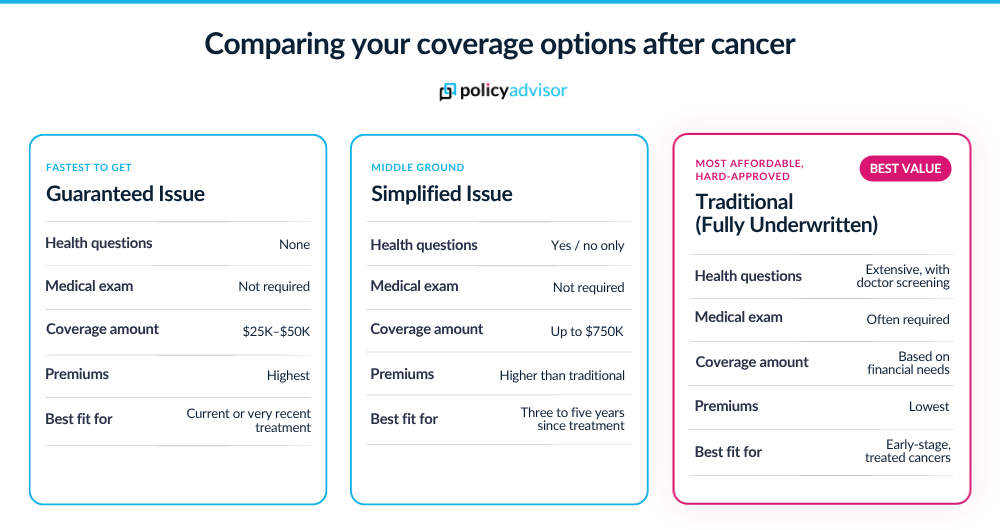
Here is a comparison of the different types of applications and underwriting for the policies:
| Feature | Fully Underwritten | Simplified issue | Guaranteed issue |
| When to apply | If health is normal and all parameters are stable for more than 12 months | If health is normal and cancer treatment is just completed | If health is denied/ no qualified elsewhere |
| Medical exam | Usually required | No | No |
| Health questions | Yes | Limited | No |
| Approval times | 2-4 weeks | 1 week | 1-2 days |
| Premiums | Lower, if health meets standard requirements | Higher than fully underwritten | Highest since no health checkup |
| Coverage amount | High | Moderate | Lower |
Can you reapply for better life insurance after cancer?
Yes, in many cases you can. If you initially purchase simplified issue or guaranteed issue life insurance because you have recently completed cancer treatment or did not qualify for traditional coverage, you may be able to apply for a fully underwritten policy later.
If you have remained cancer-free for several more years or have satisfied the underwriting conditions, insurers may offer you a traditionally underwritten life insurance policy. Stable health conditions may also lead to lower premiums and higher coverage amounts, owing to your reduced risk. Additionally, some policies also allow you to convert term into permanent and group coverage into individual.
It is also recommended to review your coverage periodically. Insurers may offer more favorable underwriting options and the option to switch to traditional coverage or a better solution with lower premiums and higher coverage amounts. However, it is recommended not to cancel an existing policy until your new coverage has been formally approved and is in force.
What to do if your life insurance application is denied?
If your life insurance application gets denied because of a cancer history, it usually just means you need a different approach. Insurers vary widely in how they assess cancer risk, so a denial from one insurer is often not a denial everywhere. Here’s what to do next:
- Ask why your application was declined: Request the reason from your insurer or advisor to understand whether the rejection was due to recent treatment, a high-risk cancer type, or missing medical information
- Apply with another insurer: Canadian insurers have different underwriting requirements and risk tolerances. Another insurer may assess your cancer history more favourably and offer coverage or a rated policy
- Wait and reapply later: If your application was declined because treatment ended recently or you are still within the insurer’s postponement period, waiting until you have been cancer-free for longer may improve your eligibility
- Consider a simplified issue or guaranteed policy: If you don’t qualify for fully underwritten life insurance, a simplified or guaranteed issue policy may be an option
- Check group life insurance through work: Employer-sponsored policies often do not require individual health underwriting, especially for the base coverage amount
- Look into “graded” or “modified” policies: These offer coverage with limited payouts in the first two to three years, followed by full benefits. They are easier to qualify for and can bridge the gap while you wait to reapply for standard coverage
What riders should you consider adding to your life insurance policy as a cancer patient in Canada?
If you qualify for life insurance after cancer, choosing the right riders can make your policy more flexible and provide additional financial protection if your health or life circumstances change in the future. While rider availability varies by insurer and policy type, the following options are particularly valuable for many cancer survivors:
- Waiver of Premium Rider: This rider waives your life insurance premiums if you become totally disabled and are unable to work due to a covered illness or injury. If you are diagnosed with another serious illness or experience a disability that prevents you from earning an income, your policy can remain in force without you having to continue paying premiums
- Term Conversion Rider: If you purchase a term life insurance policy, a conversion rider allows you to convert it to an eligible permanent life insurance policy before a specified age or the end of the conversion period without providing new medical evidence. This is particularly helpful for cancer patients and recovering applicants.
- Guaranteed Insurability Rider: Also known as a Guaranteed Purchase Option, this rider allows you to increase your life insurance coverage at specific life events or policy anniversaries without undergoing another medical exam or answering additional health questions.
How much life insurance coverage do cancer survivors need?
For many Canadian families, a rule of thumb is to purchase life insurance worth 7 to 15 times your annual income. However, this is just a baseline and should be adjusted based on your financial situation.
Another great method of calculating how much coverage you need is to use the Debt, Income, Mortgage, and Education (DIME) method. It is a simple way to estimate how much life insurance you may need by considering four key financial obligations your beneficiaries could face.
Check out our life insurance calculator to determine how much coverage you need.
How to purchase life insurance for cancer survivors in Canada
PolicyAdvisor’s licensed life insurance advisors can help cancer survivors compare life insurance quotes from leading Canadian insurers based on their cancer history, age, budget, and coverage needs.
Whether you have recovered from an early-stage cancer or completed treatment for a more complex diagnosis, our advisors can help you find the right coverage for your situation. Our advisors at PolicyAdvisor compare underwriting guidelines across multiple insurers, explain your options, and help identify the policy that offers the best balance of coverage and affordability.
Frequently Asked Questions
Can cancer survivors get life insurance in Canada?
Yes, many cancer survivors can qualify for life insurance after completing treatment. Your eligibility depends on factors such as the type and stage of cancer, your treatment history, and overall health profile.
Can I get life insurance while I am in remission?
Yes, many cancer survivors apply for life insurance while in remission. Insurers typically consider how long you have been in remission and your overall health before making an underwriting decision.
Will I need a medical exam to purchase life insurance as a cancer survivor in Canada?
Not always. While fully underwritten life insurance may require a medical exam or additional medical information, simplified or guaranteed issue life insurance policies generally do not require a medical exam.
Can I get whole life insurance after cancer in Canada?
Yes, many cancer survivors qualify for whole life insurance once they have completed treatment and satisfied the insurer’s underwriting guidelines.
Can I increase my coverage later?
Depending on your policy and your health at the time of application, you may be able to apply for additional life insurance in the future. If your health improves or you have spent more time cancer-free, you may also qualify for lower premiums and higher coverage amounts.
What happens if my cancer comes back after I buy life insurance?
If your policy is approved and active, a future cancer recurrence typically will not affect your coverage or premiums. As long as you pay your premiums and all the health declarations during the application process were accurate, your coverage continues to be in effect.
Many cancer survivors in Canada can qualify for life insurance after completing treatment, but eligibility depends on factors such as the type and stage of cancer, treatment history, remission period, and overall health. This guide explains how insurers assess applications, when to apply after cancer, and the differences between available policies.
Canadian Cancer Statistics Dashboard. Canadian Cancer Society.