1-888-601-9980


- Backdating can help you secure a younger insurance age, which may result in lower premiums for the duration of your policy
- The savings are not immediate as you must first pay the premiums for the backdated period
- Backdating may offer greater value for permanent life insurance, where even small premium savings can add up significantly over time
- Whether backdating is worthwhile depends on your policy type, insurer rules, premium difference, and ability to manage the upfront cost
Life insurance policy backdating can be a useful strategy for Canadian buyers who want to reduce long-term premiums. It means setting the policy’s effective date earlier than the actual issue date so the insured person may qualify for a younger insurance age. This can lower the premium in some cases, but it also means paying for coverage starting from the backdated date, even though the policy was issued later.
What is life insurance policy backdating?
Backdating is the practice of assigning a policy an effective date earlier than the date it is actually issued. The most common reason is to “save age,” which means the insurer prices the policy as though the insured were younger than they are on the issue date. This is usually done when a buyer is close to a birthday or another age-based pricing threshold and wants to avoid moving into a higher premium band.
Understanding life insurance pricing in Canada
The majority of Canadian insurers do not base premiums on an individual’s chronological age (referred to as “Age Last Birthday” or ALB). Instead, a common approach is to utilize the Age Nearest Birthday (ANB). Under this methodology, usually six months subsequent to an individual’s birthday, the insurance company automatically rounds their age up to the next year.
For instance, if an applicant turns 40 in January and applies for a life insurance policy in August, the insurer calculates the premiums as if the applicant were 41. This can trigger a permanent, non-reversible increase in monthly premiums. Backdating permits the applicant to shift the policy’s effective date backward, typically to a date before their insurance age increased, thereby restoring the pricing tier associated with the younger age.
Why Canadians consider backdating a life insurance policy
The main reason Canadians request backdating is to potentially reduce the cost of life insurance. The pricing often changes when the insured moves into a new age category, so even a short delay can result in a higher premium. If backdating keeps the insured in a younger age bracket, the savings may apply across the entire policy term.
There are a few common situations where this matters:
- The applicant is close to a birthday and wants to avoid the next age band.
- The buyer wants to lock in a premium before prices rise further.
- The buyer is purchasing permanent insurance and is focused on long-term value.
When you backdate a policy, you do not get “free” coverage for the past. The insurance company requires you to pay the premiums for those retroactive months upfront. To figure out if backdating is worth it, you have to calculate your “break-even point”.
Our advisors take on backdating your life insurance policy
Imagine you are applying for a permanent whole life insurance policy. At age 45, the premium is $150/month. At age 46, the premium jumps to $180/month. You are technically 45, but because you are past your half-birthday, the insurer considers you 46.
- The Strategy: You backdate the policy by 3 months to secure the 45-year-old rate.
- The Upfront Cost: You must immediately pay 3 months of premiums for the backdated period (3 x $150 = $450).
- The Monthly Savings: You save $30 a month for the rest of your life.
- The Break-Even Point: $450 upfront cost ÷ $30 monthly savings = 15 months.
In just over a year, the strategy pays for itself. If you hold that policy for 25 years, that single decision saves you $9,000 over the life of the contract, minus the initial $450 backdated premiums.
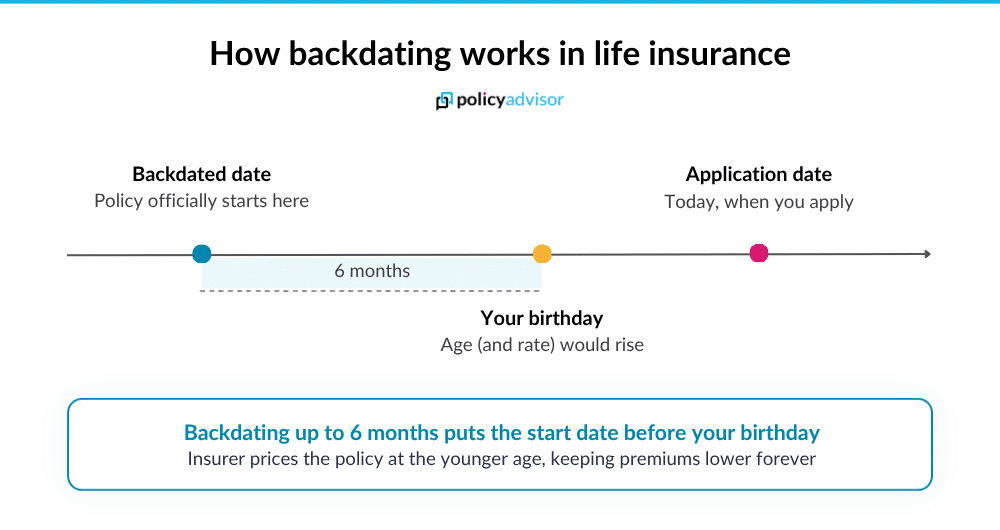
How life insurance backdating works in Canada
The exact process depends on the insurer and the policy. Here’s how the process usually looks like this:
- The applicant submits the insurance application.
- The insurer reviews underwriting and confirms whether backdating is available.
- If approved, the policy is issued with an earlier effective date.
- The policyholder pays all premiums due from that backdated date up to the issue date.
- The policy is then maintained going forward at the younger insurance age.
Benefits of backdating a life insurance policy in Canada
Backdating can be valuable when the premium savings are large enough to justify the upfront cost. Potential benefits include:
- The main benefit is lower long-term premium pricing if the policy can be dated to a younger age. Over many years, that difference can become meaningful, especially for larger policies or permanent coverage.
- There’s a better ROI on Permanent Insurance. Because Universal Life and Whole Life policies are designed to be held until death, the compounded savings of locking in a younger age are substantial.
- If you are converting a Term policy into a Permanent policy, backdating can ensure the new permanent contract is priced at a more favourable price.
Risks and drawbacks of backdating a life insurance policy
Backdating is not automatically a win. The most obvious drawback is the larger initial payment, because the policyholder must pay premiums for the backdated period upfront. That can create cash-flow pressure, particularly if the buyer expected a normal first premium.
Other drawbacks include:
1. You cannot backdate a policy indefinitely. How far a policy can be backdated depends on the insurer. Most insurers generally cap backdating at a maximum of 6 months prior to the application date. Some companies like Equitable allow backdating up to 364 days.
2. Every Canadian life insurance policy has a two-year contestability period and a two-year suicide exclusion clause. These clocks do not start on the backdated date. They usually begin on the actual issue date or the date the policy is delivered and signed. You cannot use backdating to fast-forward through these critical waiting periods.
3. If a policyholder uses extra cash to backdate, that money is tied up in premiums rather than available for other needs. For some households, that is not a problem. For others, it makes the strategy less attractive.
Is backdating a life insurance worth it?
| Scenario | Should You Backdate? | The Reason |
| Buying Permanent Life Insurance | Yes | The lifetime premium savings will almost always outweigh the upfront cost of a few months of premiums. |
| Just passed your “Half-Birthday” | Yes | You are currently paying the premium of an older age bracket (ANB). A 1- or 2-month backdate pays for itself very quickly. |
| Buying a Short-Term Policy (Term 10) | Usually No | If you only plan to hold the policy for a few years to cover a temporary debt (like a car loan), the math rarely reaches a meaningful break-even point. |
| Cash-Flow is Extremely Tight | No | If coming up with 3 to 6 months of lump-sum premium payments will put you in financial distress, it is better to accept the slightly higher monthly premium. |
When backdating may make sense
Backdating may be worth exploring if the applicant is close to a birthday and wants to avoid the next premium increase. It can also be attractive for Canadians who are buying permanent insurance and want to optimize long-term cost rather than just the first-year price. If the policy is kept for many years, even a small reduction in premium can become meaningful.
It may also be useful when the policyholder values certainty. Some buyers prefer to lock in the lower age before the pricing changes, rather than wait and risk moving into a more expensive age band. In that sense, backdating is a timing strategy as much as a pricing strategy.
When backdating may not be worth it
Backdating is not ideal for every applicant. If the premium difference is small, the higher initial payment may not justify the benefit. If the buyer needs the policy to begin only when a specific life event happens, such as a mortgage closing or a business transition, then starting earlier may not align with the actual need.
It may also be the wrong choice if the client is trying to use backdating to force a benefit or eligibility feature that the policy does not support. Backdating is a pricing and timing tool, not a way to rewrite the product.

Need insurance answers now?
Call 1-888-601-9980 to speak to our licensed advisors right away, or book some time with them below.
Frequently asked questions
What is life insurance policy backdating?
Life insurance policy backdating is when the effective date of a policy is set earlier than the actual issue date, usually so the insured may qualify for a younger insurance age and potentially a lower premium.
Is backdating legal in Canada?
Yes, backdating can be legal in Canada when it is done within the insurer’s rules and product limits. It cannot be used to create a benefit or provision that the policyholder would not otherwise qualify for.
Why do people backdate a life insurance policy?
People backdate policies mainly to save age, avoid a birthday-related premium increase, and potentially lock in a lower premium for the life of the policy.
How far back can a life insurance policy be backdated in Canada?
The allowed period depends on the insurer and the product. There can be different limits, including six months, 12 months, and in some cases up to 364 days.
Do I have to pay for the backdated period?
Yes. If a policy is backdated, the policyholder must pay the premiums due for the backdated period when the policy is issued.
Can backdating help lower my premium?
It can, if the backdated date keeps the insured at a younger insurance age. The potential savings depend on the product, the insurer, and how close the applicant is to the next age band.
Does backdating give me extra coverage for free?
No. Backdating does not provide free protection for the earlier period. The premiums for that period still need to be paid.
Can every policy be backdated?
No. Backdating is product-specific and insurer-specific, so it may not be available on every policy type or with every insurer.
When is backdating most useful?
It is usually most useful when someone is close to a birthday, wants to avoid a higher age band, and expects to keep the policy long enough for the lower premium to matter.
Life insurance backdating allows a policy to be dated earlier so the applicant may qualify for a lower insurance age and premium. However, the missed premiums from the backdated period must be paid upfront, so the savings need to outweigh this initial cost. The blog explains why backdating may be more beneficial for long-term or permanent life insurance than short-term coverage.