

 1-888-601-9980

- Whole life insurance and universal life insurance both have lifelong coverage with a cash value component
- Whole life offers more predictable premiums, policy values, and less active management
- Universal life provides greater flexibility in premiums, investments, and death benefits, but involves more responsibility and investment risk
- Your budget, financial goals, risk tolerance, and ability to manage the policy should guide your choice between whole life and universal life insurance
Whole life and universal life insurance are both permanent policies that can last for life and build cash value. The biggest difference is how flexible they are and how much control the policy provides. While whole life offers fixed premiums and cash value growth, universal life insurance gives flexibility in premium payments and investment choices.
Core differences
- Premium payments: Whole life insurance typically has fixed, predictable premiums, while universal life insurance allows more flexibility in how much and when you pay
- Cash value growth: Whole life policies offer more predictable cash value growth, while universal life policies allow you to choose from investment options whose performance can affect the policy’s cash value
- Policy risk and control: Whole life requires less active management. Universal life gives you greater control but also puts more responsibility and investment risk on you
To understand which of these differences matters most for your wallet, let’s break down how each policy actually works.
What is whole life insurance?
Whole life insurance (WL) is a type of permanent life insurance that provides lifelong coverage and includes a cash value component that can grow over time. As long as the policy remains in force and the required premiums are paid, beneficiaries receive the policy’s death benefit when the insured dies, generally tax-free.
With a whole life policy, the cost of insurance and premium are established when the policy is issued and remain fixed for the policy’s duration. Moreover, the cash value component grows within the policy over time and may be accessed during your lifetime through policy loans or withdrawals, subject to the policy’s terms and conditions.
What is your Whole Life Insurance worth?
Get instant quotes from Canada's top life insurance providers and find the perfect coverage for your family.
Powered by

How does whole life insurance work?
When you apply for a whole life policy, premium rates are decided based on the amount of coverage and other factors like your age, health, and lifestyle. In some cases, you may be asked to take a medical exam. Once your policy is approved, you are responsible for paying premiums either annually or monthly, depending on your agreement with the life insurance provider.
Every time you pay premiums, a portion of the money goes towards keeping the policy active and covering administration fees, while another portion is invested by your life insurance provider. This money is your policy’s cash value. It increases with a fixed interest rate and on a tax-deferred basis.
You also have access to cash value during your lifetime. Or, if you cancel the policy, you can walk away with a cash surrender value of whatever has accumulated minus applicable surrender charges. You can access this value whether you have participating or non-participating whole life insurance. Participating policies may earn dividends based on the insurer’s participating account, while non-participating policies do not pay dividends but provide guaranteed values.
When a whole life policyholder dies, the beneficiary receives a guaranteed death benefit. The life insurance company pays this benefit as a one-time, tax-free payment. This money can be used as income replacement for family members, to cover final expenses, as an inheritance, or anything else the beneficiary chooses to use it for.
Pros and cons of whole life insurance
| Pros | Cons |
| Whole life insurance provides coverage for your entire life, as long as premiums are paid | The cash value growth is typically lower compared to other investment options |
| Beneficiaries receive a fixed payout regardless of when you pass away | The combination of insurance and savings can make the policy harder to understand and manage |
| A portion of your premiums builds cash value, which grows tax-deferred and can be borrowed or withdrawn | |
| Whole life insurance is often used to pass on wealth efficiently or cover estate taxes |
What is universal life insurance?
Universal life insurance (UL) is also a type of permanent life policy that provides lifelong coverage and a tax-free death benefit when the policyholder dies. But what stands out the most about this type of insurance is its flexible premiums, death benefits, and investment options. This is perhaps the biggest difference between universal and both whole and term policies,
With a universal policy, you choose how much you want to pay in premiums. There is a minimum payment amount, set at least equal to the cost of insurance; administrative and other policy fees may be deducted separately from premiums or cash value according to the contract. However, policyholders can decide how much more they want to contribute to their policy’s cash value portion. The minimum premium cost can also vary over the course of the policy, depending on whether the size of the death benefit changes.
In addition to flexible premiums, this type of policy can give you a greater say in how your cash value is invested. You can choose among several investment account options that vary by interest rate and risk, such as the Daily Interest Account (DIA), Guaranteed Interest Account (GIA), Variable Interest Options (VIO), and Mutual Fund Accounts.
How does universal life insurance work?
Applying for a universal life insurance policy looks similar to other permanent life insurance policies: your minimum premium rate is decided by the life insurance provider based on the amount of coverage, as well as age, health, and lifestyle. To keep the policy active, you must ensure that your policy’s premiums are paid as agreed with your insurer. When you pass away, your beneficiaries will be entitled to a one-time, tax-free death benefit.
The key difference from whole life insurance is that universal life insurance gives you more flexibility over how much you pay and how your policy’s cash value is invested. After the cost of insurance and other policy charges are deducted, you can direct additional funds into investment accounts within the policy. These investments can grow on a tax-deferred basis.
However, this flexibility also comes with more risk. Universal life policies have an ongoing Cost of Insurance (COI), which is deducted from the policy’s cash value. If your investments perform poorly, your cash value may not be enough to cover these costs. You may then need to increase your premiums or the policy could eventually lose its cash value and lapse, causing your coverage to end.
Pros and cons of universal life insurance
| Pros | Cons |
| You can modify the death benefit amount to align with changing financial needs | The combination of insurance and investment makes the policy harder to manage |
| The cash value grows tax-deferred, which can be beneficial for long-term wealth accumulation | Fees and administrative charges can reduce returns, especially in the early years |
| Many policies allow you to choose investment portfolios, potentially earning higher returns | Investment can perform poorly depending on the interest rates |
| The cash value can be accessed for loans or withdrawals, providing liquidity for emergencies or opportunities |
What is the difference between whole life and universal life insurance?
Whole life and universal life insurance differ in premium payment, investment choice, policy control, and a few other features. The table below outlines these differences.
Whole life vs universal life insurance
| Features | Whole life insurance | Universal life insurance |
| Premiums | Locked in when policy is signed | Flexible premiums |
| Premiums payments | Level premiums do not change for the duration of the policy | Policyholders choose how much to pay |
| Death benefit | Guaranteed, and the minimum amount is locked in when the policy is signed | Can be increased or reduced |
| Risk level | Low (Insurers carry the investment risk) | Medium to High (Policyholder carries the investment risk) |
| Cash value growth | Grows based on a guaranteed rate | Dependent on market-linked interest rates |
| Dividends | With participating whole life only | No dividends |
| Policy management | Managed by the life insurance company, and little supervision is needed | Managed by the policyholder, and close supervision is needed |
| Ideal for | People seeking lifelong coverage | People who want flexibility and coverage at the same time |
What do whole life and universal life have in common?
Whole life insurance and universal life insurance share some important key features. Both of these permanent life insurance policies:
- Provide lifelong coverage as long as the policy remains in force
- Build cash value that can grow on a tax-deferred basis
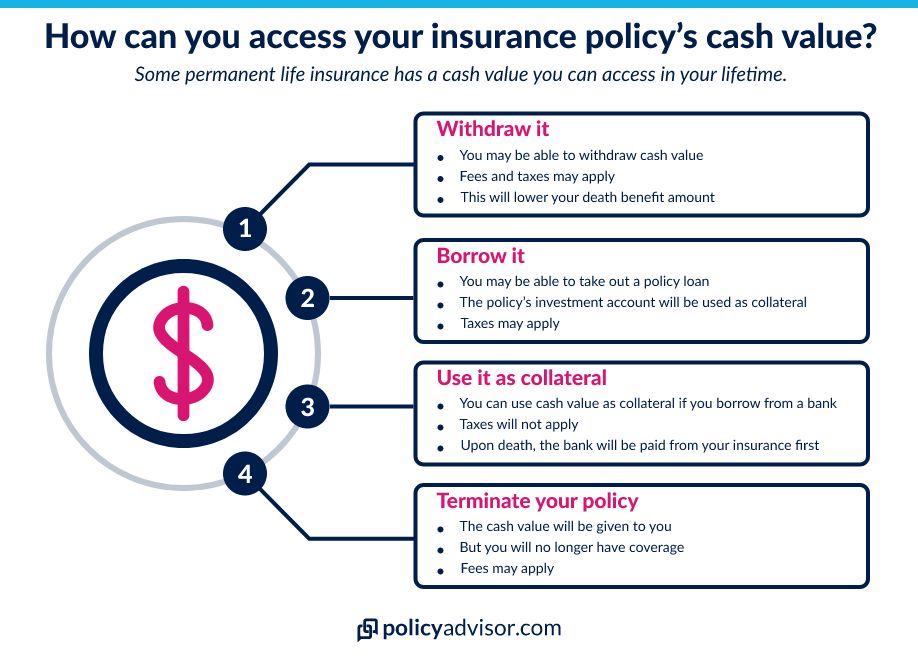
- Allow access to cash value during your lifetime through policy loans or withdrawals, subject to the policy terms
- Pay a tax-free death benefit to beneficiaries, provided the policy remains in force
Key factors to consider when choosing whole life vs. universal life insurance
When choosing between whole life and universal life insurance, consider factors such as your financial goals, risk tolerance, budget, and long-term objectives. Some of these factors are as follows:
- Budget: Consider how much you can comfortably commit to life insurance premiums over the long term. A policy should remain affordable not only today but also as your financial circumstances change
- Financial goals: Think about what you want the policy to accomplish. Your goals could include leaving an inheritance, covering final expenses, providing liquidity for your estate, supporting a business, or building cash value for future needs
- Risk tolerance: Consider how comfortable you are with fluctuations in the policy’s cash value. If you prefer greater certainty, you should consider whole life insurance
- Flexibility: Consider whether your financial needs are likely to change over time. If you want the ability to adjust your premium payments, coverage, or investment strategy as your income, expenses, or financial goals change, go for universal coverage
- Your investment knowledge: Think about how comfortable you are choosing and monitoring investment options. A policy like universal life insurance that requires more active management may not be suitable if you prefer a simpler approach.
- Ability to manage the policy over time: Think beyond the initial purchase. Universal life insurance requires more ongoing attention to premiums, cash value, investment performance, and policy costs. Choose this policy only if you are comfortable monitoring it throughout its lifetime
Is universal life insurance risky?
Universal life coverage is considered riskier than whole life insurance. Whereas whole life insurance offers many guarantees (fixed premiums, death benefit, policy dividend options), universal life insurance offers flexibility and a wider range of investment options. Naturally, this comes with greater risk.
That being said, the level of risk associated with a universal life insurance plan depends on the type of investments chosen. Universal life policyholders should always keep in mind that their cash value depends on their rate of return.
The greatest risk is if you rely on your policy’s cash value to pay your premiums. If your investments underperform and you do not have enough money in your cash value account to cover premiums, your policy can lapse. This could leave you without the crucial death benefit options that life insurance is meant to provide in the first place. It is therefore important to keep a close eye on the investment portion of your universal plan.
Is universal life insurance cheaper than whole life insurance initially?
Yes, universal life insurance is cheaper than whole life insurance initially. But it is not necessarily cheaper over the lifetime of the policy. Its overall cost depends on factors such as the Cost of Insurance (COI), premium structure, investment performance, and how the policy is managed. If investment returns are lower than expected or the cost of insurance increases, you may need to pay more to keep the policy in force.
Our advisor’s take on whole life insurance vs. universal life
Recently, one of our advisors at PolicyAdvisor worked with a 42-year-old non-smoking Canadian who wanted $500,000 of permanent life insurance to protect his family and create a financial legacy. He also wanted to build cash value that he could potentially access later in life, but his priority was knowing what his premiums and policy values would look like rather than taking on investment risk.
Client profile:
- Age: 42-year-old non-smoking Canadian
- Coverage need: $500,000 of permanent coverage for family protection, estate planning, and legacy planning
- Primary concern: Predictable premiums, guaranteed values, cash value growth, and lifetime access to policy value
- Our comparison: We compared whole life and universal life based on premiums, guarantees, cash value growth, investment options, flexibility, risk, and ongoing policy management. For this client, whole life was the better fit because he valued predictability and guarantees more than investment control or premium flexibility.
Why we recommended whole life insurance:
- Fixed premiums made it easier for him to budget for permanent coverage without worrying about changing insurance costs
- Guaranteed policy values provided more predictability than a universal life policy whose cash value depends partly on investment performance
- The policy builds cash value that he could potentially access through policy loans or withdrawals during his lifetime, subject to the policy terms
- Unlike universal life, he would not need to actively manage investment allocations or monitor whether the policy’s cash value remains sufficient to cover ongoing costs
Speak with a licensed advisor to compare whole life and universal life options based on your coverage needs and budget in more detail. Schedule a call now!
Frequently asked questions
Which is more flexible: whole or universal life insurance?
In terms of flexibility, universal life insurance offers more options. Whole life insurance is known for its consistency. It has guaranteed premium rates, death benefits, and cash value growth.
But universal life policies let you decide how much you want to invest in the policy’s cash value component. This type of policy also gives you more control over investments, allowing you to choose the level of risk that may help maximize gains. The death benefit is also flexible; you can choose to decrease or increase the size of the benefit depending on your changing needs.
How are whole life and universal life insurance the same?
Whole life insurance and universal life insurance share some important key features, such as offering lifelong life insurance coverage, a cash value component, and paying a tax-free death benefit when the policyholder meets an unfortunate demise.
Can you have both whole life and universal life insurance?
Yes, you can own both types of permanent life insurance if you have a need for the combined coverage and can afford the premiums. For example, whole life could provide predictable lifelong coverage while universal life provides additional flexibility and investment options.
Can you withdraw cash value from whole life and universal life insurance?
Yes, you can withdraw cash value from whole life and universal life insurance. Both types of policies may allow you to access cash value through withdrawals or policy loans, depending on the policy terms. Accessing the cash value can affect the policy’s death benefit and may have tax or other financial consequences.
Is universal life insurance a good investment?
Yes, universal life insurance is a good investment. This is because universal life insurance includes an investment component. Its cash value can be invested in different options depending on the policy, but investment performance, fees, and policy costs can affect the value that accumulates.
The two major types of permanent life insurance are whole life and universal life. They both offer similar benefits, but stand on opposite sides of the scale when it comes to investments. The question of which one is right for you depends on your long-term goals and how much risk you want to take.