1-888-601-9980



- Cash surrender value is the amount you receive after surrendering a permanent life insurance policy, minus applicable charges, outstanding loans and other deductions
- Your payout depends on the policy’s accumulated cash value, surrender charges, policy loans and contract terms
- Surrendering a policy ends your life insurance coverage and death benefit
- Before surrendering, consider alternatives such as a policy loan, partial withdrawal or reduced paid-up insurance, if your policy allows them
- Surrendering a policy may trigger income tax if the proceeds of disposition exceed its adjusted cost basis (ACB)
Cash surrender value is the dollar amount you receive after cancelling a permanent life insurance policy, minus any applicable fees. You can also withdraw all or part of this amount depending on your needs. A cash surrender value gives policyholders a way to recover some of the money accumulated in a permanent life insurance policy if they no longer need the coverage or want to access the funds.

Need insurance answers now?
Call 1-888-601-9980 to speak to our licensed advisors right away, or book some time with them below.
What is the cash surrender value and how is it calculated?
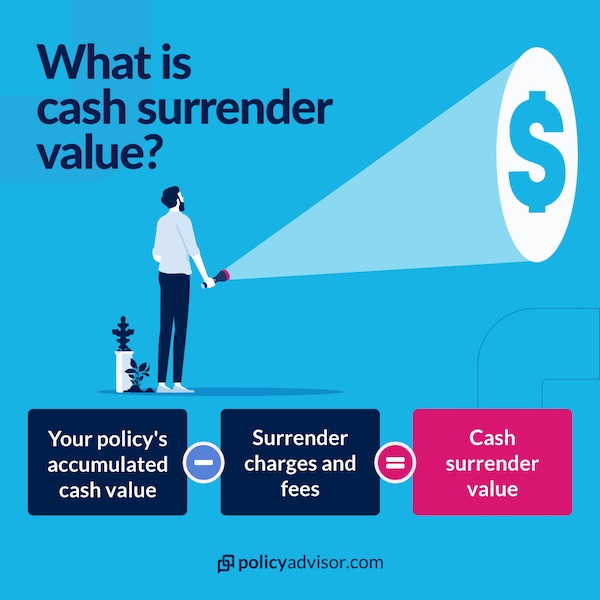
Over time, permanent life insurance policies accumulate a cash value. Cash surrender value is your cash value minus any surrender charges or fees. Others might describe cash surrender value as an amount you receive when you cancel your insurance. The surrender fees are contractual deductions that apply to certain policies. It’s also a deterrent for early withdrawals. In some cases, these surrender fees can be a few hundred dollars. It’s important to note that your cash surrender value doesn’t necessarily equal your policy’s death benefit. Withdrawing the cash value from the policy, however, usually decreases the death payout.
How is cash surrender value calculated?
Let’s understand this with an example: If your whole life insurance policy has accumulated $20,000 in cash value, an applicable surrender charge of $1,000 and an outstanding policy loan of $2,000, your estimated cash surrender payout would be $17,000.
The cash surrender value is actually dependent on the following factors:
- Accumulated cash value: The amount your policy has built up over time through premium payments and any applicable interest, investment returns or dividends
- Surrender charges: Fees that an insurer may deduct if you cancel your policy, particularly during its early years. These charges depend on the policy’s surrender schedule
- Outstanding policy loans: Any unpaid loans taken against your policy, along with accrued interest, can reduce the final surrender payout
- Policy dividends: If you have a participating whole life policy, dividends may increase its cash value, depending on the dividend option you selected
- Other contractual adjustments: Certain policy-specific charges, fees or adjustments may also affect the amount payable
Why cash surrender value is important
Cash surrender value is important because it gives permanent life insurance policies financial value beyond the death benefit. It can provide policyholders and businesses with additional financial flexibility. Its key benefits include:
- Access to money: You can receive a lump-sum payment by surrendering your permanent life insurance policy. This can help cover unexpected expenses, repay debt or meet other financial needs
- Loan collateral: A policy with cash surrender value may be used as collateral when applying for a loan. You may be able to borrow from the insurer through a policy loan or approach a bank or another financial institution for a collateral loan. The amount available depends on the policy’s cash value, outstanding loans and the lender’s requirements
- Corporate financial planning: Businesses that own permanent life insurance policies may need to account for their cash surrender value when assessing corporate assets, business valuations and arrangements such as buy-sell agreements. These arrangements can have tax implications depending on the policy structure and ownership
What type of life insurance has cash value?
Cash surrender values are available for permanent life insurance plans such as whole life insurance or universal life insurance. Permanent life policies contrast with term life insurance policies, which only provide a death benefit if you pass away during a particular period. Permanent policies provide lifetime coverage and pay a death benefit as long as you maintain the premiums. They also have some living benefits, like accessing cash value.
Only permanent life insurance policies contain a savings or investment portion. Term policies do not. Whole life insurance and universal life insurance also have their differences. Whole life coverage covers your entire life on a fixed premium. Premiums won’t change as you grow older, change occupations, or find new hobbies. Part of these payments also goes into a savings or investment account to accumulate and grow tax-free.
Universal life insurance also covers you for your entire life and similarly puts part of your premiums into a savings or investment account to accumulate and grow tax-free. The difference is that a universal policy offers flexibility in premium payments. You can choose to pay a minimum amount or increase your payments to boost the cash value.
Common reasons for cash value surrender
Policyholders may choose to surrender a permanent life insurance policy when their financial needs, coverage requirements or personal circumstances change. Some of the reasons you can surrender the accumulated cash value are as follows:
- Changing financial priorities: You may no longer need the original life insurance coverage because your mortgage is paid off, your children are financially independent, or your financial responsibilities have decreased
- Difficulty paying premiums: Permanent life insurance premiums can become difficult to maintain after retirement, a loss of income or other financial changes. Surrendering the policy may provide a lump-sum payout and eliminate future premium payments
- Need for immediate funds: You may want to access your accumulated cash surrender value to cover unexpected expenses, repay outstanding debts or meet other financial obligations
- Finding more suitable coverage: Your insurance needs may have changed, and you may prefer a different policy with a lower premium or a more appropriate death benefit
- No longer needing the death benefit: You may have accumulated enough savings or assets to support your beneficiaries without relying on life insurance proceeds
- Dissatisfaction with policy performance: If your policy’s cash value growth, dividend performance or ongoing costs no longer align with your financial expectations, you may consider surrendering it

Cash value versus surrender value: What’s the difference?
Cash value is the accumulation of a portion of your permanent life insurance premiums that are redirected towards a savings or investment component. This money accumulates on a tax-deferred basis. You’re also able to access this cash value as the policyholder.
Cash surrender value is similar and is part of every policy with a cash value. Essentially, when you cancel a permanent life insurance policy or withdraw the cash value, there’s a surrender charge or fee. The cash surrender value is what you would receive upon cancelling your policy or making a withdrawal after the surrender charges.
Example of cash value versus surrender value
Suppose the following terms were part of a universal life insurance policy:
- Monthly premium of $100 ($1,200 per year);
- 30% of the premium goes towards the cash value;
- A surrender fee of $300; and
- Current cash value of $3,500.
The policy’s current cash value of $3,500 is the amount built over time by the accumulation of 30% of the premiums. It may have grown further if your insurance company invested the money and those investments performed well over time.
Suppose you want to withdraw this money or cancel the policy at this very moment. This action requires paying the $300 surrender fee. As a result, you would receive $3,200, the difference between the policy’s cash value and the surrender charge. This $3,200 is your cash surrender value.
| Difference | Cash value | Cash surrender value |
| Definition | Accumulated value within a permanent life insurance policy | Amount payable when surrendering the policy |
| How it grows | Builds over time through policy premiums, interest, investment returns or dividends, depending on the policy | Does not accumulate separately; it is calculated from the policy’s value when surrendered |
| Deductions | Represents the accumulated policy value | May be reduced by surrender charges and outstanding policy loans |
| When you receive it | Can be accessed through eligible policy features while coverage remains active | Paid when you surrender and cancel the policy |
| Life insurance coverage | Remains active while the policy continues | Ends when the surrender takes effect |
Is the cash surrender value of life insurance taxable?
Yes, surrendering a permanent life insurance policy in Canada may trigger income tax if the proceeds of disposition exceed the policy’s adjusted cost basis (ACB). The difference is generally treated as a taxable policy gain and included in your income, not taxed as a capital gain. If the proceeds are equal to or lower than the ACB, there is generally no taxable policy gain.
For example, suppose a total of $1,000 of your premium payments went to the policy’s savings or investment account. This $1,000 is referred to as the Adjusted Cost Base (ACB). But because the investments grow or the savings account accumulates interest, your total cash surrender value is $1,500. (Additionally, let’s pretend the surrender fee is zero here.)
Now, suppose you withdraw the $1,500. This $1,500 is your Proceeds of Disposition (PD). When you withdraw the money, you’re taxed on any gains, which is the difference between your PD and ACB. In this example, you’re taxed on $500 as a policy gain.
But let’s say your investments on the initial $1,000 didn’t do too well. As a result, when you withdraw your cash surrender value, the PD is $900. Because the difference between the PD and ACB is negative, there’s no taxable gain. Your withdrawal is, therefore, likely not taxed.
Tax may also apply when you make a partial withdrawal or take a policy loan. A partial withdrawal can result in a taxable policy gain if the amount withdrawn exceeds the portion of the policy’s ACB attributable to that withdrawal. Similarly, a policy loan may trigger a taxable policy gain when the amount exceeds the policy’s ACB, depending on the transaction and applicable tax rules.
Instead of withdrawing the cash surrender value, many policyholders leave it as part of their death benefit. This move has significant tax advantages, as death benefits are usually paid tax-free to beneficiaries. This tax advantage is why many insurers call whole life insurance policies an estate planning tool.
Should you surrender a life insurance policy’s cash value?
You should avoid surrendering a life insurance policy’s cash value unless you are in financial trouble. This is because surrendering gives up the death benefit and future cash value accumulation.
Surrendering your policy may make sense in certain situations, but it is important to weigh the benefits against the financial consequences.
Consider surrendering your policy if:
- You are facing financial difficulties
- You can no longer afford the premiums
- You no longer need the coverage
- Your policy no longer meets your financial goals
- You have a more suitable replacement policy
When should you avoid surrendering your life insurance policy?
- If your beneficiaries still depend on your death benefit for financial protection
- If you are close to the end of a surrender charge period and can afford to maintain the policy
- If surrendering would trigger a significant taxable policy gain
- If you may have difficulty qualifying for new life insurance because of your age or health
- Your policy provides valuable guarantees or benefits that would be difficult to obtain under a new contract
Alternatives to surrendering cash value
If you need access to your life insurance policy’s cash value but want to retain your coverage, consider alternatives to surrendering the policy.
- Take a policy loan: You can borrow against your policy’s accumulated cash value without surrendering the coverage. The loan accrues interest, and any unpaid balance may reduce the death benefit or result in tax consequences
- Make a partial withdrawal: Some permanent life insurance policies allow you to withdraw a portion of the accumulated cash value while keeping the policy active. However, withdrawals may reduce the death benefit and could trigger a taxable policy gain
- Convert to reduced paid-up insurance: You may be able to use your accumulated cash value to purchase a smaller, fully paid-up life insurance policy. This lets you maintain some death benefit without making future premium payments
Can I stop paying premiums without surrendering my life insurance policy?
Yes, you may be able to stop paying premiums without immediately surrendering your life insurance policy, depending on the policy. Some permanent life insurance policies offer options such as reduced paid-up insurance, which allows you to stop future premium payments while keeping a smaller amount of lifelong coverage. There are policies that may use accumulated cash value to cover premiums temporarily through an automatic premium loan or other options. However, these choices can reduce your coverage or cash value over time.
Need help deciding whether to surrender your policy?
At PolicyAdvisor, our licensed insurance advisors can help you understand your policy’s cash value and explore alternatives to cancelling your coverage. We work with 30+ Canadian insurers to help you evaluate your options based on your financial needs and insurance goals. Schedule a call now to discuss your existing policy and find an approach that works for you.
Frequently asked questions
Can I withdraw my cash surrender value without cancelling my life insurance policy?
No, you cannot receive the full cash surrender value without cancelling your policy. However, some permanent life insurance policies allow partial cash value withdrawals or policy loans while keeping the coverage active. These options may reduce your death benefit or trigger tax consequences.
Does term life insurance have a cash surrender value?
No, term life insurance generally does not have a cash surrender value because it does not accumulate cash value. It provides coverage for a specified period, and the policyholder does not receive a payout if they cancel the policy before the term ends.
How long does it take to receive cash surrender value?
The time required to receive your cash surrender payout depends on the insurer’s processing procedures, documentation requirements and policy terms. You can contact your insurance company to request a surrender quotation and confirm its expected payment timeline.
Can I surrender my life insurance policy at any time?
You can generally request to surrender a permanent life insurance policy while it is active. However, surrendering early may result in substantial charges or a lower payout because the policy may not have accumulated significant cash value. Check your insurer’s surrender quotation before cancelling your coverage.
Does cash surrender value increase over time?
Cash surrender value can increase over time as a permanent life insurance policy accumulates cash value. However, the growth depends on the policy type, premium payments, applicable charges, dividends and investment performance. The actual surrender payout may also be affected by outstanding loans and surrender fees.
What is the difference between cash surrender value and death benefit?
Cash surrender value is the amount you receive when you cancel a permanent life insurance policy, after applicable deductions. The death benefit is the amount the insurer pays to your beneficiaries when you die while the policy is active. The death benefit is generally higher than the cash surrender value.
Permanent life insurance policies accumulate a cash value. A cash surrender value is the original cash value, minus any applicable charges and fees. You can access a policy’s cash surrender value after cancellation or while keeping the policy in force, depending on the terms and conditions of your policy.