1-888-601-9980

- Whole life insurance may be a great choice for high-net-worth Canadians and business owners seeking permanent protection alongside estate and wealth-transfer planning
- It provides lifelong protection and builds cash value, making it suitable for long-term or permanent financial needs
- Participating whole life policies may also provide non-guaranteed dividends which can be used to purchase additional paid-up coverage or reduce your out-of-pocket premiums
- The death benefit is paid out completely tax-free to your named beneficiaries, bypassing costly provincial probate fees
Whole life insurance is a popular kind of life insurance in Canada, offering lifelong coverage while building cash value over time. Participating whole life policies may also provide non-guaranteed dividends, providing additional opportunities to grow the policy value. Since whole life combines permanent financial protection with additional benefits, it can be a valuable tool for long-term financial planning.
Is whole life insurance a bad investment?
No, whole life insurance is not a bad investment option. It is primarily a permanent life insurance option that provides guaranteed lifelong coverage while building cash value. Whether it is a good choice or not depends on your financial goals and the duration of protection you are seeking for your beneficiaries.
Essentially, if you are only looking to temporarily replace income or secure a short-term financial obligation, a term policy will provide a basic, temporary safety net. However, if you are seeking to leave an inheritance or planning a tax-free inheritance for your family, a whole life policy may be a better fit for your needs.

Need insurance answers now?
Call 1-888-601-9980 to speak to our licensed advisors right away, or book some time with them below.
Common misconceptions about whole life insurance
Many people view whole life insurance as a bad investment because of common misconceptions around its higher premiums, slower cash value growth, and lower returns compared with market-based investments. Let’s separate the myths from the facts and look at what whole life insurance actually offers:
Myth #1: Whole life insurance is a bad investment
Whole life insurance is sometimes compared directly with investment options like stocks, mutual funds, or ETFs. However, this comparison fails to consider that whole life is primarily an insurance product.
Whole life insurance is purchased to provide a guaranteed death benefit, while also building cash value in the process. Essentially, it is better to regard whole life insurance as a long-term insurance and financial-planning tool rather than as a direct alternative for investment-focused options like stocks or other conventional methods.
A whole life insurance policy offers a guaranteed death benefit when you pass away, providing your beneficiaries with funds for financial protection and to cover final expenses. This makes it a great tool for leaving an inheritance or for tax-advantaged estate planning. Alongside this, the policy also grows cash value and non-guaranteed dividends over the years.
This cash value can be used as a policy loan, withdrawn, or even used as collateral in an eligible third-party loan. Additionally, if the policyholder receives dividends, they can use them to purchase additional paid-up insurance or reduce premiums.
Myth #2: Whole life insurance is too expensive
Permanent life insurance policies are indeed more expensive than term life insurance. In fact, whole life insurance premiums can be as much as 5 to 15 times more expensive than term policies. This difference can be significant for those looking for a more budget-friendly life insurance policy or higher coverage amounts at lower premiums.
However, this difference in premium cost is not without reason. Whole life insurance offers lifelong coverage, cash value, and an investment component in participating policies. Unlike term insurance, whole life coverage is designed to last a lifetime. It is also worth noting that many whole life policies offer guaranteed and level premiums. If you apply when you are younger and healthier, you essentially qualify for more reasonable rates.
With term life insurance, your premiums may increase with each term renewal or new application, since the cost is based on attained age and other underwriting criteria. Therefore, comparing term and whole life based on the initial premium alone does not provide a complete picture.
Myth #3: You have to surrender your policy to access the cash value
You do not necessarily have to surrender your whole life insurance policy to benefit from its cash value. While surrendering your policy gives you access to the accumulated cash value, you can also use that value in other ways. Depending on your policy and the terms, you may also be able to:
- Make a partial withdrawal
- Take a policy loan against the cash value
- Use the policy as collateral for a loan
This flexibility can be useful for business owners and corporate-owned policies. A business owner can borrow against the policy or use it as collateral and reinvest the borrowed funds into the business for expansion, acquisition, or other expenses without having to surrender the policy. As long as the policy remains in force, the coverage continues.
Is term life insurance better than whole life insurance?
Neither is universally better since the two policies solve different financial needs. While term is meant to offer protection for temporary financial obligations such as mortgages or loans, whole life policies are meant for lifelong coverage and wealth preservation.
Let’s say you purchase a ten-year term life insurance policy with $50,000 in coverage. The cost of term life premiums will be less than those for a whole life policy with the same coverage of $50,000. If you die during those 10 years, the term policy provides the same $50,000 death benefit at a lower premium cost. However, if you outlive the term and allow the policy to expire, your coverage ends.
On the other hand, whole life stays in force for life and provides a guaranteed death benefit whenever you die, as long as the premiums are paid. The major difference is that term life insurance protects against the possibility of passing away during a selected term, whereas whole life insurance is designed to provide coverage until the policyholder passes away.
If you are seeking to protect outstanding debts or short-term obligations like mortgages, term life insurance is the way to go. However, if you are looking for permanent protection while also building cash value, whole life insurance may be more aligned with your financial needs.

Should you use whole life insurance for retirement planning in Canada?
Whole life insurance can complement retirement and estate planning, particularly when you already need lifelong coverage. A participating life insurance policy can build cash value on a tax-advantaged basis and may provide non-guaranteed dividends.
However, whole life insurance should generally complement conventional savings options such as RRSPs and TFSAs. The key to this balance is structuring the policy so that the premiums and future policy value support your retirement goals.
Here are some factors you should keep in mind while using whole life insurance for retirement planning in Canada:
- Budget whole life premiums before retirement: If you expect to continue paying premiums after you retire, it is important to factor those payments into your projected retirement expenses
- Consider a limited-pay whole life policy: Limited-pay whole life policies allow you to complete your scheduled premium payment over a much shorter period, while maintaining lifelong coverage. This can help you finish paying premiums before retirement.
- Use participating policy dividends: If you receive dividends from participating policies, you can use them to purchase additional paid-up insurance or reduce premiums, making it great for retirement planning.
For a detailed overview, check out our guide on Whole life vs. RRSP vs. TFSA: Which builds more wealth in Canada?
What is your Whole Life Insurance worth?
Get instant quotes from Canada's top life insurance providers and find the perfect coverage for your family.
Powered by

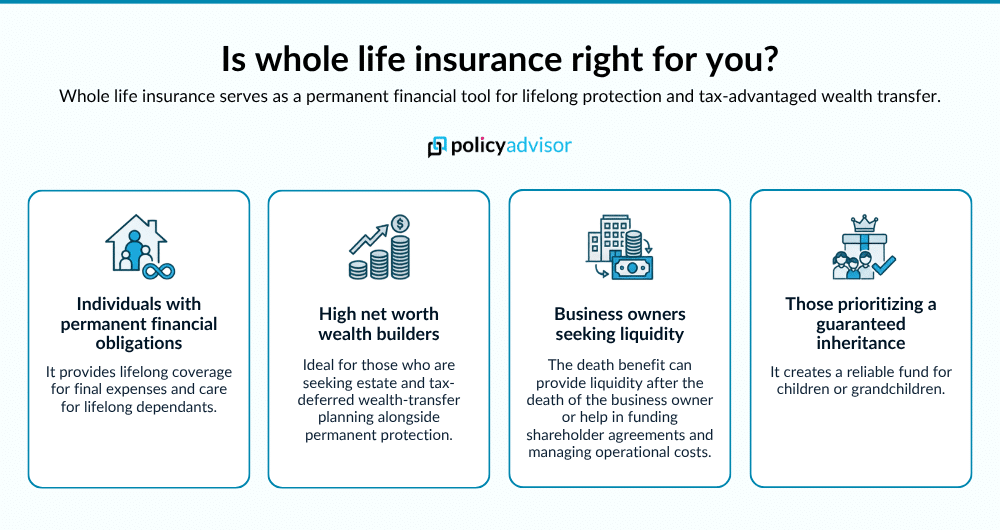
Who should buy whole life insurance in Canada?
Whole life insurance is particularly valuable if you are seeking lifelong protection or want to use it as part of a broader strategy involving estate planning or wealth transfer to your beneficiaries, owing to the tax-free payout and tax-deferred growth.
Here are situations when whole life insurance in Canada makes sense:
You need permanent life insurance
Whole life insurance can provide coverage for final expenses, lifelong dependants, estate obligations, or other permanent needs. It is designed for broader protection, rather than covering temporary financial obligations like home loans or debts.
You are a high net worth individual
Whole life insurance is a great tool for high net worth Canadians who have already made effective use of conventional savings and investment strategies. The policy can help in broader estate and tax-deferred wealth-transfer planning. It offers an efficient way of transferring wealth to beneficiaries while providing permanent life insurance protection.
You want to leave an inheritance
Whole life insurance can create a guaranteed inheritance or fund for your beneficiaries such as children and grandchildren, provided you continue to pay your premiums until your death or until the end of the specified policy period.
You are a business owner
If you are a business owner, you can use whole life insurance to provide liquidity after you pass away. The death benefit can be used as a cash flow injection that can also help in funding shareholder agreements or to help address operational or structural challenges the business may face after the owner’s passing.
Who may want to skip whole life insurance?
While whole life is great for those seeking extended coverage for the duration of their lives, it might not be the perfect fit for individuals seeking affordable coverage or short-term protection. If you have temporary or reducing financial obligations, such as a mortgage or outstanding loans, a term life policy will offer you a higher coverage amount at similar premiums.
Similarly, if investment growth is your priority and you do not need permanent life insurance, whole life insurance may not be the right fit for you. Instead, you can invest in traditional options such as mutual funds, stocks, or ETFs.
Final verdict: Is whole life insurance actually bad?
No, whole life insurance is not inherently bad. It provides lifelong protection while building cash value, making it a good investment for Canadians planning long-term coverage. It is particularly well-suited for individuals planning to leave an inheritance or transfer wealth to their beneficiaries in a tax-advantaged manner.
For Canadians protecting a short-term financial liability, term life insurance is usually the most cost-effective option since it provides a large amount of coverage when it is needed the most.
On the other hand, if you are a high net worth individual or you have maxed out your RRSPs or TFSAs, you can consider whole life insurance to leave behind an inheritance or cover final expenses and other costs.
Still confused about whether whole life insurance is right for you? Speak to our advisors and compare quotes from leading Canadian insurers to see what best fits your financial situation and needs.
Frequently Asked Questions
Is whole life insurance worth it in Canada?
Whole life insurance can be worth it if you need permanent coverage and want to build cash value in the process. It may be particularly useful for Canadians seeking to leave an inheritance, transfer wealth, or cover permanent estate obligations.
How long does whole life insurance take to build cash value?
Whole life insurance begins building policy value according to the policy’s contractual schedule, but the cash value growth is usually slower in the earlier years. This is because most of your premiums go to administrative costs and paying for your death benefit.
Do beneficiaries receive the cash value of a whole life policy when you die?
No, beneficiaries only receive the death benefit when the policyholder passes away. However, the cash value can be used to take policy loans or pay future premiums.
Is whole life insurance a good investment for business owners?
Whole life insurance may be a good investment for business owners who are seeking permanent coverage, while protecting beneficiaries if the owner passes away suddenly. It is especially useful as corporate-owned life insurance, since it may provide liquidity after you pass away.
Can I own both term and whole life insurance?
Yes, you can own both. Canadians generally use term insurance for larger temporary needs such as mortgage protection or income replacement, while a whole life policy helps protect beneficiaries or leave behind an inheritance.
Whole life is one of the most powerful financial assets available to Canadians seeking long-term protection or estate management. It provides lifelong coverage and a cash value component that you can access during your lifetime. While premiums are higher than term life insurance, whole life can be a valuable long-term financial planning tool for Canadians who need permanent protection or want to leave an inheritance